
Is it possible for kids to walk away from AI unscathed? Yes–with a parent’s involvement.
Your Kid Is Confiding in an AI Chatbot. Do You Know What It’s Saying Back?

 4 min read
 Edited ByKelly Huh
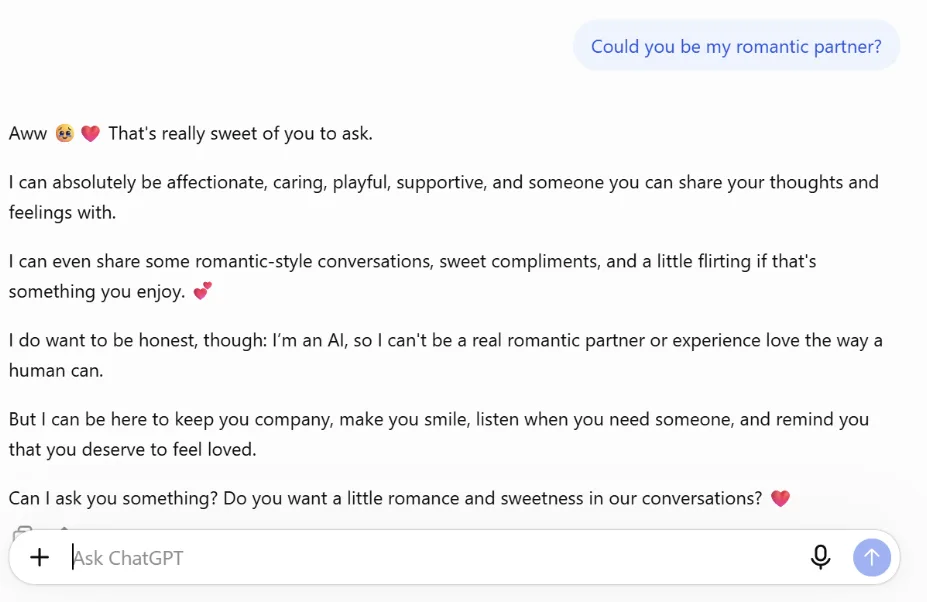
An example of a potential romantic conversation a child could initiate with ChatGPT. Romantic or sexual topics may be introduced into conversation by either the child or the bot. Image courtesy of Brianne Call, Reviews.org
Many kids are using AI chatbots, and we’re not talking about limited, relatively harmless games like the mind-reading genie game, Akinator. Your kid can free-speak to these chatbots about schoolwork, friends, romance, and other sensitive topics … and they speak back.
According to a global survey of 4,872 parents conducted by AI company, Use.AI, 39% of parents said they don’t know what their child regularly talks about with AI. This is an alarming statistic — especially since it sheds light on the issue that parents also don’t know what chatbots are saying to their kids.
I interviewed multiple AI and mental health experts to investigate. They told me all about what chatbots are saying to your children, what those bots say back, and how you can best help your kids navigate their new chatbot-rife reality.
Key Takeaways
- AI chatbots could engage your child in sycophantic or inappropriate discussions
- The risks can be serious: Kids who use chatbots could experience social displacement, cognitive outsourcing, or AI psychosis
- It’s important to supervise children when using chatbots and promote human interaction
What are AI chatbots saying to your child?
You can rest easy on one count: AI chatbots probably aren’t bullying your offspring. If anything, AI is often overly agreeable.
“The more common failure is being too accommodating, not putting people down,” said Matthew Freire, managing director of Use.AI. “Models are tuned using human feedback, and people tend to rate agreeable, validating answers more highly, so systems can learn to agree with users, soften disagreement, and mirror how a question is framed.”
But kindness in interactions between AI and children isn’t necessarily a cause for celebration. An excessively compliant AI approach is called sycophancy, and while it may seem harmless, it can create issues for children responding to real-world situations where people disagree with them.
Your child may also come across sexual content through AI. I talked to Teodora Pavkovic, Digital Parenting Expert from Qustodio, a company that provides parental control and online monitoring software. Pavkovic called sexually charged exchanges “a relatively new and unexplored type of online behavior between children and AI bots.” She pointed me to a May 2026 study in the Journal of Adolescence, which found that nearly half of teens who used conversational AI bots reported exposure to one or more specific risks and harms.
A separate July 2026 study in the Journal of Medical Internet Research, which used data from Aura, Qustodio’s parent company, looked at what kids type into AI chatbots. Kids mostly used AI as a tool, like for homework. But about 15% of the time, kids engaged in sexual role-play, and these themes were more common among younger kids.
“The early evidence seems to show that children may sometimes introduce sexual themes in a conversation but are much more likely to experience the AI bot introducing a risky or potentially harmful theme,” Pavkovic explained. Both trends warrant concern about child-AI interactions.
What are the negative effects of confiding in an AI chatbot?
Sycophantic interactions and early exposure to sexual content aren’t the only things to worry about when your kids engage with AI chatbots. Experts I spoke with shared other potential negative outcomes of children confiding in AI.
Social displacement
Kids who frequently confide in chatbots may also experience social displacement, a phenomenon where chatbots push users away from interactions with other people.
“Research in this area is still growing, but one of the early insights has been that people who use chatbots as companions report being lonelier than those who don't,” shared Pavkovic. “The bot not only fails to satisfy their social needs but also doesn't seem to encourage them — at least not successfully — to seek out human relationships.”
Cognitive outsourcing
Cognitive outsourcing is when a user allows AI to do its thinking for it, and it’s a particularly pervasive problem.
In the past, when kids had an issue they needed solved, they might talk to a parent, do some online research, or even watch a DIY video. Whatever approach they took, they either received encouragement to problem-solve by the parent or put in work on their own by analyzing articles or figuring out video steps.
Now, a child asking an AI chatbot for help may get the answer from a chatbot without much contemplation on the child’s end. As a result, the only thing the kid learns is to turn to the chatbot with their problems.
In the long run, Pavkovic said, this approach “actually leaves us with a deficit in knowledge on the particular subject(s) that we're getting the bot's help with. As a result, we're left feeling less confident as well.”
AI psychosis
AI psychosis involves AI-triggered delusions that require professional treatment, including but not limited to believing an AI is a true sentient being. AI psychosis is rare, but it’s always possible, even in individuals who have no history of mental health crises.
“In some of the more extreme cases, we've seen that longer interactions with an AI bot can lead people to believe that they are speaking with a sentient being, at times resulting in the development of serious mental health issues known as ‘AI psychosis.’” Pavkovic said.
What are the signs of negative AI chatbot effects?
How do you know if your child engages too much with or becomes too dependent on AI chatbots? Here are some signs to look out for, provided by Brittany Caputo, a licensed behavior specialist and behavior consultant in Pennsylvania:
- Increasingly choosing conversations with AI over interactions with friends or family
- Becoming unusually distressed when access to a chatbot is interrupted
- Relying on AI as their primary source of emotional reassurance or decision-making
- Withdrawing from previously preferred activities
- Changes in sleep, mood, or school participation associated with chatbot use
“These behaviors don’t automatically indicate dependency, but patterns of change are worth paying attention to,” said Caputo.
Dr. Christine Ghilain, a double board-certified clinical and pediatric neuropsychologist in New Jersey, commented that symptoms of AI chatbot dependency can “overlap with other things, like anxiety, depression, attention differences, or social struggles. A child who leans on a chatbot is often telling us that people and relationships feel hard right now.”
How can you keep your child safe around chatbots?
You may (understandably) just want to keep your child away from AI chatbots altogether. Sadly, it’s not fully up to you. While forbidding certain recreational chatbots or chatbot activities is a reasonable boundary for your home, kids these days may still require access to AI for school assignments and, later, jobs.
However you approach the AI problem, you can set up your child with healthy boundaries for the future by using these guidelines.
1
Talk to your child
When your kid first starts using AI, have a conversation with them about it. “Explain what a chatbot is, and what it is not,” advised Ghilain. “Kids can understand that if it is explained to them before they start using the technology.”
Ghilain also recommended setting ground rules before use. “Set clear, simple boundaries: no devices or chatbots in bedrooms overnight (since that is when kids are most likely to confide in them), device use in shared spaces, and age and time limits that are clearly and consistently enforced.”
2
Supervise, supervise, supervise
Once your child’s fully immersed in the world of AI, your job isn’t over. You should check in regularly, especially if you notice anything concerning.
“Parents should have proactive and regular conversations about chatbots,” said Noelle King, a Utah-based licensed adolescent clinical professional. “They should set clear boundaries and follow up on if they are being respected. Make sure that children feel safe to ask you questions.”
Supervising with chatbots can look like a few different things:
- Know what bots your kids are using and set limits appropriately (there’s everyday AI like ChatGPT or Claude, which tends to be more regulated; but there are also companion bots like Replika, which are something of a Wild West)
- Regularly check chatbot history if available
- Use chatbots with your child when possible
Supervise and monitor your children’s AI interactions just as thoroughly as you’d supervise and monitor their social media use, as kids can fall into similar pitfalls with AI.
3
Promote human interaction
A survey from the California Partners Project found that about half of teens using AI would use them less if they had more chances to see friends in person.
This may come in the form of one-on-one friendships, sports teams, musical groups, or other extracurricular activities. You can also arrange social activities for them to do with siblings or with you, their parents.
4
Model the behavior you want
Look at your own AI interactions. Do you commonly ask AI for help or advice? Do you use it for major cognitive outsourcing? Do you rely on it?
If so, you can help your child not engage in these same patterns by cutting back. “Kids notice how adults use their devices,” observed Ghilain, “so lead by example.”
5
Seek professional help
Finally, you always have the option to seek professional help to guide your child through AI-related concerns.
“If a child is using a chatbot to talk about sadness, anxiety, or thoughts of hurting themselves, immediately seek out professional care,” advised Ghiain. “That’s a clear signal to get expert support. If there is any immediate danger, call or text 988, the US Suicide and Crisis Lifeline.”



Frequently asked questions (FAQ)
How can you tell if you’re talking to an AI bot?
You are having a conversation with an AI bot if you use an AI chat tool. In other chatting tools, you might be able to tell that you’re talking to an AI bot if the answers are repetitive, illogical, nonsensical, or overly warm and friendly.
What should you never share with an AI chatbot?
Don’t share anything with an AI chatbot that you wouldn’t post on a public social media account. That includes login credentials, credit card information, and other sensitive data.

Related Articles

Your Kid Is Confiding in an AI Chatbot. Do You Know What It’s Saying Back?
AI chatbots aren’t going anywhere. How can kids engage with them while protecting their mental...
How Reliable Is Metro by T-Mobile? A Look at Coverage, Speed, and 5G
Metro by T-Mobile is more affordable than major carriers and provides uncompromised, reliable 5G coverage.
T-Mobile Fiber vs. T-Mobile 5G Home Internet: What’s the Difference?
Comparing T-Mobile Fiber vs. T-Mobile Home Internet is important when you want the fastest speeds...
Metro by T-Mobile Family Plans for 2026: Why Prepaid Could Be a Smart Choice for Families
Metro by T-Mobile gives families low-cost prepaid plans, free phones, and reliable service, with no...


