
T-Mobile Fiber offers the fastest and most reliable speeds, while T-Mobile 5G offers a simpler setup.
T-Mobile Fiber vs. T-Mobile 5G Home Internet: What’s the Difference?

 4 min read
 Edited ByKelly Huh

Sponsored by T-Mobile Fiber.
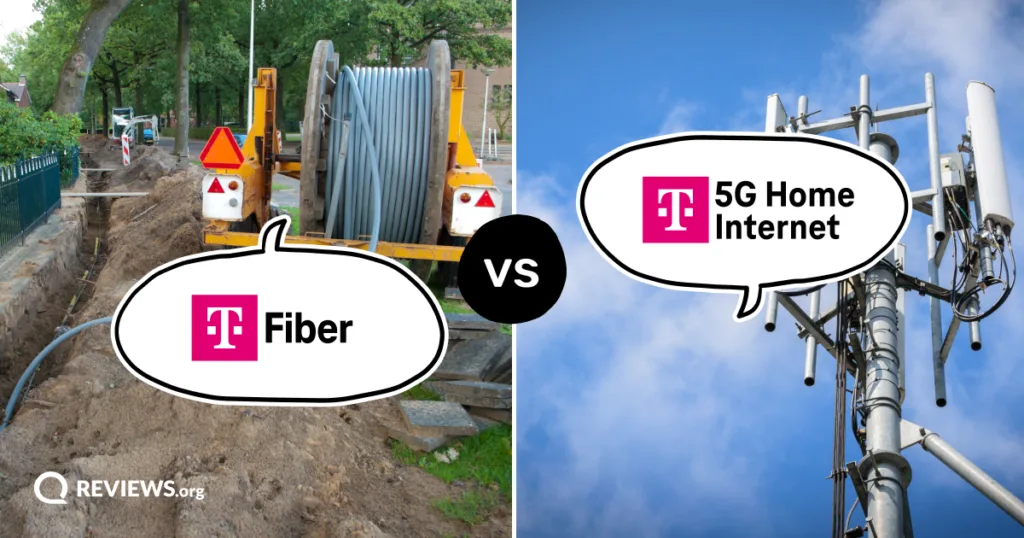
Comparing T-Mobile Fiber vs. T-Mobile 5G Home Internet is important for Americans looking for the fastest speeds at the best value. T-Mobile Fiber delivers internet service through a 100% fiber-optic network directly to your home, whereas T-Mobile 5G Home Internet connects wirelessly from a gateway router device in your home to a nearby 5G network tower. For both connection technologies, you can stream in 4K, make video calls, and surf the web, but they work differently.
T-Mobile Fiber speeds are symmetrical, so upload and download speeds are the same. This helps heavy data users who need the fastest speeds on the market. According to over 5 million speed tests run on HighSpeedInternet.com, T-Mobile Fiber also delivers the fastest average internet speed.
T-Mobile’s 5G Home Internet service is also impressive — T-Mobile 5G Home Internet ranks first for customer satisfaction in the JD Power 2026 U.S. Internet Service Provider Satisfaction Study.
This guide walks through the two available options and how they work. Ultimately, the best choice depends on your internet usage habits, budget, household size, and availability.
Key Takeaways
- Fiber-optic internet is the fastest internet available, with symmetrical speeds.
- T-Mobile Fiber has the fastest average speed of any U.S. provider, at 323Mbps, per HighSpeedInternet.com.
- Both T-Mobile Fiber and T-Mobile 5G Home Internet offer unlimited data, no annual contracts, and include the equipment you need.
- T-Mobile 5G Home Internet connects wirelessly, but requires a device and is easy to install.
- Availability, household usage, and budget determine which is the right fit.
On this page:
Meet the expert

My name is John Schmoll, and I’m an internet expert at Reviews.org. I’ve researched most major internet service providers in the U.S. across all technologies, including fiber, fixed wireless, satellite, and DSL. My biggest takeaway is that fiber internet is the best option and offers significant value compared with other choices.

Writer, Reviews.org
What’s the difference between 5G home internet and fiber?
The key difference between 5G home internet and fiber internet is that fiber uses fiber-optic cables to deliver internet directly to your home, while 5G internet uses cellular towers to deliver internet wirelessly. Fiber-optic internet is best for households with power users or heavy users who need the fastest speeds and ultimate reliability. Fiber internet also offers low latency or ping, which is helpful for heavy data users who want responsive internet when playing multi-player games or video conferencing over Zoom meetings.
5G home internet is best for households that want relatively fast speeds on a budget. It offers reliable streaming and internet browsing and you can self-install 5G home internet. With 5G home internet, you may experience slower speeds due to network tower congestion and any physical interference between your home and the network tower, such as inclement weather, large buildings, or natural obstructions like trees, hills, and mountains.
Neither fiber nor 5G home internet is inherently better; the right option for you depends on your needs.
What is the difference between T-Mobile Fiber and T-Mobile 5G home internet in 2026?
The main difference between T-Mobile Fiber and T-Mobile 5G Home Internet is that T-Mobile Fiber uses a wired connection and fast and symmetrical speeds ranging 300–5,000Mbps. T-Mobile 5G Home Internet is wireless and offers typical download speeds of 170–498Mbps.
How does T-Mobile Fiber and T-Mobile Home Internet work, and what does it cost?
T-Mobile Fiber operates on fiber-optic cables, which transmit data in light through thin glass wires. T-Mobile 5G Home Internet uses the cellular network to transmit data. Both options offer multiple plans with varying speeds, cost, and benefits.
T-Mobile Fiber plans and prices
Availability and pricing depend on where you live. Comparing the speeds and features is necessary to identify the best fit for your situation.
T-Mobile Fiber has plans with symmetrical speeds between 300–5,000Mbps. Plans begin at $35 per month (with AutoPay and voice, plus taxes and fees).
T-Mobile Fiber uses an optical network terminal (ONT) and a Wi-Fi router to distribute internet throughout your house. Professional installation and equipment is required, with no extra fee. Fiber doesn’t rely on receiving a signal from a local tower, making it the most reliable connection type.
The T-Mobile Fiber 300 plan is a good starting point and works for households with multiple users who regularly stream or work remotely. Fiber 1 Gig adds more capacity for simultaneous activity and the Fiber 2 Gig plan is best for households that regularly upload or download large files, stream in 4K, or active gamers. Fiber 5 Gig upgrades you to T-Mobile's fastest plan, built for the most connected households.
Provider | Plan | Monthly price | Download Speeds | Recommended use | Details |
| Fiber 300 | $35/mo. w/ Fiber AutoPay plus taxes and fees. $45/mo. standard without discount.* | Up to 300Mbps | Everyday streaming and work | View Plans | |
| Fiber 1 Gig | $50/mo. w/ Fiber AutoPay plus taxes and fees. $60/mo. standard without discount.* | Up to 1,000Mbps | Busy households and multiple heavy users | View Plans | |
| Fiber 2 Gig | $70/mo. w/ Fiber AutoPay plus taxes and fees. $80/mo. standard without discount.* | Up to 2,000Mbps | Intensive simultaneous usage | View Plans | |
| Fiber 5 Gig | $90/mo. with AutoPay (plus taxes and fees).* | Up to 5,000Mbps | Best for the most demanding, connected homes. | View Plans |

*
Plus applicable taxes & fees. Not available in all areas. Pricing based on estimated location; may vary by verified service address. Return each device undamaged or fee may apply.
T-Mobile 5G Home Internet plans and prices
T-Mobile 5G Home Internet has three plans with speeds between 170–498Mbps. Plans start at $35 and go up to $55 monthly, with AutoPay and a voice line, plus taxes and fees. T-Mobile 5G Home Internet is wireless and depends on the cellular network for data delivery.
Customers need a 5G Home Gateway, which T-Mobile provides and it converts the signal to Wi-Fi for your home. Customers can easily self-install the device within 15 minutes. T-Mobile 5G Home Internet is a good solution for households with typical streaming, web browsing, and video call needs. Home internet isn’t as reliable as fiber-optic since it relies on local towers bandwidth.
Rely is the base plan and suitable for households with basic needs. Amplified has the fastest speeds with no speed caps and uses a premium Wi-Fi 7 Gateway rather than the 5 with Rely. All-in builds on Amplified, with a Mesh Wi-Fi Extender, 24/7 Personal TechPro by Assurant, and a 5-Year Price Guarantee.
How do you check if T-Mobile Internet is available?
1
Check T-Mobile Fiber first
Visit the T-Mobile Fiber website and enter your address to check availability. Review plans to see speed tiers and pricing.
2
Check T-Mobile Home Internet
If you can’t get fiber, visit the T-Mobile 5G Home Internet website and enter your address to see if it’s available in your area. Review plans to determine speed tiers and pricing.
3
Compare available internet plans
Compare pricing, speeds, discounts, equipment, and installation needs on available plans, then select the best plan for you.
Where is T-Mobile Internet available?
T-Mobile Fiber Internet is actively expanding and acquiring footprints in more locations.
T-Mobile 5G Home Internet offers service in all 50 states, but according to T-Mobile, availability can vary due to factors like local capacity, signal strength, building materials, and apartment restrictions can affect availability. Performance can also vary depending on where you live. Factors like weather, congestion, and buildings can affect reliability.
Where is T-Mobile Fiber available?
In 2026, T-Mobile Fiber is available in the following states:
- Alabama
- Arizona
- Arkansas
- California
- Colorado
- Florida
- Georgia
- Illinois
- Indiana
- Iowa
- Kentucky
- Louisiana
- Michigan
- Minnesota
- Missouri
- Nebraska
- New Mexico
- New York
- North Carolina
- Ohio
- Oklahoma
- South Carolina
- Tennessee
- Texas
- Virginia
- Wisconsin
Which T-Mobile home internet should you choose in 2026?
T-Mobile Fiber is best for households with heavier data needs that want symmetrical speeds. The reliability and faster speeds of T-Mobile Fiber make it attractive for consumers who need more bandwidth.
T-Mobile 5G Home Internet is best for people who prefer a simple wireless installation and wider availability. While T-Mobile operates 5G towers nationwide, it doesn’t mean T-Mobile 5G Home Internet is available in your area.
Confirm if T-Mobile Fiber is available in your area, then select the fastest speed you need. The Fiber 300 already supports most online activities. The 1 and 2 Gig plans are best for homes with more simultaneous usage for multiple users.
Which T-Mobile internet plan is best for your needs?
Frequently asked questions (FAQ)
Is T-Mobile Fiber faster than T-Mobile 5G Home Internet?
Yes, T-Mobile Fiber is faster than T-Mobile 5G Home Internet. T-Mobile Fiber has symmetrical speeds of up to 5,000 Mbps vs. T-Mobile 5G Home Internet offers download speeds of up to 498Mbps, and aren’t symmetrical.
Can I switch from T-Mobile 5G Home Internet to T-Mobile Fiber?
Yes, you can switch from T-Mobile 5G Home Internet to T-Mobile Fiber. You must first confirm that T-Mobile Fiber is available at your address, then contact T-Mobile to learn how to make the switch.
Is T-Mobile Fiber available in my area?
T-Mobile Fiber is currently available in 26 states, but coverage depends on your address. Visit T-Mobile’s Fiber availability checker. If it’s not yet available, join the fiber waitlist to be notified when it’s in your area.

Related Articles

How Reliable Is Metro by T-Mobile? A Look at Coverage, Speed, and 5G
Metro by T-Mobile is more affordable than major carriers and provides uncompromised, reliable 5G coverage.
T-Mobile Fiber vs. T-Mobile 5G Home Internet: What’s the Difference?
Comparing T-Mobile Fiber vs. T-Mobile Home Internet is important when you want the fastest speeds...

Metro by T-Mobile Family Plans for 2026: Why Prepaid Could Be a Smart Choice for Families
Metro by T-Mobile gives families low-cost prepaid plans, free phones, and reliable service, with no...
Would You Give Your Partner Your Phone Passcode?
Sharing cellphone lock screen passcodes is a personal choice between partners. It represents trust, but...


