
From smart TVs to AI assistants — what Americans really think about connected device privacy.
State of Consumer Data 2026: Americans Want More Control Over What Their Devices Collect

 8 min read
As smart home devices become more common, so does the need for awareness around data privacy. More devices, more potential for problems.
According to our 2026 Consumer Trust Survey, 30% of respondents reported feeling more concern about connected devices collecting data than they did a year ago.
And while you can take some privacy control into your own hands, do you really trust the devices and brands to handle your data responsibly?
We surveyed Americans about their smart home devices and asked what they know about data collection and tracking, which brands and devices they trust most, how concerned they are with AI assistants, and what actions they take if a device collects more data than expected.
Guide to this report:
- Key findings
- How many Americans own smart home devices?
- What Americans know about smart device data collection
- Do people use separate streaming devices for privacy reasons?
- Top reasons for using a separate streaming device
- Which streaming devices Americans trust most
- Do Americans think their devices are listening?
- Privacy steps Americans have taken
- Which AI assistants are consumers most concerned about?
- Do Americans feel in control of device data?
- Companies Americans trust most
- Would Americans pay more for privacy protections?
- Response to unexpected data collection
- Has concern increased over the past year?
- Methodology
Key findings:
Here’s a look at the key findings from Reviews.org’s State of Consumer Data 2026 report:
- 77% of Americans own a smart TV, making it the most common connected home device in the survey.
- 53% say they have meaningful control over the data their connected devices collect, while 47% say they do not.
- 83% would support legislation requiring smart device manufacturers to disclose what data they collect in plain language.
- 78% would disconnect a connected device if they learned it was collecting more data than expected.
- 74% would switch to a competing brand with better privacy practices if a device crossed the line on data collection.
- 84% would adjust privacy settings if they discovered a device was collecting more data than expected.
- Mainstream AI assistants are the most concerning tools in the survey: 65% are concerned about Alexa and Gemini, 64% about ChatGPT, and 63% about Siri.
- Google ranks highest on trust to protect personal data at 3.25 out of 5, while the U.S. government ranks lowest at 2.26.
How many Americans own smart home devices?
Most Americans own some form of smart home device, and smart TVs are the most popular smart home devices.
Smart home devices are a great way to access your media quickly, but that also means the content you watch is likely being tracked on your smart TV through Auto Content Recognition (ACR), which is a technology that identifies what you watch and builds a profile of your viewing habits for targeted advertisement. i.e. this manifests in ways that may seem uncanny ("I was just talking about this…" you say as you watch an ad).
What data does my smart TV collect?
Are you wondering if your smart TV is spying on you? Depending on the make and model of your TV, you can update your privacy settings, including turning off smart TV tracking or ACR tracking. You may also want to learn more about which particular data points your specific smart TV collects, or email the manufacturer.
Following smart TVs in popularity are smart speakers, which act as handy home assistants and hands-free media players, and then doorbell cameras, which let you record and view what's happening outside your door.
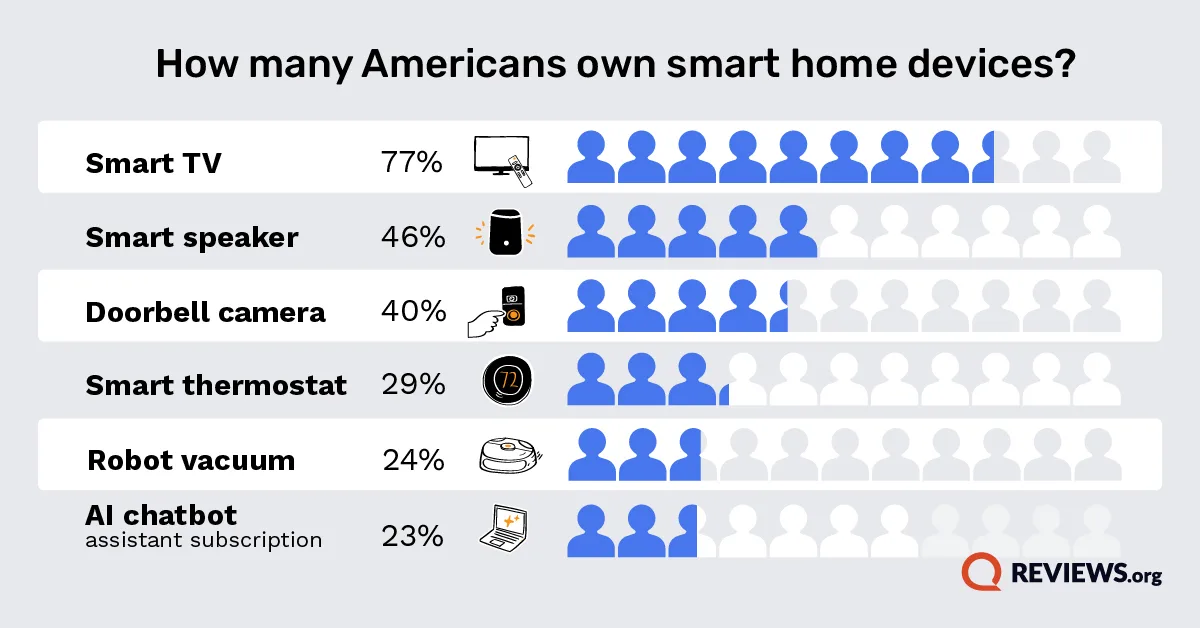
To a lesser extent, people use smart thermostats and robot vacuums to keep their homes cozy and clean, and some folks use AI chatbots and assistant subscriptions such as ChatGPT, Claude, or Google Gemini.
All of these products point to people finding greater convenience for in-home daily activities and tasks. But does that convenience come with a cost to your privacy?
What do Americans know about smart device data collection?
Being connected is convenient until you realize smart devices can turn into entry points for data collection or exposure to bad actors.
According to our survey, consumers are already aware of common data tracking practices and understand how to disable microphones, cameras, or toggle off tracking on smart TVs.
The majority of respondents understand that smart TVs can track what you watch, and that internet routers log every website visited and every device connected.
The least known privacy issue raised is that law enforcement can request your doorbell camera footage without consent in some areas. You'd have to check your local laws for specifics, but still, over half of the respondents assume this to be the case.
Do people use separate streaming devices for privacy reasons?
According to our survey, not only do most people prefer a separate streaming device to their smart TV's built-in apps, but many choose their devices specifically for privacy or data practices.
Most people know that using a separate streaming device can limit the data the TV manufacturer collects about your viewing habits, but it's not always why they're using a separate device in the first place.
Top reasons for using a separate streaming device on a smart TV
Privacy concerns aren't the primary reason for most people when using a separate streaming device. In fact, privacy comes behind even choosing "none of the above" from the given options at 17%.
The majority of users are looking for better app selection, followed by better speed or performance. In other words, they're expanding their ability to stream what they want at high quality rather than making a firm choice to limit their smart TVs' data collection or adding a device for more privacy, per se.
Which streaming devices do Americans trust most with their data?
When it comes to trusting companies with their data, consumers rank Roku highest for trust in streaming devices, followed by Samsung smart TVs and Apple TV. Roku scored a 3.32 on the trust scale where 1 means not trustworthy and 5 means very trustworthy.
LG smart TV and Google TV tied for 4th place with 3.06, leaving Amazon Fire Stick with the lowest trust score, 0.29 points below Roku.
Do Americans think their devices are listening to them?
Is my smart TV spying on me? Some people may dismiss these questions as paranoia, but they're real concerns of consumers.
While the government provides basic information on how data is tracked and collected along with some privacy practices, consumers are concerned that the spying goes further.
A majority of survey respondents said they saw ads for topics they discussed but never searched (59%) or targeted ads connected to private conversations (57%). Nearly half of respondents said they felt like their devices were listening or watching without their knowledge (45%).
Consumer concerns may be explained by cross-device tracking or clever marketing and algorithms, but these concerns are coupled with past incidents involving privacy issues and data safety practices, such as those involving the mishandling of customer information. Thus, some (but definitely not all) consumers take matters into their own hands.
What privacy steps have Americans already taken with connected devices?
As a response to privacy concerns, the most common practice Americans take is adjusting privacy settings on connected home devices (55%). Deleting or limiting AI assistant conversation history was the next most common practice (50%).
Knowing what a privacy policy actually says before using a device may be more common than you think, with 43% of respondents saying they have done this at least once before using a smart device.
Still, privacy is one of the many things people have to consider when setting up an in-home smart device, and understanding the implications of long legal documents is another barrier to cross for many people.
Over 30% of consumers have switched brands due to privacy concerns or data breaches, showing that privacy might not always be the primary reason people buy certain brands or devices, but problems around privacy certainly will make people leave.
Which AI assistants are consumers most concerned about?
Amazon Alexa wins out for the most concerning AI assistant, followed closely by Google Gemini, ChatGPT, and Apple Siri, with concern scores all in the 60s.
Despite the name recognition of the brands behind these assistants, consumers show no default trust in any major AI assistant.
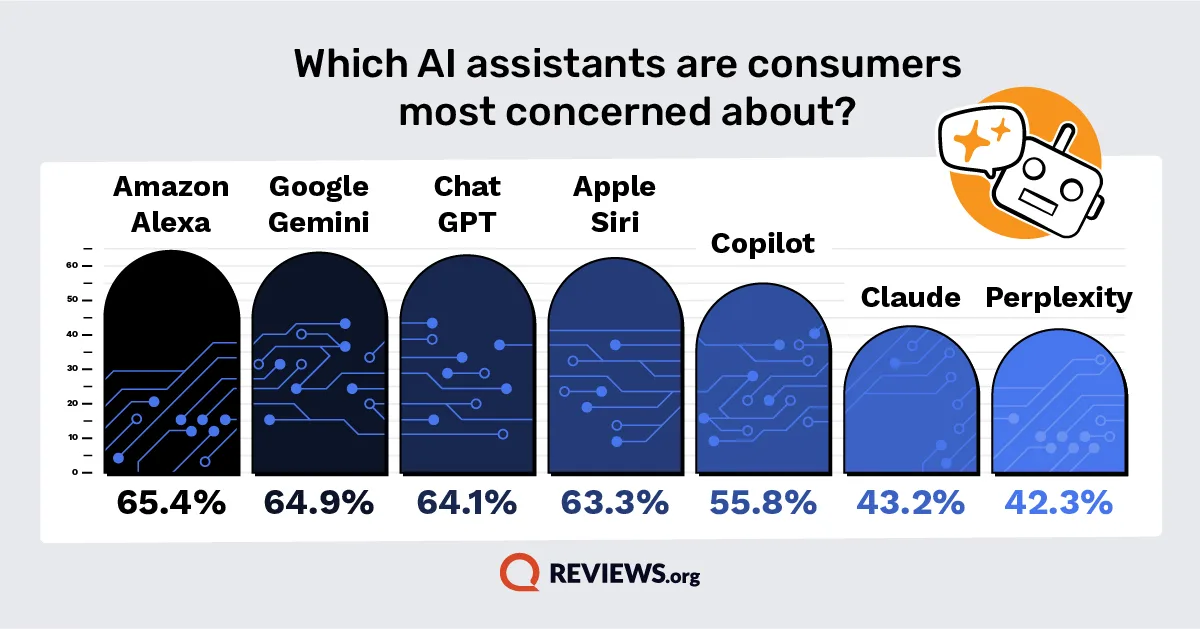
Image placeholder: Graphic 3: Which AI assistants are consumers most concerned about?
Consumer concern scores for major AI assistants. Image by Scott Stanley, Reviews.org
But as we'll discuss later, it seems people are more distrustful of the actual AI assistants than the companies themselves. If you're curious, you can learn more about what data Alexa and the other smart assistants collect.
Do Americans feel in control of the data their devices collect?
Americans are divided on how in control they feel over their data — 53% say they do feel in control, whereas 47% say they do not. This 47% is significant, suggesting that there is more to privacy than simply switching on a few settings and rejecting cookies.
Which companies do Americans trust most to protect their personal home data?
Survey respondents gave the baseline trust of the federal government a trust score of 2.26, so the trust for tech companies is relatively high by comparison. Google scored the highest with a 3.25 trust score, followed by Amazon and Samsung tying with 3.17 scores, and Roku trailing not too far behind at 3.16.
Still, if the highest score (3.25) is barely above the midpoint score (2.5), it doesn't demonstrate high trust.
*US government added to this question as a control.
Earlier, Amazon Alexa and Google Gemini raised the highest concerns for consumers, but their parent companies, Amazon and Google, are comparatively trustworthy among their tech giant peers, which points to a lack of trust in the AI technology more than the brands themselves.
Would Americans pay more for devices with better privacy protections?
According to our survey, 66% of Americans are willing to pay more to replace devices they don't trust.
Americans are willing to pay more for smart TVs and voice assistants that guarantee not to collect or sell their data. And they're more willing to disconnect a connected device if they learned it was collecting more data than they expected.
But more than any other measure surrounding privacy, Americans would support legislation requiring smart device manufacturers to disclose what data they collect in plain language.
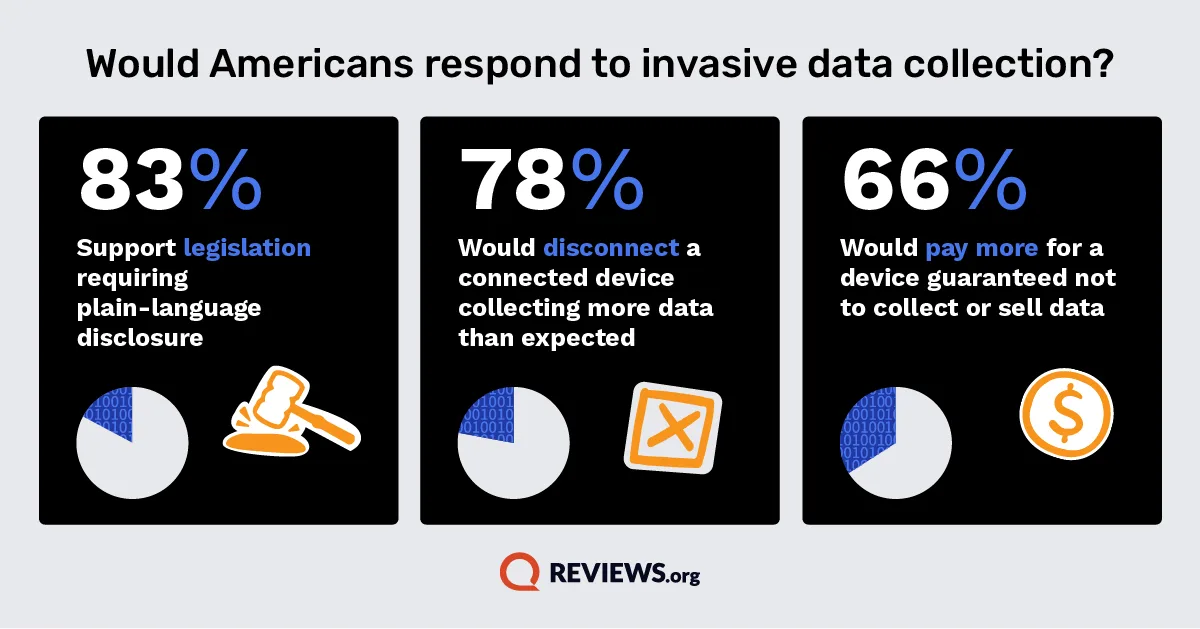
How Americans say they would respond if connected devices collected more data than expected. Image by Scott Stanley, Reviews.org
Overall, respondents are more willing to support legislation than any other individual action.
What would people do if a connected device collected more data than expected?
The feeling of being spied on, or used for data, leads consumers to some form of direct action in most cases, be it in simple privacy setting adjustments or discontinuing the use of a device entirely.
The easiest thing to do, and the one the most respondents say they would do, is adjusting their privacy settings on the device.
But brands should be wary of consumer perception around privacy practices: nearly 74% of Americans would switch to using a competing brand with better privacy practices. And 66% would disconnect or stop using the device entirely.
Still, when they feel slighted, nearly half (47%) of consumers are at least willing to post about it on social media, which isn't something brands like to see pop up in the public discourse, either.
Has concern about device data collection increased over the past year?
As technology, in particular AI, continues to expand into our homes, has our level of concern increased with it?
According to our survey, 30% of respondents reported feeling more concern about connected devices collecting data than they have before, and only 3% have decreased their worry.
About half (55%) of Americans feel roughly the same amount of concern for data collection from their connected devices as before. And about 12% of Americans haven't thought about it until asked, so the question is, once again, a matter of awareness.
As a general recommendation, it's worth considering your privacy and data every time you add another device to your connected network. You don't always have to go to great lengths to get more control of your private data. Even taking a few steps to adjust your privacy settings can go a long way.


To compile the data for the State of Consumer Data 2026, we conducted an online survey of 1,000 Americans. The results were stratified to reflect the current U.S. population according to Census data for age, gender, and geographic region. The survey explored connected-device ownership, awareness of smart-device data practices, trust in brands and platforms, privacy-related experiences, attitudes toward AI assistants, and how consumers would respond to more invasive data collection.

Share your experience and rate your internet provider
Your feedback helps others find the right internet provider. Whether your experience was great, frustrating, or somewhere in between, we want to hear about it.

Related Articles

She Quit Social Media for 30 Days—Including Dating Apps. Here’s What She Learned.
I spend 27 hours a week on social media. I wanted freedom from it. Danika...

Viasat Internet Plans and Deals
Read about Viasat internet prices, plans, and deals for high-speed internet.

Did You Just Get Hacked? Here’s What to Do in the Next 10 Minutes
Getting hacked cost me $4,500 in fraudulent charges. Here's what to do immediately after getting...

Your Mom Could Save $50/Month With This One Trick
Cut down your monthly phone bill by switching to a more affordable carrier that offers...



