
How Long Do Americans Really Keep Their Phones?
Smartphone Lifespan Report 2026: How Long Do Americans Really Keep Their Phones?

 6 min read
 Edited ByKelly Huh
Americans keep telling themselves they don’t need to upgrade their phones, but their actual upgrade cycle says otherwise. Reviews.org surveyed 1,000 Americans about their smartphone lifespan, how often they actually upgrade, and what they pay for their devices. What we found is that there’s a gap between intention and reality.
On average, Americans have owned their current phone for nearly two years. When asked when they plan to upgrade, they say in about 1 year and 9 months — meaning they expect to keep their device for nearly four years total. But historically, people upgrade their phones every 2 years and 8 months, which is roughly a year earlier than planned. The reason? Needing faster performance and experiencing battery issues are key drivers for the upgrade.

Why you can trust us
At Reviews.org, our team takes its editorial independence seriously. We may earn money when readers click affiliate links, but we don't work for our brand partners, and they don’t approve our pieces before publication. To learn more, visit our About us page.
Key takeaways
- Americans have owned their current phones for 2 years and plan to wait another 21 months to upgrade.
- This brings their expected total phone lifespan to almost 4 years (45 months).
- In reality, they upgrade every 32 months — roughly a year earlier than planned.
- Faster performance (21%) and battery issues (19%) are the top reasons people want a new phone.

Meet the expert
Christian de Looper has covered smartphones, carriers, and the wider consumer technology industry for over a decade. He has personally tested all of the top new phones for publications like Digital Trends and BGR, has attended major trade shows like CES, and owns his own smartphone lab testing business, BandicootLab.com. Christian has a deep interest in smartphones, how they work, why they sometimes don’t, and how people can get the most out of their phones for the longest amount of time.

Reviews.org
How long do Americans really keep their phones?
The average American upgrades their phone every 32 months — about 2 years and 8 months. That's four months longer than last year's 29-month figure, and it's the clearest sign yet that the smartphone upgrade cycle keeps stretching.
What makes the number interesting isn't just the length, though. It's the gap between what people plan and what they do. Respondents said they intend to upgrade in about 21 months, having owned their phone already for 24 months. This means the total time they expect to keep their current phone for is 45 months. However, the actual replacement cycle runs closer to 32. In other words, the average person's upgrade is nearly a year earlier than expected.
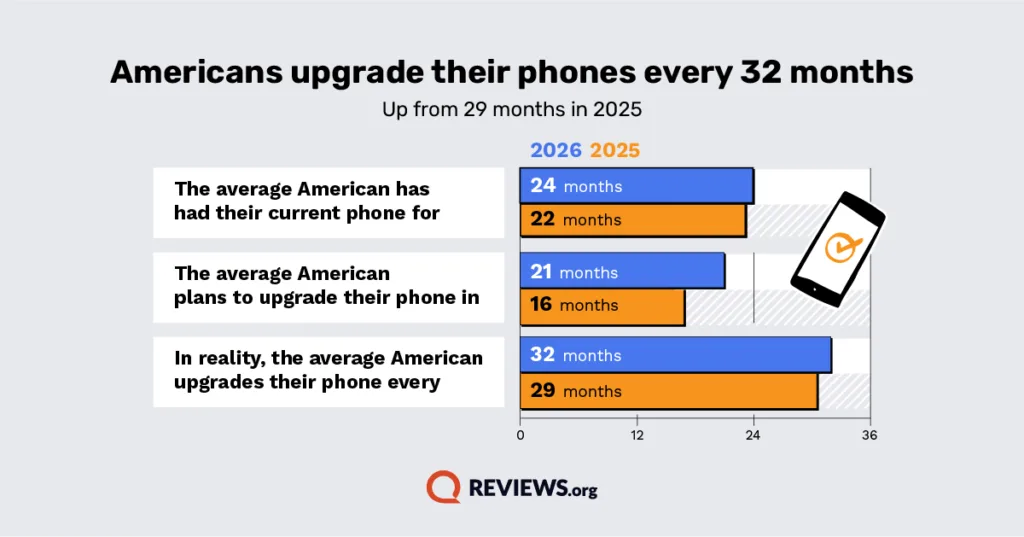
Americans upgrade their phones every 32 months. Image courtesy of Reviews.org
Industry data suggests our respondents may be on the quicker end. Several market analyses put the global replacement cycle at around 3.5 years in 2025–2026, and some U.S. estimates approach 3.8 years — with Verizon's CFO last year publicly describing cycles extending beyond 42 months. Those figures measure the installed base, which is the total number of active devices currently in use across a population or market. This isn’t self-reported behavior, so some difference is expected.
That said, not everyone is slowing down. Power users, mobile creators, and early adopters still upgrade on a one-to-two-year cycle, and launch-week coverage can make it feel like everyone does. The data says otherwise. Longer 36-month financing terms, tougher hardware, and mid-range phones that stay fast for years have all pushed the average phone lifespan in one direction – up.
How long do Americans keep their smartphones for?
What are the top reasons Americans want to upgrade their phones?
Faster performance tops the list at 21%, with battery issues close behind at 19% — and to be fair, those two often blend together, since a degrading battery makes a phone feel slow. Lithium-ion batteries typically lose noticeable capacity after two to three years of daily charging, which lines up almost exactly with the 32-month upgrade cycle. Broken or lost phones account for another 14%, the forced upgrades nobody plans for. What's notable is what ranks low. Better cameras motivated just 4.9% of respondents, and new features only 9.7%, despite both dominating manufacturer marketing.
Apple and Samsung spend a lot of time on camera systems and AI features, but the average buyer is upgrading because their phone got slow or the battery gave out, not because they want a better telephoto lens. Meanwhile, about 7.5% upgrade because of trade-in deals or contract options, a reminder that carriers shape the upgrade cycle as much as consumers do.
Top reasons for wanting to upgrade smartphones
How much do phones cost?
Our respondents paid an average of $634, with a median of $600 — essentially flat from last year. That median is the more telling number. Flagships like the iPhone 17 Pro and Galaxy S-series Ultra models start at $1,000 or more, so a $600 median means most Americans are buying a tier or two below the top. That's not surprising. Phones like the iPhone 16e and Google's Pixel A-series deliver most of the flagship experience for hundreds less, and they've pulled the average phone cost down with them.
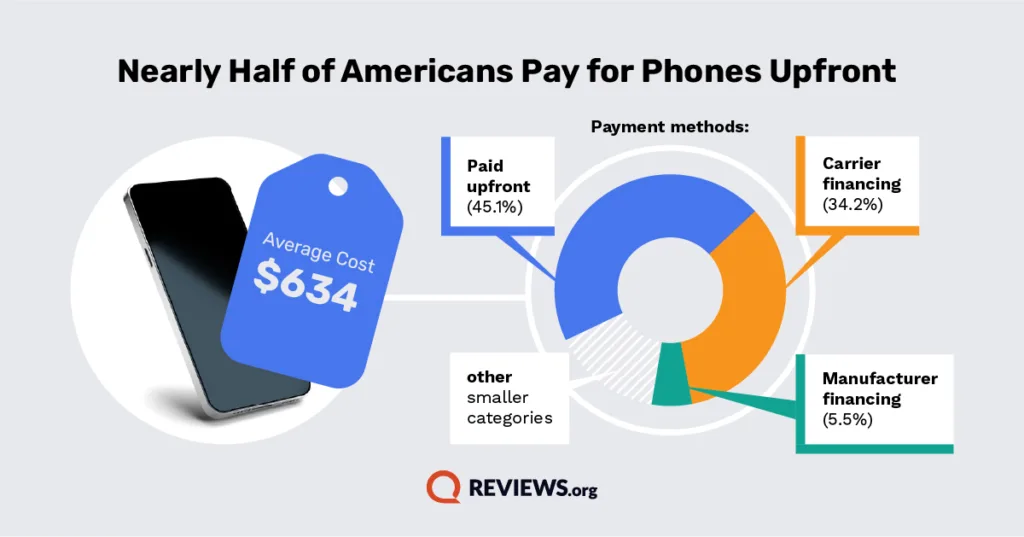
The average phone cost is $634 (mean) and $600 (median). Payment methods include: Paid upfront (45.1%), Carrier financing (34.2%), Manufacturer financing (5.5%). Image courtesy of Reviews.org
Of course, averages hide the extremes. Pro and Ultra buyers routinely spend $800 to $1,200 or more, while the refurbished market offers perfectly functional devices under $300. And if a $600 phone lasts the 32 months our data suggests, that works out to under $20 a month — not a bad deal for the device most people use more than any other.
How much do Americans pay for their phones?
How do Americans pay for their phones?
For all the installment plans and trade-in promotions carriers push, the single most common way Americans pay for a phone is upfront, in full. Paying cash means no monthly line item and no contract nudging you toward the next upgrade, and it arguably makes it psychologically easier to keep a phone longer. Financing spreads the cost, but it also ties your upgrade timing to your carrier's terms rather than your actual needs.
There are arguments for either approach. What's striking is how small everything else is: manufacturer financing, leasing, and the secondhand market all sit in the single digits, though gifted, hand-me-down, refurbished, and used phones together account for roughly one in ten devices.
Do Americans finance their phones or buy them outright?
About 45% of respondents pay upfront in full, presumably to avoid rolling debt. Another 34% finance through carriers like T-Mobile or Verizon, often on 30- to 36-month terms — which lines up almost perfectly with the 32-month replacement cycle. It's hard to say which drives which, but the two may be correlated.
How do Americans pay for their phones?
iPhone vs. Android ownership
For the first time in this survey series, iPhone leads Android: 58% to 42%, a reversal of last year's 48/52 split towards Android. Sure, a single-wave survey of 1,000 people can move several points on sample composition alone, but the direction is clear. It tracks with the broader picture of the iPhone vs Android market share in the U.S., where independent datasets regularly put iOS in the mid-50s to low-60s of the installed base, even as Android dominates globally.
Platform preference also splits along demographic lines. Younger and higher-income users skew iPhone in most analyses, while value-conscious and rural buyers often lean Android for the price flexibility and hardware variety. And to be clear, Android is hardly fading. More than four in ten Americans in our sample carry one.
iPhone vs. Android users in America: What type of smartphone is most popular?
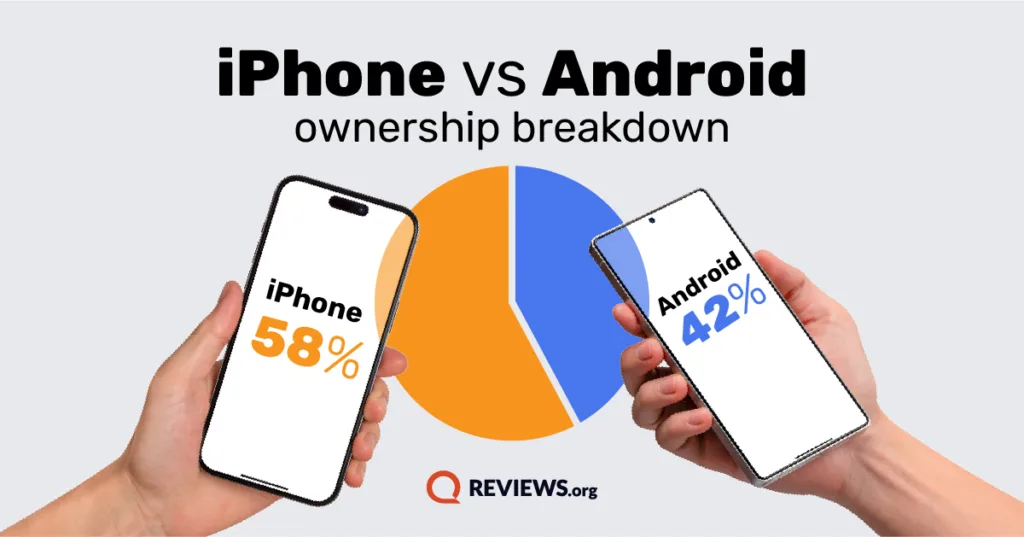
58% of users own iPhone devices and 42% of users own Android devices. Image courtesy of Reviews.org
What is the most popular iPhone model?
The most-owned iPhone isn't a new one: it's the iPhone 11 or older, at 9.4% of iPhone owners, which says a lot about how long iPhones last in practice. Those phones launched in 2019 or earlier, meaning a sizable group of Americans is carrying a device that's six-plus years old.
Apple's five-to-six years of iOS support has long fueled that longevity, though flagship Androids from Samsung and Google now promise four to seven years of updates, so the gap is narrowing.
Most popular iPhone models
When should you upgrade your phone?
The honest answer comes down to two things: hardware limits and software limits. On the hardware side, the biggest signal is the battery. If your phone dies before the end of the day or needs multiple charges to get through normal use, something has to change. But that something doesn't have to be a new phone. A battery replacement costs a fraction of a new device and can extend usability by a year or two, and it's an option a surprising number of people never consider — which is probably part of why battery issues drive nearly a fifth of upgrades.
The software side is less negotiable. Most phones stop receiving security patches somewhere around year four to six of ownership, depending on the brand and price tier. Once that happens, upgrading stops being about preference and starts being about security: running banking and authentication apps on an unpatched phone is a genuine risk.
Until you hit that point, though, the data in this report should be reassuring. If your phone still performs fine for the things you actually do, waiting another year isn't falling behind. At 32 months and climbing, it's what most Americans are doing.

The Smartphone Lifespan Report's findings are based on a Pollfish survey of 1,000 U.S. adults conducted on August 15, 2026. The survey gathered information on smartphone ownership, upgrade frequency, reasons for upgrading, and payment methods. The data represents a single-wave, non-probability sampling format, so results should be read as indicative of consumer upgrade behavior rather than definitive. Year-over-year comparisons use similar methodology but remain subject to changes in sample composition.

Related Articles

Why Some Households’ Wi-Fi Crashes During the World Cup (and Yours Doesn’t Have To)
Frustrated by an internet connection that constantly cuts out while you're watching a game? Learn...

Spectrum Mobile Cell Phone Plans and Deals: Unlimited Plans, Better Value
Learn about Spectrum Mobile’s three prepaid plans and how to get its Unlimited line for...
Best Sports Packages in 2026: I Tested and Ranked the Top Picks
We have a list of the best sports packages in the streaming, cable, and satellite...

How to Program Your Spectrum Remote to Your TV
Spectrum TV customers will need to program their new remote so that it works with...



