
No, your forgetfulness won’t crash the plane
Do You Actually Need To Use Airplane Mode?

 3 min read
 Edited ByKelly Huh
When the flight attendant announces, “Please switch all electronic devices to airplane mode,” most people scramble to send off one last “Taking off, love you!” text.
I, however, think of a quintessential “West Wing” scene from the pilot episode, where the character Toby Ziegler, the White House Communications Director, attempts to make a call after hearing about the president’s bike accident. The flight attendant stops him, saying, “You can’t use your phone until we land, sir.”
Toby’s commonsense reply reflects a timeless question: “We're flying in a Lockheed Eagle Series L-1011. Came off the line twenty months ago. Carries a Sim-5 transponder tracking system. Are you telling me I can still flummox this thing with something I bought at Radio Shack?”
It’s 2026, and avionics technology is as advanced as it’s ever been, but little has changed regarding cell phone use on a plane since that episode premiered in 1999.

Why you can trust us
At Reviews.org, our team takes its editorial independence seriously. We may earn money when readers click affiliate links, but we don't work for our brand partners, and they don’t approve our pieces before publication. To learn more, visit our About us page.
Key takeaways
- Don’t worry, skipping airplane mode won’t crash the plane
- The main issue with using cell phone service on a plane is that there could be potential interference between the aircraft’s navigation and communication systems
- At the very least, airplane mode saves your battery

I investigated why the 2.9 million people who board planes in the U.S. every day are asked to toggle on airplane mode. For some first-hand insight, I spoke with a pilot and an avionics professor. The short of it? Your iPhone isn’t flummoxing anything serious.

Reviews.org
What does airplane mode actually do?
Airplane mode disables all cellular signals and wireless transmission so you can’t receive text messages, make calls, or use any apps that require an internet connection.
You can toggle some of those signals back on, like Wi-Fi or Bluetooth, while still keeping cellular off.
Why do airlines ask you to turn on airplane mode?
Airplane mode is largely a precautionary exercise to eliminate any possibility of interference with radio signals, communications, and other systems the plane uses during the flight. Officially, the Federal Aviation Administration (FAA) states there is potential interference between portable electronic devices and the aircraft’s navigation and communication systems.
Limiting cellular signals can also help keep people attentive to on-board communications, safety instructions, and potential emergency situations – especially during takeoff and landing.
“There is a safety concern, but it's not what people expect,” said Thomas Inman, author and retired professor of avionics at Pennsylvania College of Technology. “I'm sure you are aware of how easily one can get mesmerized by the small screen — the crew wants your full attention.”
Ground interference is a concern
The real impact of skipping airplane mode is actually happening on the ground. When your phone is searching for a signal in the air, it sends a higher amplitude signal in an effort to make a connection. These loud signals can blast cell towers in the flight path and drown out signals on the ground.
“Cellular systems are designed for terrestrial use, so being thousands of feet in the air can create conditions that ground networks aren't optimized to handle,” said Justin Crabbe, commercial pilot and founder of private jet charter companies, Jettly and BlackJet.
You may successfully get a spotty signal if the plane is low enough. But at high speeds and altitudes, your phone’s frantic attempts to search for a connection can cause congestion and noise for cell towers on the ground.
What happens if you don’t use airplane mode?
Nothing. If you forgot to turn on airplane mode, the most likely inconvenience is draining your battery.
If phones were capable of interfering with the safety of a plane in a significant way, airlines wouldn’t rely on the honor system and the occasional announcement for you to turn on airplane mode.
That said, the precaution is in place for a reason, and it doesn’t hurt to comply.
“One forgotten phone won't be too risky, but it's not always safe to assume that isolated risks are harmless,” said Crabbe. “Everyone on board should still follow instructions and protocols to control and mitigate risks and make sure everyone maintains the same safety standards.”
Can your phone really interfere with an airplane?
Planes are designed to block interference that could disrupt their instruments. In fact, the FAA recently mandated that all aircraft radio altimeters be upgraded to tolerate any potential 5G network interference, despite debate about the threat level of such signals. This rule targets ground-based 5G towers, rather than phones.
“Aircraft systems are shielded, redundant, and certified with wide margins, so not every phone poses a direct threat,” said Crabbe. “While aviation relies on multiple layers of protection, it's always sensible to minimize unnecessary interference on board.”
That said, the “noise” of your phone attempting to send a signal can create annoying headset interference for pilots in the cockpit. One or two phones not using airplane mode could go unnoticed, but a plane full of frequency disruptions would make communication difficult.
“It's very unlikely the phone will interfere with any systems on board the airplane.” — Thomas Inman, author and retired professor of avionics at Pennsylvania College of Technology.

Frequently asked questions (FAQ)
Why can you still use Wi-Fi on a plane?
Airplanes with in-flight Wi-Fi host an onboard wireless network that lets you connect to the internet while operating separately from any aircraft communication or navigation system. It’s a contained Wi-Fi network that flight attendants are able to turn off if need be.
Will you get in trouble if your phone is not in airplane mode?
You won’t get in trouble purely for not putting your phone in airplane mode. The rule operates largely on the honor system. That said, if it’s clear you haven’t switched airplane mode on, a flight attendant has to repeatedly ask you, and you become unruly — then an escalated situation can result in a fine, removal from a flight, or ban from the airline.
Do other countries have the same rule about airplane mode?
Not always. Other countries have slightly different rules about cell phone use than the U.S. For example, in the European Union, airlines can provide 5G technology to make voice calls and use data the same way they would on the ground.

Related Articles
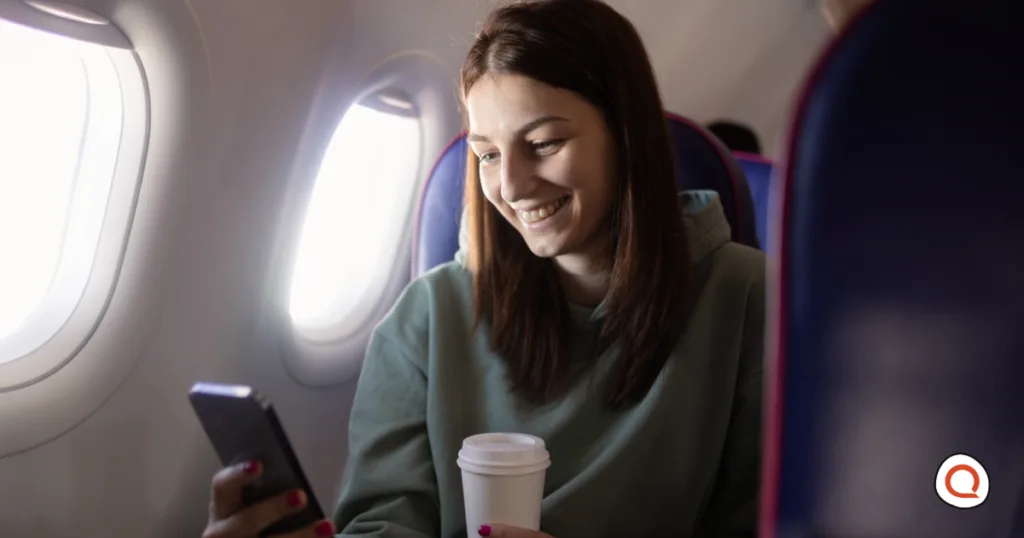
Do You Actually Need To Use Airplane Mode?
A deeper look into the reason for airplane mode and what happens if you don’t...

How Couples Split Bills Without Fighting
Finances are a leading topic that causes arguments between couples. Let’s talk about how to...
Is Tracking Your Partner’s Location Caring or Controlling?
Is sharing your location with your partner a sign of trust or control? Therapists and...
Holiday-Season Streaming: Will Your Internet Survive Black Friday Through the New Year?
Internet can slow during the holidays, but you won’t experience Black Friday, Christmas, or New...


