
Experts weigh in on healthy ways couples can approach location sharing
Is Tracking Your Partner’s Location Caring or Controlling?

 5 min read
Life360, the location-sharing app and maker of the Tile Bluetooth location tracker, uses the slogan, “Love knows no distance, but we do” on its website. While it’s up for debate whether that deserves an “aww” or an “ew,” there’s no question couples, families, and friends are lapping it up, with the company reporting 102 million monthly active users in 2026.
Location tracking adds an extra layer of complexity for relationship trust. It’s a convenient way to check if your partner is safe or on their way — but for some, it’s a slippery slope to concluding that your partner’s location pin is somewhere it shouldn’t be.
So should sharing your location with your partner be a default expectation? Or does it normalize something that can lead to obsession?
Key Takeaways
- 95% of American adults in relationships use some form of location-sharing tech, according to a survey of 1,000 people by location-sharing app company Life360.
- Location sharing can make coordinating plans easier and offer peace of mind, especially for couples juggling kids’ schedules.
- Frequently checking a partner’s location without a clear reason, or demanding access, can cross into controlling behavior.
Should you share your location with your partner?
The experts I spoke to agree that sharing your location with your partner can be beneficial for coordinating plans or for peace of mind knowing that loved ones are safe. However, when a couple struggles with trust, location sharing can introduce tension.
Rebecca Tydeman, a licensed marriage and family therapist in Essex, Connecticut, says that in a healthy relationship, it’s important to communicate openly about why you might check a partner’s location. “They would be comfortable and confident saying to their partner, ‘Oh, I looked at your location today halfway through the day because I was curious if your appointment was done.’”
This can be especially useful for parents with young kids. “It helps with the logistics of pickups, drop-offs, just confirming you brought our daughter to the appointment,” Tydeman says.
Is it toxic to share your location with your partner?
It’s not necessarily toxic to share your location with a partner, but it can step into that territory without mutual understanding of the reason behind a location-sharing request.
For example, Tydeman says that if somebody demands their partner to share their location, and isn’t open to a conflicting view point, it could be a potential sign of wanting to use location sharing as a way of controlling the other person.
Tydeman draws the line when someone is frequently checking their partner’s location throughout the day and can’t clearly and calmly explain why. “It definitely borders on the edge of controlling … it’s not just to track their every move just because.”
Dr. Maya Levy, a pediatrician in North Lauderdale, Florida, says the topic of location sharing sometimes comes up with parents in her practice. She generally sees it as a positive. “I have always seen location sharing as a valuable safety tool, especially when someone is in a healthy relationship, with a partner, child, or parent,” she says. In those cases, she adds, it serves as “an added safety tool and is not used to control or manipulate the other person.”
Important note: If a partner tracks you without consent or uses your location to control you, the National Domestic Violence Hotline (1-800-799-7233) offers free, confidential support. Additional resources are found on their website.
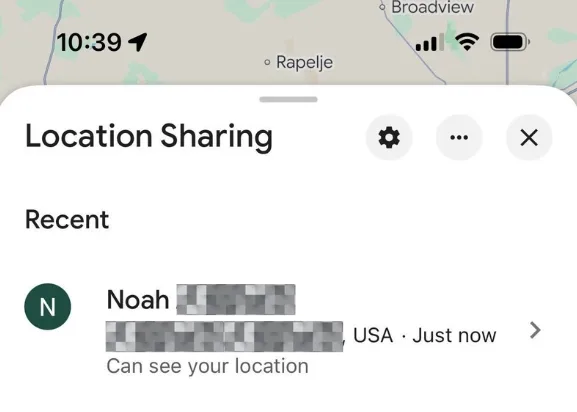
I have my husband’s location on my Google Maps app and usually check it to see if he’s on his way home from work. Image courtesy of Kelly Huh, Reviews.org
In Google Maps, location sharing options allow for specific contacts you select to see your real-time location, distance from your location, and how much battery is left on that contact’s device. This can be for a set amount of time or ongoing. In a situation where you may be worried about a partner’s safety, a quick check on Google Maps reassures you of their location and if they have enough battery on their phone.
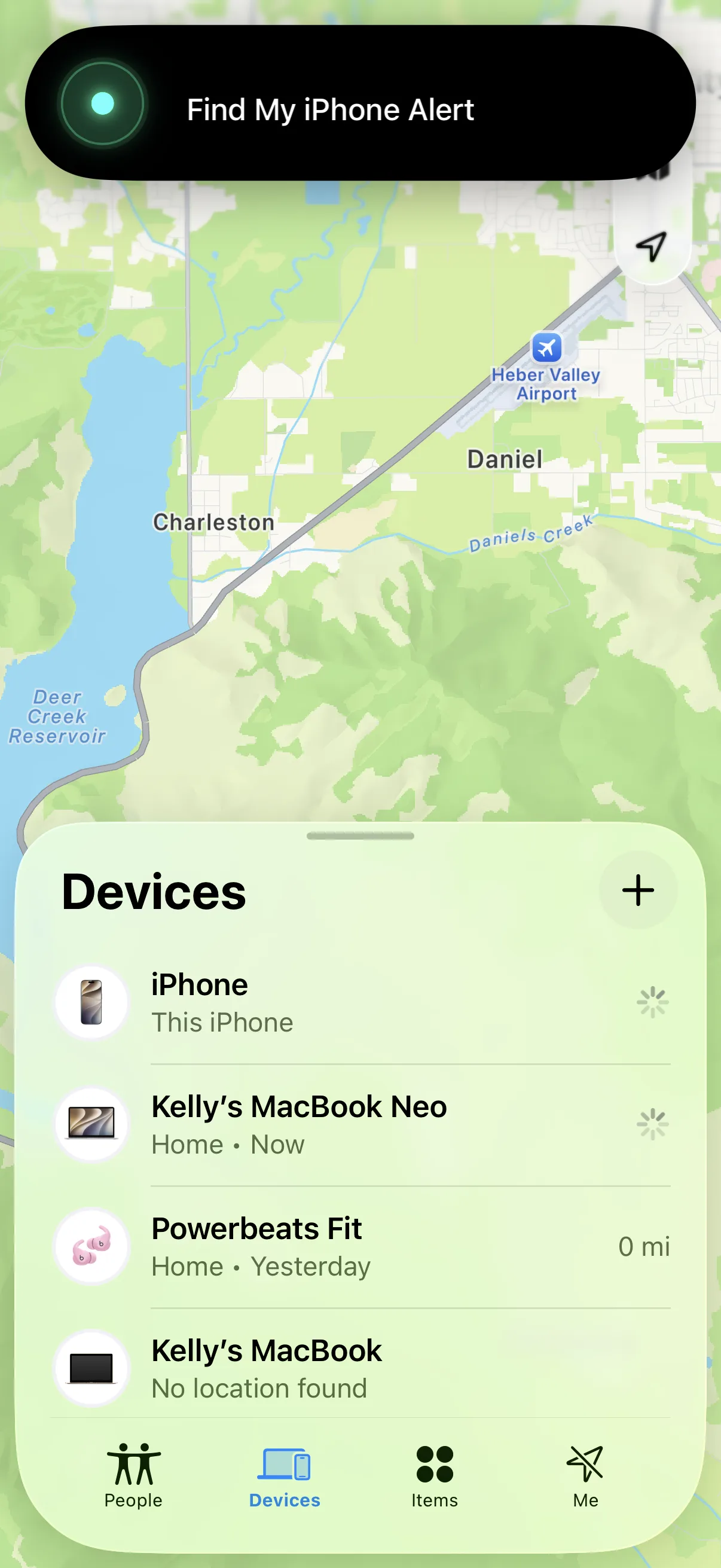
On Apple Find My, alongside selected contacts, you can track the location for items with an AirTag or Apple devices. You can also select “Play Sound” making it extra convenient to find lost items in another room or buried in the couch. Image courtesy of Kelly Huh, Reviews.org
Why might a partner not want to share their location, even in a healthy relationship?
Even in a healthy relationship, sharing your location can be a point of friction. “To many more private, independent individuals, location sharing feels like an invasion of privacy!” Levy says. In her view, the added safety value usually outweighs that feeling.
Dr. Maritsa Yzaguirre-Kelley, a licensed mental health counselor I talked to who specializes in quantitative electroencephalography, or qEEG, a form of brain-mapping, says that location-tracking has neurological effects. “From a brain-based perspective, being constantly monitored keeps the nervous system in a low-grade state of vigilance,” she explains. This can produce a feeling of anxiety and resentment, rather than safety.
Whether it’s a good idea or not depends on the nature of the relationship and attachment style. “It should never function as a loyalty test: the healthiest framing is that access to your location is a revocable gift, not proof of love, and trust is shown by how a partner responds when sharing is declined,” Yzaguirre-Kelley advises.
Is location sharing becoming the norm?
In January 2025, Life360 surveyed 1,000 adults in relationships to understand how couples approach location sharing. The survey found that 95% of people in relationships use some form of location-sharing tech, and 21% say they’d consider it a deal breaker if a potential partner isn’t willing to share their location.
Still, common doesn’t mean it’s the default expectation. “It’s a conversation a lot of people are having,” says Tydeman.
Tydeman thinks generational differences play a role in how normalized location sharing is. For people in their 20s or 30s, sharing whereabouts or activities on social media is normal. “There's very little privacy in their life in general. So to them, it’s like ‘This just makes my life easier if I know where my friends are.’”
The numbers back her up. According to a 2025 CivicScience report on location sharing, Gen Z adults aged 18–29 are the most likely group to use location sharing (65%), whereas Millennials (45%), Gen X (42%), and older (24%) are less likely.
This behavior shows up in the apps younger people use most. Snapchat’s Snap Map, introduced in 2017, lets users share their locations with friends and view heatmaps of busy areas, or check local map listings for restaurants, stores, and events. “[It was a way] to skip this step of asking them, like, hey, are you around this weekend? Do you want to get together?” says Tydeman.
Snap Map’s reach is massive. In May 2025, Snapchat announced its Snap Map feature had more than 400 million monthly active users. Instagram was a little late to the game, adding Instagram Map in 2025 and including similar features where users can upload stories, posts, and reels pinned to specific locations.
Several messaging tools like Instagram Direct Messages and Facebook Messenger also include location sharing that can be sent to contacts in a message or a group chat for up to one hour, and can be stopped anytime. WhatsApp also offers the option to share your location in a chat for 15 minutes, 1 hour, or 8 hours.
With location sharing built into so many apps, there isn’t just one single “right” way couples can approach location sharing — which can make it all the more confusing.
How should I respond to my partner asking me to share my location?
Tydeman offers the following tips for approaching location sharing:
1
Get curious and have an open discussion
There may be a valid reason someone wants their partner to share their location, just as there may be a valid reason why someone doesn’t. “I would say the very first thing is not to pressure or to push.” For example, someone may not be trying to hide anything, but may simply want space to make their own decisions without being monitored.
2
Share fears with your partner
Slow down and talk through what’s driving each of your feelings, whether it’s hurt from a past relationship that makes someone afraid of being controlled or a personal need they haven’t yet shared with their partner. “If you dive a little bit deeper and just get curious and allow them to open up and share what their fears are around it, I think that there will be a lot more of an understanding.”
3
Agree on the arrangement
Once both partners’ concerns are fully laid out, you can choose an arrangement you’re both comfortable with, such as sharing for logistics and peace of mind or agreeing on clear boundaries after a breach of trust.
Ultimately, the decision to share your location with your partner should be taken with care and consideration of each partner’s feelings and preferences. “The answer is not in pushing and battling. It’s in listening,” Tydeman concludes.



Frequently asked questions (FAQ)
Should you let your partner track your location?
Location sharing should be a decision both partners make together. If both partners agree and understand why they are sharing their location, it can be beneficial. However, if there is any pressure or manipulation, it may not be advisable.
Can someone track my location without me knowing?
It’s possible for someone to track your location without you knowing, perhaps through a shared or compromised account or a hidden Bluetooth tracker like an AirTag. However, if you have an iPhone, you may receive a notification saying “AirTag Found Moving With You” indicating that an AirTag that's separated from its owner is seen moving with you over time.
Does Find My tell you when someone stops sharing their location?
Find My doesn’t notify the other person when you stop sharing. However, if the location was initially shared from iMessage rather than Find My, the person may receive a notice in iMessage saying sharing has stopped.

Related Articles
Is Tracking Your Partner’s Location Caring or Controlling?
Is sharing your location with your partner a sign of trust or control? Therapists and...
Holiday-Season Streaming: Will Your Internet Survive Black Friday Through the New Year?
Internet can slow during the holidays, but you won’t experience Black Friday, Christmas, or New...
PureTalk USA Review (2026): Is It the Best AT&T Network Alternative?
PureTalk uses AT&T’s network and provides discounted rates on cell phone plans. But how does...

Is it Rude to Ask Friends to Pay for Your Streaming Password?
Streaming services are getting expensive and splitting the cost can help keep your monthly rate...


