

5 Things You Need to Know Before Switching Cell Phone Carriers

A couple comparing phone plans and details together, weighing whether switching cell phone carriers is worth the hassle.

Before you switch, run the numbers together — the "better deal" isn't always better once you factor in the whole picture.

// Cell phone carrier changes are less intimidating with preparation
Brianne Sandorf
Sep 05, 2026
Icon Time To Read4 min read
Icon CheckEdited ByKelly Huh

In the 18 years that I’ve had a cell phone, I’ve used each of the three major mobile providers: T-Mobile, Verizon, and AT&T. Each time my family switches providers, we encounter bumps — some major, some minor.

And we’re not alone. A survey that Reviews.org conducted shows that many American consumers have trepidation about switching phone providers due to potential problems:

  • 54% expressed worries about network coverage and reliability
  • 32% expressed reluctance to deal with the hassle of switching
  • 97% expressed lack of trust in the quality of cheaper carriers
  • 83% expressed concern about the complexity of untangling an existing family plan
  • 91% expressed uncertainty over which alternative carrier is the best option

With all my phone-switching experience and professional research, I’m here to address each of these five concerns. And when you’re done reading, you’ll know exactly what you need to make a phone provider switch.
1. What will the new network coverage and reliability be like?

It’s normal to wonder what network coverage and reliability will be like with a new provider, but luckily, that’s easy to find out.

All cell phone coverage in the U.S. comes from one of three networks: Verizon, T-Mobile, or AT&T. You just have to figure out which network your potential new provider uses (our MVNO piece is a good place to start). Then you can compare your home, work, and other frequent locations to that network’s coverage.

If you switch to Verizon, T-Mobile, or AT&T, your coverage should be dependably reliable in-network (unless you’re in an overcrowded area, like a sports event, or an impenetrable area, like an underground parking lot).

If you move to one of the smaller providers, your coverage may not be as reliable if your plan is on a lower priority. This means you may experience slower internet speeds when a tower gets crowded, compared to higher priority customers.


2. How much of a hassle will switching be?

Switching providers can be a bit of a hassle, particularly if you’re under contract or on a phone payment plan. The last time I switched providers, physically getting my phone switched over to the new network was a royal pain.

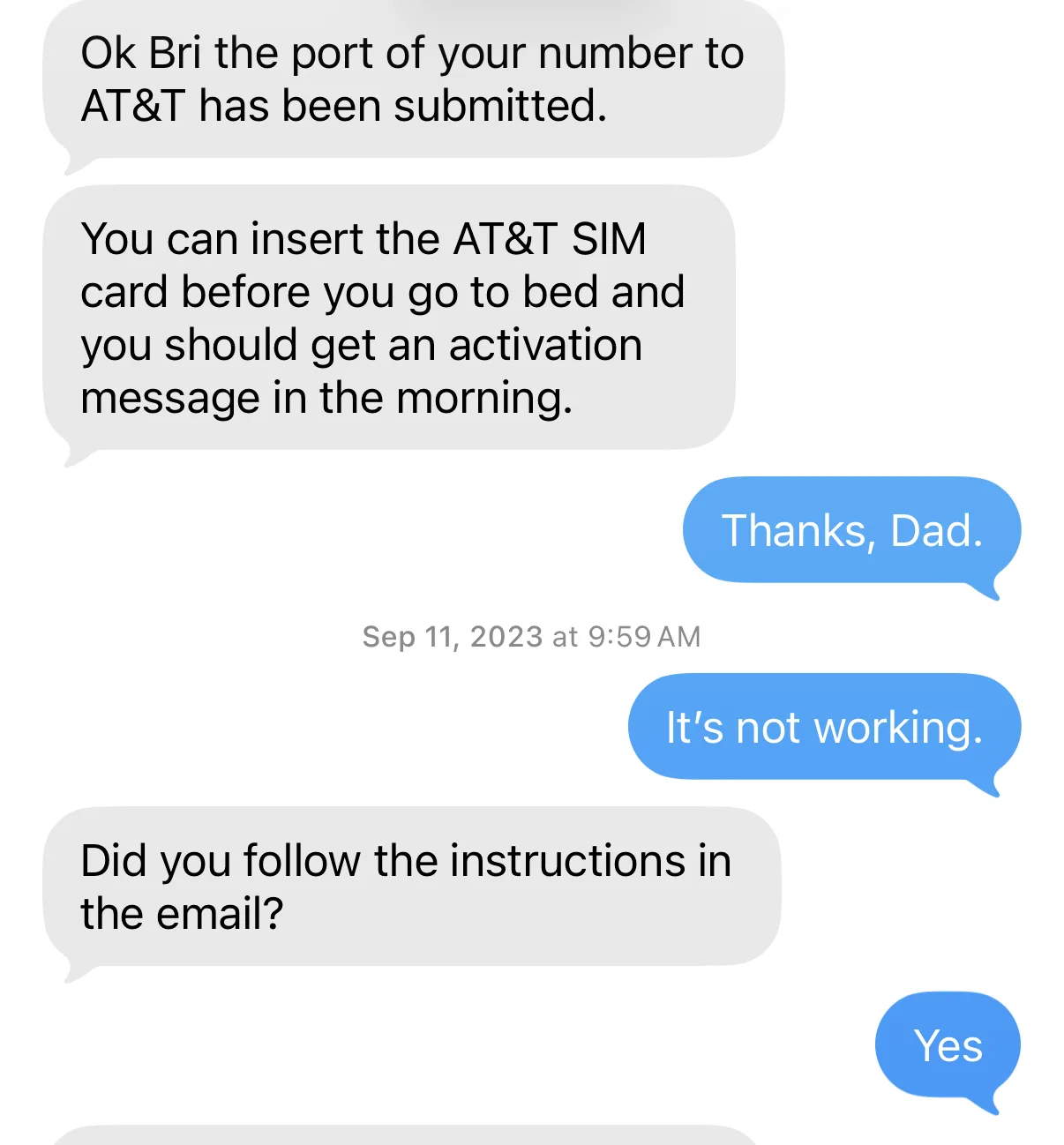
A text conversation about trouble switching providers between the reviewer and her father

My conversation with my dad when we left our Verizon family plan in favor of a new AT&T family plan. It took a little extra work to get my phone properly set up with an eSIM. Image courtesy of Brianne Sandorf, Reviews.org

But you can make switching easier for yourself if you enlist an ally: your new phone carrier. For instance, AT&T provides directions for keeping your number while switching to AT&T. There’s even a section that gives you the exact numbers to call if you’re leaving Verizon or T-Mobile.

3. Are you getting a quality downgrade with a cheaper plan?

Moving to a cheaper plan doesn’t automatically mean that the phone service is lower quality. “Mint delivers excellent coverage that is just as reliable and fast as a T-Mobile plan,” says Monica Yoshida, a Reviews.org writer who switched from T-Mobile to Mint several years ago.

But how can you be sure that your cheaper plan’s not a step down? The best way is to ask questions and do research. You can talk to people who use the service or plan you’d like to switch to. And, of course, you can check out our Reviews.org cell phone service reviews.

4. Can you get off your existing family plan?

If you aren’t a minor and your phone’s paid off, getting off a family plan is relatively easy. You sign up with a new provider and end your service with the old one, and voilà! You’re done.

The real difficulty in getting off a family plan lies in the relationship dynamics. Although AT&T suggests speaking to your parents (or whoever handles the plan) before leaving, you technically don’t need the account holder’s permission if you’re okay with a new number. If you want to keep your current number, then generally, account holder cooperation is necessary. Plus it’s nice to give the plan members a heads up — once you’re gone, their costs will typically increase.

5. How do you choose a new carrier?

If you’ve gotten this far, you’ve already done about half the work in choosing a new carrier. Now that you’ve researched the networks and quality of potential new providers, you just need to consider features and price.

Features cover everything the new provider offers (unlimited data, hotspot data, streaming service deals), and price is what you’re paying for them. To choose the perfect new carrier, you want to find a balance of features versus price that feels fair to you.

Once you’ve considered these five things, if you find a new provider that’s a good fit, great. But if it turns out that your current provider is the best you can get, you don’t want to chase a deal that looks good on the outside but doesn’t provide the substance you need in a phone plan.

Methodology

Reviews.org conducted an online survey of 1,000 Americans on Feb. 22, 2026. The survey was designed to gauge consumer sentiment regarding internet and mobile outages, refund credits, and processes. To ensure the findings accurately represent the national landscape, the results were stratified to reflect the current U.S. population according to Census data for age, gender, and geographic region. The margin of error for this study is ±3% with a 95% confidence level.


Found this useful? Follow Reviews.org on Instagram, Facebook, LinkedIn, or catch us on YouTube

You can also add us as a preferred Google search source for the latest in tech and home services.

Brianne Sandorf
Written by
After five years with Reviews.org, Brianne can and will tell you which internet or mobile provider you should sign up for. She’s talked with internet customers across the U.S. and beyond and addresses their real-life concerns in every piece she writes. Brianne also created the ratings system for the Reviews.org internet service provider reviews and wrote most of them. Brianne channels her lifelong interest in detective work by hunting for obscure, need-to-know information about internet service providers. She’s always learning so that she can pass her knowledge on to Reviews.org readers. Her writing and expertise have appeared in numerous other publications, including Move.org, Parents.com, and the Stanford student blog. Her work for Reviews.org is also cited in a research paper about smart home assistants titled “Expert-Generated Privacy Q&A Dataset for Conversational AI and User Study Insights.” Brianne is a homegrown Utahn who loves to travel and see new places. She graduated from Westminster College with a double major in honors and creative writing. After 20 years in a 8,000-person city, she now lives in Murray, a bustling metropolis of 50,000 where she and her husband raise their two little girls.

Related Articles

A couple comparing phone plans and details together, weighing whether switching cell phone carriers is worth the hassle.
5 Things You Need to Know Before Switching Cell Phone Carriers
Americans switching carriers have five main concerns, and Reviews.org is here to address them.
A woman looking concerned while checking her phone, wondering why her "unlimited" data plan has slowed down.
What “Unlimited” Means on Each Major Carrier: The Devil is in the Details
The three major carriers — Verizon, AT&T, and T-Mobile — all prioritize data differently. Here’s...
An Honest Quantum Fiber Internet Review, According to Customers
You’ll love Quantum Fiber if you want to save money, but beware of its customer...
Compare Cox Internet and Spectrum Internet
The Cheapest Quantum Fiber Internet Plans: Save Money on Wi-Fi
Internet providers are known for jacking up prices every year, but Quantum Fiber’s cheapest plan...