

It’s Not Just Your Grandma Getting Scammed—These Texts Are Fooling Everyone

A person holds a phone displaying a scam text message offering a suspicious high-paying remote job, illustrating common text message scams.

Scam texts like this one promise easy money but are designed to steal your information.

// If you fall for these scam calls or texts, you’re not alone.
Brianne Sandorf
Jul 18, 2026
Icon Time To Read4 min read
Icon CheckEdited ByBrenna Elieson

When my grandparents were alive, my family worked around the clock to protect them from scammers. On one memorable occasion, Mom even called the police on a predatory salesman named Barney who convinced my grandmother to spend tons of money on stuff she didn’t need.

But maybe we should’ve been more worried about the junior members of our family, because the Pew Research Center has found that right now, no one’s safe from scammers. Recent data shows phone and online scam attempts are rising across all age groups, including younger adults who tend to overestimate their own ability to spot fraud.
The scams that everyone’s falling for

So what are these super-convincing phone and online scams that have everyone tricked? Here are the ones I most often see or hear about:

  • Robocalls: Some of these prerecorded calls are clunky and obvious, but the really good ones sound like a real person carrying on a conversation. Either way, they’re designed to get you to send money or share sensitive information.
  • Voice cloning calls: In these uncanny robocalls, the robot speaks to you in the voice of someone you know and trust to ask for … you guessed it … money.
  • Deepfake videos: These videos look real but are completely fake and made with AI technology. Like with voice cloning, they can be used to imitate someone you know or even a celebrity you follow.
  • Relationship scams: In this old but effective chestnut, the scammer tries to strike up a friendship or romantic relationship, oftentimes through a “wrong number” text. Once the relationship is established, the scammer asks for gift cards or money.
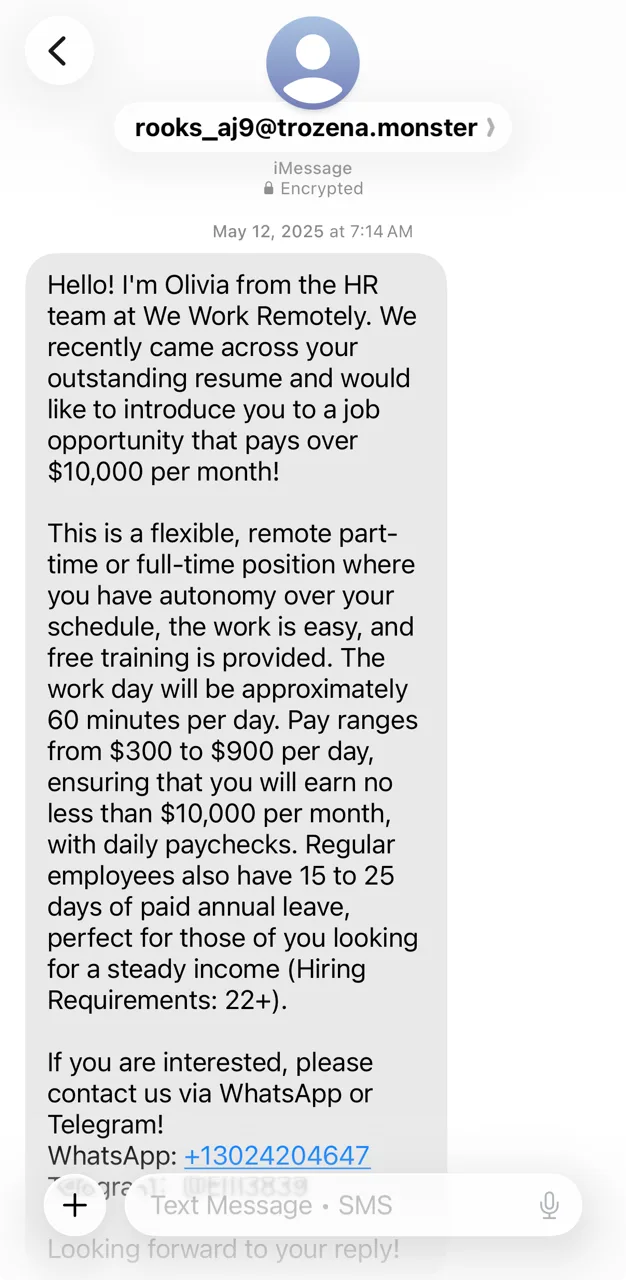
  • Employment scams: These may be as simple as a job-related phishing text or as elaborate as a fake job posting designed to steal your personal information.
  • Government scams: This usually involves a scary call, text, or email claiming you’re in trouble with the police, DMV, IRS, or another government agency or agent.
  • Post office scams: With this scam, the swindler sends you a phishing message about a missing or delayed package.
  • Money transfer scams: Scams involving payment apps come in many different forms, including someone transferring stolen money to you “by accident” or requiring digital payment for a good or service you haven’t received (and never will).
A screenshot of an employment scam text asking the recipient to apply to a fake We Work Remotely position that pays $10,000 a month

A screenshot of an employment scam text I recently received from a fake email address. Image courtesy of Brianne Sandorf, Reviews.org

For a more complete overview of the scams that have everyone fooled, check out McAfee's comprehensive list of the latest online scams.

What makes these scams so convincing

Historically, successful scams prey on strong emotions or use credible technology to create and bolster a persuasive facade. These recent swindles are no different.

If you get a call from your beloved relative saying they’re in jail, shock and fear take over. It’s hard to stop and ask yourself whether you’re being taken for a ride. Or if you’re looking for a job and get a text from an unknown number offering you one, your gut instinct may be to click now and think later.

To complicate things further, 2020s technology knows few bounds. AI technology can produce deepfake videos, copy your best friend’s voice to a T, or correct less-than-perfect English from foreign players. It can spoof phone numbers and email addresses and make robocalls convincing enough for a surface-level conversation.

With these factors at play, it’s not surprising that scammers are luring so many people in from all backgrounds and age groups.


Why younger people fall for scams

In 2025, the Pew Research Center found that 18- to 29-year-olds are more likely to lose money to online scams than the elderly (25% of these young adults versus 15% of 65+ folks). So … why? After all, younger people are more tech-savvy and less trusting. They know that the internet can be deceiving, and unlike my grandparents, they grew up in an era where people are mistrustful, suspicious, and lock their doors at night.

Of course, even younger people can be swayed by powerful emotions and convincing technology. But there’s also a degree of overconfidence involved. Younger people feel more confident in their ability to detect scams, so when they do fall, they fall hard.

How to avoid falling for these scams

The top way to protect yourself from scammers is to think before taking action.

Many scams masquerade as emergencies. The scammers want you to click a link, send payment, or provide sensitive information immediately. Pausing for even a few seconds can interrupt this momentum and let you evaluate the situation rationally instead of acting impulsively.

It’s not always easy, but if you stop and reflect, you’re less likely to fall victim to a scam. But if impulse control isn’t your strong suit, don’t despair. You can still slow your roll by remembering these tips:

  • Be wary of texts or calls from unknown numbers
  • Double- and triple-verify surprising communications from friends or family
  • Don’t buy gift cards for or send money to anyone you haven’t met in real life
  • Don’t click links unless you know for sure who’s sending them
  • If something’s off with a message but you’re not sure what, you can copy and paste the body into your search bar and add “scam”

Using these guidelines will help you avoid scammers — no matter how clever they are or what age range you’re in. And with any luck, the percentage of scam victims will start trending down.


Found this useful? Follow Reviews.org on Instagram, Facebook, LinkedIn, or catch us on YouTube

You can also add us as a preferred Google search source for the latest in tech and home services.

Brianne Sandorf
Written by
After five years with Reviews.org, Brianne can and will tell you which internet or mobile provider you should sign up for. She’s talked with internet customers across the U.S. and beyond and addresses their real-life concerns in every piece she writes. Brianne also created the ratings system for the Reviews.org internet service provider reviews and wrote most of them. Brianne channels her lifelong interest in detective work by hunting for obscure, need-to-know information about internet service providers. She’s always learning so that she can pass her knowledge on to Reviews.org readers. Her writing and expertise have appeared in numerous other publications, including Move.org, Parents.com, and the Stanford student blog. Her work for Reviews.org is also cited in a research paper about smart home assistants titled “Expert-Generated Privacy Q&A Dataset for Conversational AI and User Study Insights.” Brianne is a homegrown Utahn who loves to travel and see new places. She graduated from Westminster College with a double major in honors and creative writing. After 20 years in a 8,000-person city, she now lives in Murray, a bustling metropolis of 50,000 where she and her husband raise their two little girls.

Related Articles

A person holds a phone displaying a scam text message offering a suspicious high-paying remote job, illustrating common text message scams.
It’s Not Just Your Grandma Getting Scammed—These Texts Are Fooling Everyone
Younger people are falling for more scams than the elderly. Here’s why — and how...
Man outdoors adjusting thick black square-framed glasses while looking into the distance.
Ray-Ban Meta Glasses Are Everywhere Now: Here’s the Privacy Trade-Off
Hands-free, AI-powered smart glasses like Ray-Ban Metas are convenient and popular but raise significant privacy...
A man works on his laptop near a rain-streaked window during a storm, illustrating how weather can disrupt internet connectivity.
Why Storms Knock Out Some Internet Connections and Not Others (2026 Guide)
Does your Wi-Fi drop during heavy rain or wind? Learn exactly why you lose internet...
Illustrated woman looking at a speech bubble with the Spectrum logo and a TV icon.
Spectrum TV Review (2026): Is It Worth It?
Big channel lineup, built-in streaming apps, and no contract — but is Spectrum TV worth...