Starlink in Australia: SpaceX’s satellite internet explained

 5 min read
Whether you love him or hate him, Elon Musk sure puts his money where his mouth is. It’s a big mouth, but then again, he’s got a lot of money.
After successfully burrowing underneath Los Angeles and Las Vegas with his Boring Company’s high-speed tunnels, Musk’s extra-terrestrial venture, SpaceX, set its sights on a satellite internet solution known as Starlink. The goal? Provide satellite internet access to the entire world with thousands of small satellites in Earth’s orbit.
Understandably, many Australians are excited about the prospect of having a more reliable satellite internet solution than what the NBN's Sky Muster system currently offers.
Here's what to expect from Starlink in Australia and when you can expect it to be available in your area.
What is Starlink?

Starlink is a growing system of Low Earth Orbit (LEO) satellites launched by SpaceX to provide worldwide internet coverage.
While Starlink is a very different type of satellite and internet connection to NBN’s Sky Muster, the broad principle is generally the same. Starlink satellites in orbit communicate with transceivers on the ground and deliver a wireless signal to a terminal in your home (which plays the same role as a roof-mounted NBN dish).
Australians who rely on satellite internet are particularly excited for Starlink’s rollout because it offers unlimited data and has the potential for much faster speeds than Satellite NBN.
Starlink Australia price: How much does it cost?
Standard Starlink residential plans start at $69 per month and come with unlimited downloads and speeds of up to 100Mbps. You will have to pay an additional $19 for shipping on top of that for the self-install Starter Kit. That hardware is technically a rental as well, so if you don't return it when you cancel your plan you'll be slugged with an extra $549 in hardware fees.
As you'd expect, more expensive Starlink plans offer faster speeds. However, these higher-end plans can also come with additional hardware costs that make it significantly more costly when compared to traditional satellite NBN internet plans.
For comparison's sake, here's a short list of Basic I satellite NBN plans below, which come with 12Mbps max speeds:
And for those looking at faster speeds, here are Basic Satellite II plans:
Is Starlink better than NBN?
Starlink in Australia is better than the NBN’s Sky Muster satellite in just about every way. It is more expensive, however.
Plans sold on NBN Sky Muster only advertise speeds of 25Mbps. They do have the potential to boost higher than that but it’s subject to network capacity.
On the other hand, Starlink's residential plans offer speeds that range between 20Mbps and 100Mbps. It's more expensive plans go higher still, capping out at over 200Mbps.
Then there are the data limitations. Unlike fixed-line NBN, where almost every provider and plan has shifted to unlimited data quotas, many satellite NBN providers offer peak (7 am to 1 am) and off-peak data limits. More data is typically allocated in off-peak times to reduce the amount of congestion on the network during peak hours.
In stark contrast to a convoluted system of on-peak and off-peak data caps, Starlink currently offers unlimited data.
While Starlink can cost a little more than Satellite NBN at a baseline, the unlimited data and speeds involved may mean you’re getting more bang for your buck. It’s been a bit of a raw deal for rural Australians who need to rely on satellite NBN to run a business for some time now, so it's no surprise that many people are itching are eagerly awaiting the opportunity to take Starlink for a whirl.
If you're stuck on satellite NBN in the meantime, it's worth revisiting your bill and comparing it against the latest plans and deals. Below are the cheapest satellite NBN plans available this week.
When can I get Starlink in Australia?
Starlink is now available to deliver service Australia-wide. Anyone, anywhere in Australia can now order a Starlink plan.
Starlink was initially only able to deliver internet to "low and remote density areas", but can now also sell plans to people living in cities.
You could, theoretically, order a Starlink plan in inner-city Sydney. Musk has however previously said that Starlink will work best in low-population-density situations.
Starlink installation fees in Australia
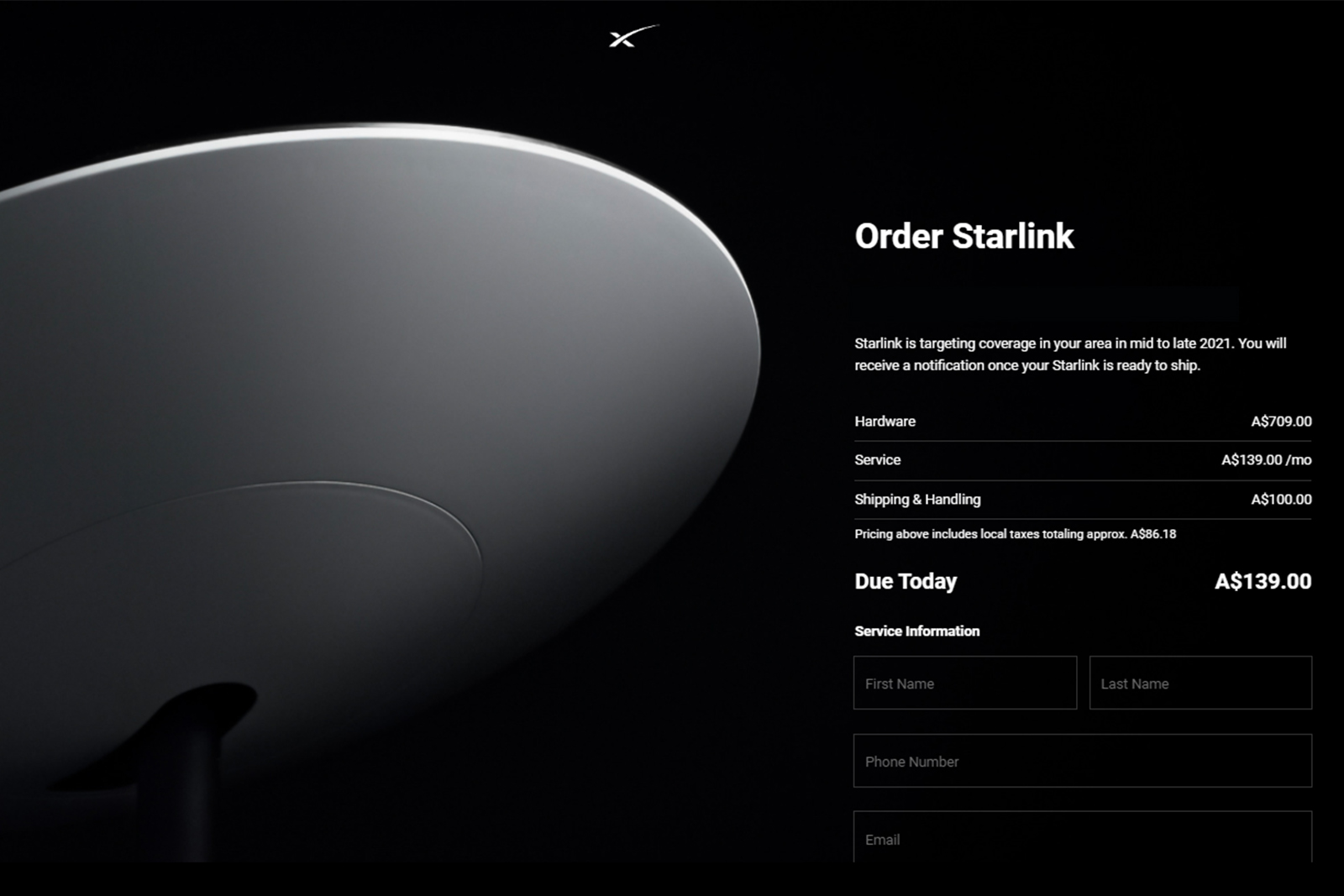
While you won't pay an installation fee for Starlink, you may need to pay $549 upfront in hardware costs and $34 in shipping fees depending the plan. This gets you all the equipment you need to get started, including a satellite dish, mounting tripod designed for ground-level usage and a Wi-Fi router.
Although many Starlink customers set up their satellite dish at ground level using the aforementioned tripod, higher elevations tend to achieve better results and opt to use a roof-mounted rack instead.
This can add to the overall cost of setting up a Starlink connection, though the sum itself isn't particularly significant and usually less than $100 (plus the cost of labor, if you have to get a contractor involved).
Some plans allow you to rent the hardware instead of buying it, which can bring down the cost significantly. In addition, Starlink may charge a one-off congestion charge of $145 when you purchase a residential plan depending on your location.
Starlink coverage in Australia
You can check out Starlink's coverage in Australia via the official Starlink coverage map.

Best Satellite Internet Plans on the NBN
There are satellite internet plans that have a good mix of value and peak data.
How fast is Starlink in Australia?
While early adopters had to rely on Starlink's own estimates when it came down download and upload speeds, the satellite internet provider is now tracked by the ACCC. As a result, it's much easier to get a sense of how the service compares to traditional NBN plans.
In the most recent Measuring Broadband Australia report, the regulator found that Starlink offered average download speeds at 215Mbps at all hours and approximately 189Mbps during peak hours. That's well ahead of what you can expect from Satellite NBN.
It's a similar story when it comes to upload speeds, with Starlink averaging 31.1Mbps during all hours and 30.6Mbps during peak hours. In any case, if you're looking to get a sense of how the cost of Starlink compares to an NBN plan with comparable speeds then you'll want to check out the widget below.
Not eligible for Starlink?



How many Starlink satellites are there?
As of March 2026, Starlink has over 10,000 satellites in orbit.
The third-party website satellitemap.space tracks the location and orbit of Starlink satellites (as well as ground transceiver locations). Below is a snapshot from the map but you can see the full interactive version here.

Starlink for Business in Australia
Starlink Priority (formerly Starlink for Business) is a more expensive alternative to a standard Starlink connection, designed for business use.
Starlink Priority offers faster download speeds of between 120Mbps and 270Mbps. Upload speeds are identical but the service does boast lower latency.
Of course, in addition to being faster, Starlink Priority is also more expensive. You're looking at $108 per month in service fees, $549 in hardware costs, and $34 in shipping.
Starlink Priority should be available in most places regular Starlink is.
Starlink Roam
Starlink Roam is also available for RV owners without a fixed location. Pricing is a little more expensive than a standard service, but you to get the option of paying for an unlimited data.
You can get a roam plan with 100GB of data for $80 per month or an unlimited data plan for $195 per month. The hardware itself usually costs $599 plus shipping. You should still get the same kind of speed as regular Starlink customers, but that performance may be reduced during peak hours.
Starlink Global Priority plans are also available for in-motion and maritime setups, though they are much more expensive. In addition to a $2,499 hardware fee for a Flat High Performance Kit they cost:
- $450 per month for 50GB of data
- $1,170 per month for 500GB of data
- $2,070 per month for 1TB of data
- $3,870 per month for 2TB of data
Starlink vs 5G Home Internet
While Starlink is competing against Satellite NBN connections for rural customers, those who aren't so remote might be able to get away with a 5G home internet connection as an alternative.
Like Starlink, 5G speeds vary based on your coverage. However, if you're in an area with good coverage, a typical 5G home internet plan will beat Starlink on both price potential and speeds.
For example, a Telstra 5G Home Internet plan offers average download speeds of around 378Mbps and upload speeds or 46Mbps. Even if Elon Musk's prediction that Starlink speeds will double in the near future proves accurate, 5G still beats it for speed at a lower monthly spend.
Check out the widget below for a round-up of cheapest 5G home internet plans.

Related Articles