
A moonshot that doesn’t quite hit that mark, but is now available on Sony's console.
Starfield (PS5) review: Big empty

 8 min read
Starfield

Platforms
PC, PS5, Xbox X/S,
Release date
7 April 2026
Reviewed on a PlayStation 5.

Pros
 Dizzying sense of scale
Immersive space combat
Novel take on New Game Plus
Dizzying sense of scale
Immersive space combat
Novel take on New Game Plus 
Cons
 Creation Engine is showing its age
Muddled loot-shooter elements
Forgettable main quest
Creation Engine is showing its age
Muddled loot-shooter elements
Forgettable main quest Bethesda Game Studios’ follow-up to Fallout 4 didn’t exactly set the world on fire when it launched back in 2023. Now, three years and several major content updates later, Starfield has made the jump over to PlayStation 5.
The list of reasons to skip the storied studios’ sprawling first-person science fiction role-playing game was a lot longer at launch than it is today, though the list of legitimate reasons to remain mad at the developer’s parent company remains quite long. In any case, this version of the game doesn’t come with any extra content or special features aside from some minor integrations with the PlayStation 5’s DualSense controller.
What you’re getting here is largely the same old Starfield with a few quality-of-life upgrades and a few pieces of DLC bundled in for good measure.
The comparisons between Bethesda’s intergalactic odyssey and something like No Man’s Sky might write themselves, but it doesn’t take too many hours of playtime to see there's a galaxy-sized gulf between the two games when it comes to their respective ambitions.
Starfield might bill itself as the next generation of open world roleplaying experiences, but it rarely ever escapes the gravity of the template laid out by Bethesda's earlier efforts and only those willing to see it through to the end will fully be able to fully appreciate the ways that it tries to complicate and converse with that familiar formula.
Set in a future where mankind has successfully colonised the rest of the solar system and beyond, Starfield initially casts you as an humble miner making a living working for one of many interstellar corporations. Soon enough, you find yourself lucky – or unlucky – enough to encounter an artifact of unknown origin and are subsequently recruited by an organisation seeking to understand the strange phenomena.
Compared to the likes of Bethesda’s Fallout or The Elder Scrolls games, the opening of Starfield is dizzyingly brisk. The narrative itself is straightforward in shape, but the speed with which it propels you to the point where you’re let loose amongst the cosmos honestly left me in a bit of a lurch. Some players might appreciate that faster pace, but it felt like I had only barely begun to understand the wider context of the world my character inhabited before I was pulled into the main plot. Perhaps it’s telling that one of the first side quests you get is to visit a museum that gives you all that missing exposition.
In any case, the meat of the meal here isn’t all that different to previous Bethesda open world RPGs. You’ll create a character – choosing their initial physical attributes, skills and background.
As you make your way through the world, overcome enemies, and find favour with the various factions that exist across the galaxy, you’ll gain experience and eventually level up. When you do, you’ll be able to improve your character across a number of axes by learning new skills and improving your existing ones. Getting higher ranks of a given skill typically requires you to meet a usage-based requirement as well.
The setup is a variation on what Bethesda has done before, though it lacks the intuitiveness of the way Elder Scrolls approached things and is nowhere near the pulpy pep associated with Fallout’s perk system. I can’t really say I hated it, but I didn’t find much to love here either. It’s simple where it should be complicated and complicated where it ought to be straightforward. As powerful as some of the passive benefits it adds are, it feels like you can honestly get away with ignoring it for a surprisingly long time – which isn’t something you can say about most RPGs, but a sentiment that applies to a surprising amount of Starfield.
As opposed to the barbarism of something like Fallout, Starfield is somewhat refreshing in that the universe it presents is one where most people ask questions before they start shooting. Even the odd group of space pirates can be talked down. In addition to giving you new dialogue options depending on your build, you can also now attempt to persuade NPCs in certain situations via a conversational minigame where you need to fill up a meter by selecting the right dialogue arguments for the situation. It’s nothing too complicated, but it does add a little bit more variety and variability to the social encounters in the game.
Unfortunately, like a lot of Starfield, the conversations themselves often come across as contrived. If you’re the kind of person who found the prospect of an adventurer taking an arrow to the knee hilarious, you probably won’t mind too much, but across the board, the writing in the game is often more functional than thrilling and more predictable than poetic.
Of course, when words fail, there’s also violence. The gunplay in Starfield feels light-years away from the clunky firearms of Fallout 3. At the same time, it’s far from the game's strongest attribute. As futuristic as some of the weaponry is, the in-game firefights lack the zing of those in Cyberpunk 2077. The sheer number of ammo types in the mix was a source of frequent frustration for me, as was the floaty melee combat – which felt like a severe step backwards from what the Skyrim-inspired Kingdom Come Deliverance had to offer.
There’s something to be said for not trying to fix something that isn’t necessarily broken. Still, when Starfield is trying so hard to sell itself as the next generation of this style of open-world role-playing game, it’s no great shock that the anachronisms eat away at the legitimacy of that promise before long. Even if the team at Bethesda Game Studios can imagine a bigger canvas, their vision for what to put on it is more limited in scope.
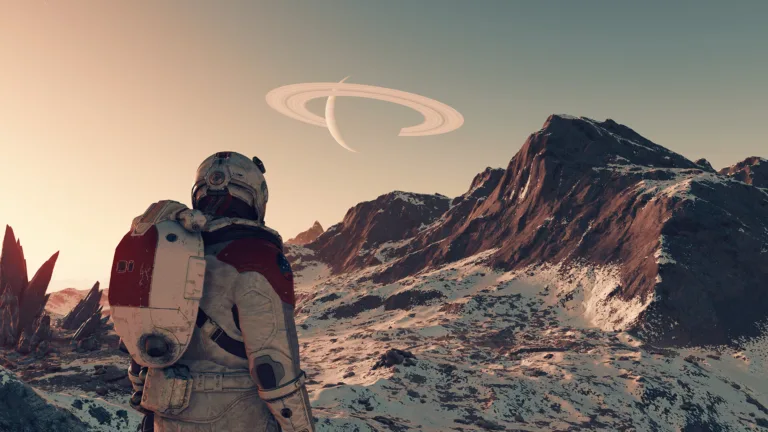
Starfield features over 1,000 explorable planets across over 100 or so star systems, though the amount that any given destination has to offer is as uneven as you’d expect. Major locations like New Atlantis and Neon have dozens of questlines to offer. Other locations might only boast a single point of interest.
Regardless of where your adventure takes you, you’ll likely pick up a few souvenirs along the way. This is one area where Starfield departs from the template somewhat. Rather than the preset distribution of items seen in something like Skyrim or Oblivion, Starfield incorporates a more modern and dynamic loot system. This works much as you’d expect, complete with colour-coded rarities, modifiers and affixes. It's almost like a loot-shooter has been stapled onto the Bethesda formula.
Unfortunately, the usual post-combat practice of vacuuming up every bit of gear off the bodies of your enemies is largely incompatible with the way that the game handles encumbrance. You can offload items to your ship’s cargo bay, but I found myself often running into frustrating restrictions about when I could or could not make use of this extra capacity. For all that Starfield promises to take the Skyrim formula into the future, the battle to balance your inventory remains just as much of a pain point.
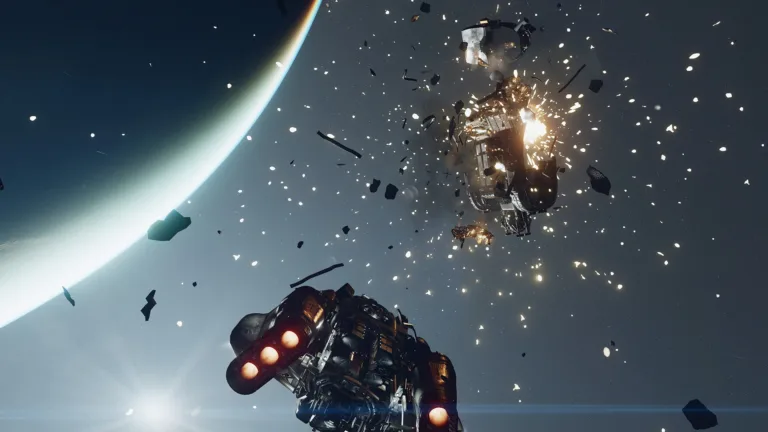
Of course, aside from scale, the other big addition to the formula Starfield brings with it is space combat. Although I loathed it initially and the ship customisation is clunkier than I’d like, I did come to enjoy this aspect of the game more over time. The basic mechanics of softening up your targets with bullets and lasers before using missiles to finish them off are easy to pick up, and engaging enough to work even as the damage gets higher.
Energy management is Bethesda’s big twist on the formula, with each ship coming with an allocation of power that can be split across its various sub-systems. If you want to go faster, just move the relevant power nodes over into your engine. Conversely, if you want your shields to hold under pressure, then you’ll probably want to divert a few pips in that direction. All told, this is a really fun wrinkle that adds a lot of colour to the game’s vision of ship-on-ship combat without necessarily getting too bogged down in the details.
All of this is to say that it doesn’t take long to get the sense that the moment-to-moment gameplay in Starfield is largely secondary to the fantasy of freedom that the experience writ large is trying to evoke. The main plot hews in the same direction. Even as the stakes get higher, this storyline just doesn’t have the gravity as the likes of Fallout 3 or The Elder Scrolls: Oblivion. More often than not, it feels like the side quest to everything else that the galaxy has to offer.
The longer I spent with Starfield, the more I began to feel like everything in the game is about servicing that fantasy of being a small pilot in a massive galaxy. Everything in the game is optimised to maximise that sense that you’re the boots on the ground.
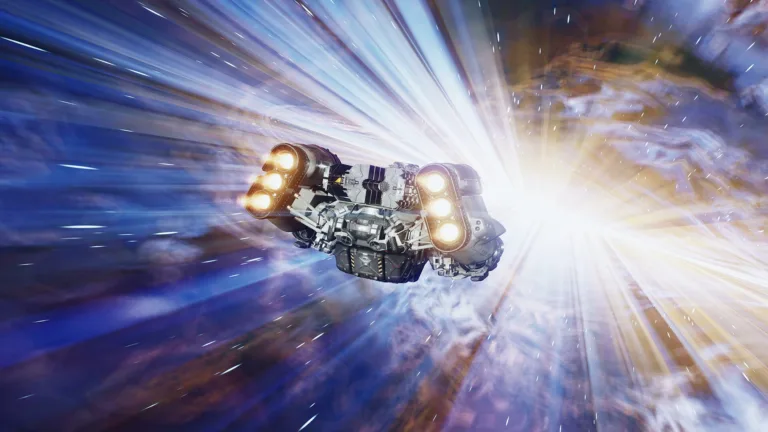
Going from one planet to another is supposed to be much more involved than just clicking on a menu. You have to go to your ship, go inside your ship, go to the cockpit, take off from the planet, fly to your destination, land on it, get up from the driver's seat and physically walk outside. Those extra steps add a lot of friction to the gameplay, but they also help cultivate a sense of motion and scale as you move through the universe.
Likewise, environments and menus are optimised towards an aesthetic more than they are legibility. I’d often have to squint and reread tooltips to understand them, and the clutter of objects that are common in a Bethesda open-world game like this one quickly became noise more than a resource that I wanted to pay attention to in much the same way that they are in real life.
That unity of purpose doesn’t necessarily make for more fun gameplay, but it does explain a lot of the friction. It isn't hard to squint and see the seams of the aging Creation Engine, but it’s easy to see what the team at Bethesda were going for. Whenever I did decide to get somewhere the long way around, I felt absolutely dwarfed by the size of the game. It feels like you're driving through a town you've never visited before using Google Maps – surrounded by streets you don’t care about but carving your own laneway to your destination.
However, in the years since Starfield originally hit shelves, Bethesda has tilted these tradeoffs in the other direction and in favour of playability over immersion. There’s a definite tension to that post-launch retconning, and I don’t even necessarily think it's the wrong approach given the feedback the studio got from fans. Nevertheless, it does radically change the nature of what sinking a few hours into Starfield looks like.
Rather than go through the motions described above, the vast majority of my time with the game involved looking at my quest log. I’d hit the fast travel button, walk to the next quest point, then open up my quest log and repeat the process over again. At a certain point, I was spending a lot more time looking at menus and loading screens than the stars – which kinda undercuts a lot of the effort that’s gone into Starfield writ large.
The path of least resistance is hard to turn down, and my desire to get the dopamine hit of seeing my in-game quest log get smaller over time easily trumps my desire to go through the rote minutiae of interstellar travel.
Is Starfield worth the money?
I don’t think going into Starfield off the back of playing The Outer Worlds 2 and Avowed earlier this year did it many favours. Bethesda’s spacefaring sci-fi RPG goes all-in on scale, for better or worse. Its lofty ambitions leave it lacking when it comes to fundamentals – though those who see the journey through to its end will likely find a lot to like in the way that Starfield recontextualises how people play these games into its own fiction.
Although the DLC in Starfield is easily one of the stronger parts of the adventure, I can’t help but doubt a sequel is on the cards. The maximalist scale of this take on the Bethesda open world RPG might come with a few fun wrinkles, but the hard limits of that novelty are easy to find. The universe here is far bigger than it probably needs to be, but all too familiar – leaving what could be a great leap into the unknown feeling like a moonshot that doesn’t quite hit that mark.


Related Articles

Telstra vs Boost Mobile: Which offers better value?
Boost on a budget.

Woolworths’ Everyday Mobile review: Perky plans
Woolworths, the Fresh Phone plan People.

The best iPhone plans available in Australia for every model
The iPhone 18 is calling.

Belong vs Telstra: Mobile plans compared
Mobile value belongs to Belong.



