Live Sports Viewership Statistics in 2026: How Americans Watch Their Favorite Sports

Trevor Wheelwright
Feb 17, 2026
Icon Time To Read5 min read
Icon CheckEdited ByKelly Huh
Icon CheckEdited ByTim Tincher

With a slew of options to keep up with your favorite teams, join fantasy leagues, and ways for the majority of US states to place gambling bets, it’s safe to say watching live sports viewership is firmly embedded in American culture.

But how we watch sports is shifting, with far more people turning to streaming over traditional TV options like cable and satellite TV. We’ll go over sports viewership statistics and costs for live and on-demand programming, as well as options for tuning into your favorite teams.

Sports viewership survey recap:

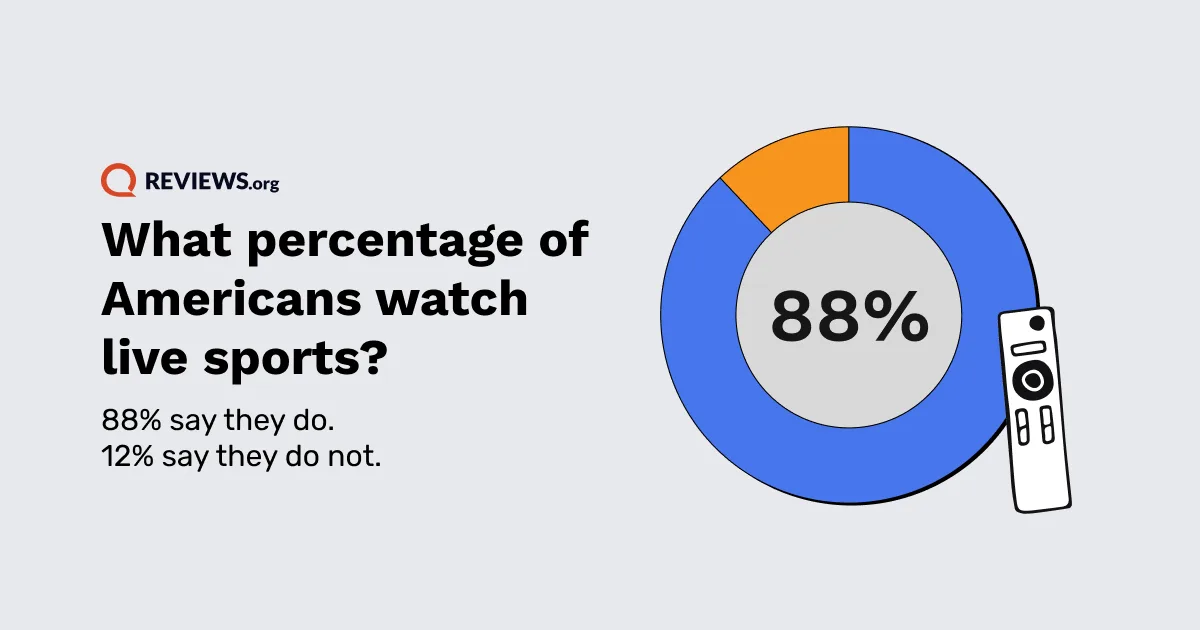
    • 88% of Americans say they watch live sports.
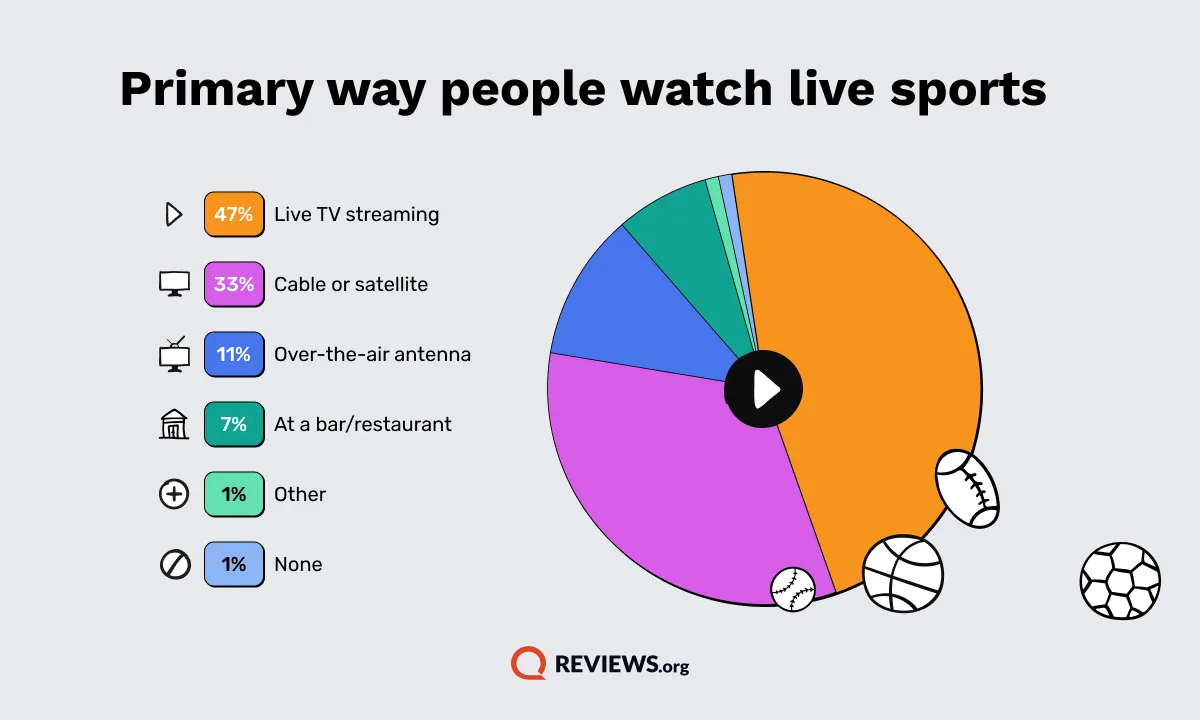
    • Live TV streaming is the primary way Americans watch live sports (47%), ahead of cable/satellite (33%).
    • Traditional pay TV services remain a major expense: estimated average monthly cost is $79.80 for a primary TV service (cable/satellite/live TV streaming).
    • Standalone sports apps add to the spending: estimated average monthly cost is $43.14 for standalone sports apps (Peacock, ESPN, NFL+, etc.).
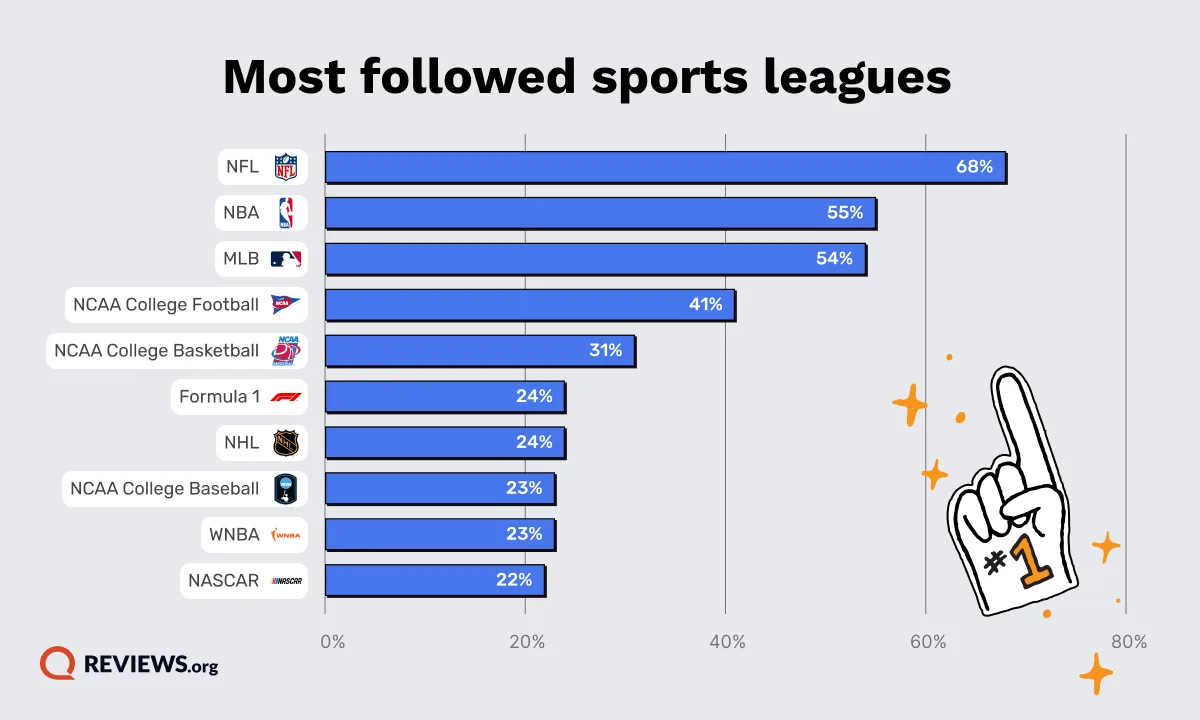
    • The most-watched sports: NFL (68%) is the most-followed league, followed by NBA (55%) and MLB (54%).
    • Top on-demand platforms used for sports: Amazon Prime Video (57%), ESPN (44%), Hulu (41%), and Peacock (38%).

What percentage of Americans watch live sports? (2026)

New survey results from Reviews.org reveal that 88% of Americans watch live sports, leaving just over 12% that do not.

Though some may gather at home to catch the big game, or frequent chicken wing restaurants and sports bars, fans are far more often willing to pay to keep the action close at home on their living room TV, or on their phone.

How much do people spend each month to watch sports?

It’s estimated that the total monthly spend for live sports is roughly $122.93 per household, per month — and that breaks down to an average of $79.80 per month for traditional pay TV and an extra $43.13 per month for on-demand streaming.

Traditional pay TV service is the main cost driver at an average of $79.80 per month. The majority of folks don’t pay quite that much, but some people pay nearly twice that price:

  • 34% pay $26–$75 per month
  • 21% pay $76–125 per month
  • 9% pay $126+ per month

Meanwhile, standalone sports apps are a smaller cost add-on for most, with an average of $43.14 per month:

  • 29% pay spend $0, or don’t use sports apps at all
  • 33% pay $1–$25 per month
  • 4% pay over $126 per month

The majority of Americans (84%) spend money for their primary TV service, and 71% also pay for standalone sports apps. So while traditional TV takes up the bulk of spending, streaming options offer a way for folks to specialize their viewership and ensure they’re in control of what events they want to see.

How do Americans primarily watch live sports? streaming vs. cable

Though people may spend more on traditional TV services, nearly half (47%) of viewers tune in to live TV streaming from online applications like Sling TV or Hulu + Live TV to watch their favorite teams, whereas only about a third (33%) rely on traditional TV services.

Not to be overlooked: Over-the-air (OTA) antennas remain a great, inexpensive option that 11% of sports viewers regularly lean on.

Still, it’s apparent that people are increasingly turning to streaming for watching live sports because they can customize their options to keep up with their favorite teams and leagues without overpaying for add-ons and extra channels.

Answer
Stratified Answers (%)
Via over-the-air antenna (free broadcast channels)10.6%
"Via cable or satellite TV (Xfinity, Spectrum, DIRECTV, Dish, etc.)"32.9%
"Via live TV streaming (Sling, Hulu Live TV, YouTube TV, etc.)"47.1%
At a bar/restaurant/gym/etc.7.3%
None of the above1.0%
Other1.0%

And while it’s always great to get out with friends, the cost of wings and drinks may be a bit of a barrier for relying on bars and restaurants as a main source of viewership — only 7% of fans watch their favorite sports teams this way.

How to watch live sports

Live TV Streaming: The best live TV streaming services for sports are YouTube TV, Hulu + Live TV, Sling, fuboTV, and others. These are an easy “cable replacement” for live sports because they bundle major sports channels, and often include regional sports networks (RSNs) too. In addition to having live functionality, many of these services also offer on-demand options for those who don’t want to miss the action but can’t quite fit it into their schedule as is, and would like to see more than the highlights.

Watch without cable or satellite service: With a budget-friendly price and a quick DIY setup, you can pair an over-the-air antenna for local broadcast games, and use a live TV streaming service (mentioned above) for cable sports channels.

Keeping up with every NFL game: Check out our NFL viewing guide that covers everything from the big broadcast networks, streaming services like NFL Redzone, and NFL Sunday Ticket.

 Watch ESPN without needing cable: You can catch all the highlights and commentary on ESPN without a cable subscription.

Live TV streaming services for NFL games
Provider
Monthly price
Available channels
Learn more
Fubo TV
$14.99-$94.99183–259
YouTubeTV
$82.99/mo.*100+
Hulu
$88.99-$88.9975
Directv stream correct logo (2023)
$84.99-$169.9990-205
Offers and availability vary by location and are subject to change. Data verified as of the article's publication date.
* Compatible device and internet connection required. Offers and availability may vary by location and are subject to change.
Plus taxes. Req's purchase of Device. New customers only.

The most-followed sports leagues in the U.S. (2026)

The NFL, NBA, and MLB dominate the top spots for sports leagues, with over half of Americans following the action via streaming and traditional TV services. The NFL takes the lion’s share (67.88%) of this viewership, making it the most-watched sport in the U.S.

The NBA (55%) and MLB (54%) aren’t too far behind — capturing over half of America’s attention — and the NCAA College Football league trails at 41% of sports viewers. NCAA College basketball for men and women’s leagues take a combined 31%.

Beyond that, less than a quarter of Americans follow sports like F1 racing, NHL hockey, NCAA baseball, and the WNBA.

Top 10 Most-Followed Sports Leagues

Answer
Stratified Respondents (%)
Football — National Football League (NFL)67.88%
Basketball — National Basketball Association (NBA)55.29%
Baseball — Major League Baseball (MLB)53.67%
Football — NCAA College Football41.11%
Basketball — NCAA College Basketball (men's and women's)31.06%
Auto racing — Formula 1 (F1)24.34%
Hockey — National Hockey League (NHL)23.67%
Baseball — NCAA College Baseball23.48%
Basketball — Women's National Basketball Association (WNBA)22.64%
Auto racing — NASCAR21.68%
Combat sports — Ultimate Fighting Championship (UFC)19.31%
Soccer — Major League Soccer (MLS)17.48%
Basketball — NBA G League17.00%
Auto racing — IndyCar Series (IndyCar)16.68%
Golf — Professional Golfers' Association (PGA)13.50%
Combat sports — World Wrestling Entertainment (WWE)12.94%
Combat sports — All Elite Wrestling (AEW)11.19%
Tennis — Association of Tennis Professionals (ATP)10.59%
Combat sports — World Boxing Association (WBA)10.51%
Auto racing — Motorcycle Grand Prix (MotoGP)10.25%
Combat sports — International Boxing Federation (IBF)10.22%
Track and field — NCAA College Track and Field10.07%
Tennis — Women's Tennis Association (WTA)9.89%
Combat sports — World Boxing Council (WBC)9.74%
Combat sports — World Boxing Organization (WBO)9.71%
Combat sports — Bellator Mixed Martial Arts (Bellator MMA)9.71%
Volleyball — NCAA College Volleyball (Indoor and Beach)8.22%
Gymnastics — NCAA College Gymnastics (men's and women's)8.21%
Skiing — U.S. Ski & Snowboard7.33%
Soccer — United Soccer League (USL)7.29%
Combat sports — NCAA College Wrestling7.08%
Soccer — NCAA College Soccer (men's and women's)7.05%
Football — Canadian Football League (CFL)6.96%
Soccer — National Women's Soccer League (NWSL)6.84%
Tennis — NCAA College Tennis (men's and women's)6.79%
Hockey — NCAA College Field Hockey6.70%
Bowling — Professional Bowlers Association (PBA)6.69%
Combat sports — Professional Fighters League (PFL)6.49%
Golf — NCAA College Golf (men's and women's)6.08%
Golf — Ladies Professional Golf Association (LPGA)5.84%
Swimming and diving — NCAA College Swimming and Diving5.82%
Bowling — NCAA College Bowling5.77%
Hockey — NCAA College Ice Hockey (men's and women's)5.41%
Softball — NCAA College Softball5.23%
Lacrosse — NCAA College Lacrosse (men's and women's)4.14%

Let’s break down why these services appeal to sports fans:

Amazon Prime Video: Most people turn to Amazon Prime Video for sports, along with everything else (shows, movies, events, etc) the service offers. And if you want to watch Thursday Night Football, Amazon Prime Video is your best bet, though you may be able to catch local games on local stations. APV also has marquee live sports inventory, along with sports add-ons depending on the season.

ESPN: A common go-to for sports fans who want access to ESPN’s streaming catalog, along with select live events. It includes everything from tennis to rugby to horse racing, so you can get your fill of just about anything sports-related that you find interesting.

NBC Peacock and Paramount+: Some events are platform-exclusive and tied to NBC and CBS’s broader sports coverage, such as Peacock’s college-level Big Ten Saturday Night football package, the NFL Wild Card playoff game, English Premier League soccer matches, and more. Paramount+ provides access to things like UFC events like Fight Nights and fights that used to be traditional pay-per-view events, PGA Tour and golf coverage, and international soccer events.

Apple TV+: With Apple’s sports programming, you can get Live Major League Baseball games on Friday Nights, global Major League Soccer matches, and it’s the exclusive US home for Formula 1 racing.

Info Box

Do you need a helpful, one-stop comparison for all these sports packages and channels? Check out our guides:

Why watching live sports feels harder right now

When asked about the barriers to watching sports, fans say they are fatigued with costly choices, which makes them feel like they’re missing out.

Cost is the dominant barrier to watching sports live. Nearly 75% of people agree that live sports are becoming too expensive to follow their favorite teams and leagues (including 53% who strongly agree or agree).

In addition, 45% say they struggle to find which channel or streaming service a specific game is on, and 53% report missing a game they wanted to watch because they didn’t have the right subscription. All of this leads to a sizable 27% of fans saying they’ve turned to unauthorized broadcasts to get their sports fix.

Fan sentiment on live sports viewership

Statement
(%) Who say they agree*
It is becoming too expensive to watch teams/leagues I follow52.70%
I have missed a game because I didn’t have the right subscription53.30%
I struggle to find which channel or service a game is on44.90%
Streaming picture quality is worse than cable/satellite34%
I regularly use unauthorized streams because of cost/difficulty26.60%

*Total Agreement represents respondents who answered "Strongly Agree" or "Agree."

It’s worth noting that buffering and resolution issues still plague sports streaming, driving nearly half of fans to stick with the reliability of cable or satellite. Thus, it’s important to ensure that you have a great internet connection or solid cell phone service to avoid these unwanted viewing issues.

Overall, it’s a great time to be alive as a sports fan, with more than enough options to catch the majority — if not all — of your favorite teams, leagues, and events. Whether you’re trying to top the fantasy leagues, make a few bucks off a big bet, or simply root for the home team, you can tailor your TV and streaming services to match your level of fandom.


Methodology

reviews.org logo png

Methodology

In January 2026, we surveyed 1,000 U.S. adults using stratified sampling to ensure a nationally representative sample. This report focuses on the 882 respondents who identify as active sports viewers. Costs are based on self-reported monthly spending, and percentages are rounded to whole numbers in the written text, and to the nearest hundredth in tables.

Trevor Wheelwright
Written by
Trevor’s written about YMYL (your money, your life) topics for over six years across editorial publications and retail/eCommerce sites. His work’s been featured on Forbes, RealSimple, USA Today, MSN, BusinessInsider, Entrepreneur, PCMag, and CNN. When he’s not researching and writing, you can find him around Salt Lake City, Utah, snapping photos of mountains and architecture or seeking out some good tunes and friendly faces.

Related Articles

Spectrum Internet Plans and Deals
Find the latest Spectrum Internet deals, prices, and plans to get high-speed internet in your...
Metronet Internet Plans and Deals
Sign up for one of Metro’s fiber internet plans today.
Fidium Internet Plans and Deals
Sign up for one of Fidium Fiber’s internet plans today.
Live Sports Viewership Statistics in 2026: How Americans Watch Their Favorite Sports
How do Americans watch their favorite sports? We asked and they answered with over half...