
The data shows that T-Mobile has the biggest and fastest 5G network—personal experience backs that up
5G Speeds in 2026: Which Carrier Is the Fastest?

 3 min read
 Edited ByBrenna Elieson
It’s 2026, and more than 90% of the U.S. population lives in areas with good 5G coverage. That means more reliable connections and faster data speeds. But the three major mobile networks are not the same.
Third-party data shows that T-Mobile has the largest and fastest 5G network in the country, beating out AT&T and Verizon. My personal experience backs this up. When I perform a mobile speed test from my office in a relatively rural part of New England, I’m pulling 521 Mbps download speeds. That’s faster than the cable internet I have at home!
I’ll go over everything you need to know about rankings, but here’s a brief overview of where the three networks stand.
- T-Mobile: Still dominating the scoreboard with 95% 5G availability and ~309 Mbps median download speed.
- Verizon: Boasts the best reliability and video performance, and unparalleled speeds in areas with 5G Ultra Wideband coverage.
- AT&T: Decent all-around performance for both 5G speeds (~172 Mbps) and availability. Last year, AT&T spent $23 billion to acquire more low-mid band spectrum, suggesting that speeds will only go up.
The 2026 leaderboard
For its latest Speedtest Award, Ookla tested the three major U.S. mobile networks. Drawing from millions of individual speed tests, Ookla evaluated various metrics, including “loaded latency” (which means testing your data speeds while the network is busy), to determine median download and upload speeds.
T-Mobile is the fastest 5G network in 2026, with the top download and upload speeds (309.41 Mbps and 13.57 Mbps, respectively).
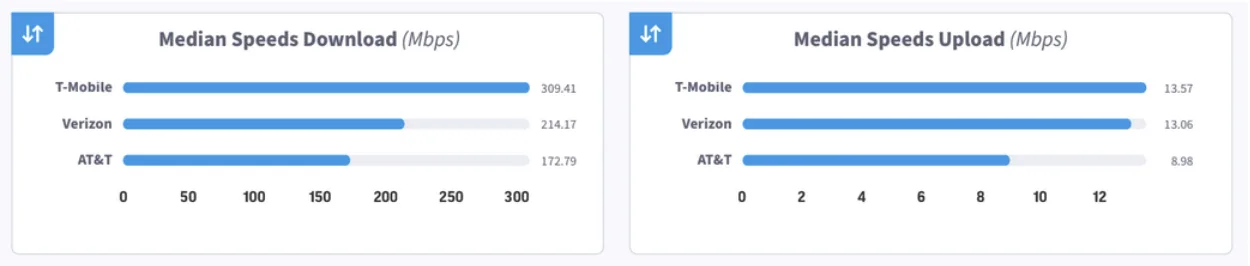
Ookla Speedtest Award showing T-Mobile with fastest download speeds followed by Verizon and AT&T. Image from Ookla.
Median download speeds: T-Mobile (309.41 Mbps), Verizon (214.17 Mbps), AT&T (172.79 Mbps)
Median upload speeds: T-Mobile (13.57 Mbps), Verizon (13.06 Mbps), AT&T (8.98 Mbps)
OpenSignal also tracks the performance of mobile networks in the United States. In its most recent Mobile Experience Awards, T-Mobile cleaned up, winning 12 of 16 categories.
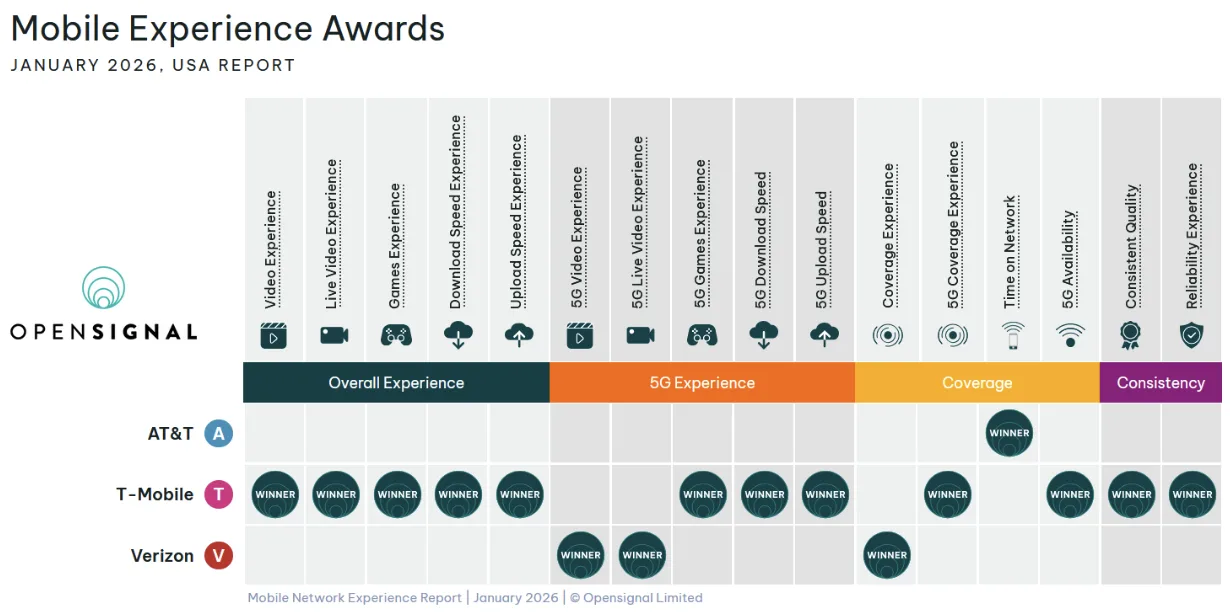
The OpenSignal 2026 Mobile Experience Award compares AT&T, T-Mobile, and Verizon against overall experience, 5G experience, coverage, and consistency. Image from OpenSignal.
T-Mobile won in the following categories: Video Experience, Live Video Experience, Games Experience, Download Speed Experience, Upload Speed Experience, 5G Games Experience, 5G Download Speed, 5G Upload Speed, 5G Coverage Experience, 5G Availability, Consistent Quality, and Reliability Experience.
Verizon won in the following categories: 5G Video Experience, 5G Live Video Experience, and Coverage Experience.
AT&T won the Time on Network category.
5G Standalone (SA) vs. Non-Standalone
For many years, the term “5G” was thrown around haphazardly. Companies would use it to describe mobile networks that were just built on top of older, slower 4G networks (this was called the 4G crutch). However, these days, the real standard for 5G is called 5G standalone (or 5G SA).
Essentially, 5G standalone networks are better because they operate on newer infrastructure that was built for the task.
Some of the 5G standalone performance benefits include:
- Significantly lower latency: This is essential for online gaming and certain augmented reality features.
- Better device battery life: Devices don’t need to connect to both 5G and 4G networks at the same time with 5G SA, saving battery life.
- Improved upload speeds
- Better built-in security features
Both T-Mobile and Verizon have made particularly strong progress in expanding 5G SA coverage. As you can see from this test I did on T-Mobile’s 5G network, the download speed is an insane 521 Mbps with a latency of just 21 ms. At those speeds, it’s an ideal home internet solution.
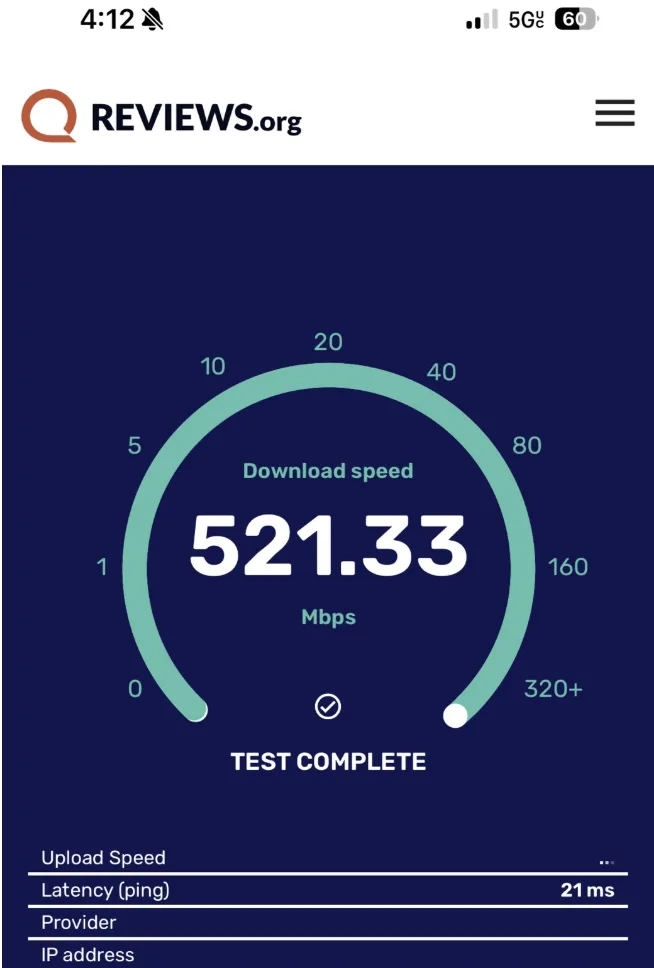
T-Mobile 5G speed test, taken on an iPhone 17 on the afternoon of March 10, 2026. Image courtesy of Reviews.org.
Why your 5G might feel slow
There are several reasons why your 5G speeds might seem sluggish in 2026.
- Network: If you're on a non-standalone 5G network, speeds may fall short of the results above. You may see higher speeds in a different area or if your provider upgrades its network.
- Congestion: Even in areas with good 5G coverage, carriers can throttle speeds during high-traffic periods. That’s why Ookla’s loaded latency speed data above is helpful.
- Indoor penetration: While cell phone signals can usually travel through walls just fine, wide-band 5G signals (which use shorter, higher-frequency waves) can struggle. This is especially true for certain types of material, like metal, thick concrete, and brick.
- Device limitations: Not all 5G phones are created equal. Some older devices have chips that can’t handle the latest frequency bands in 2026. Maybe it’s time for an upgrade.
FAQ
Speeds above 100 Mbps are considered standard for 5G. If you are getting anything above 300 Mbps, you’re really cooking with gas.
While 5G SA doesn’t primarily affect download speeds, it can greatly improve latency (which is important for gaming and other activities), boost upload speeds, and improve your device’s battery life.
In many urban areas (and even some suburban areas), 5G speeds are now faster than those offered by cable internet. Just see the speed test from my T-Mobile phone above, which is about 200 Mbps faster than my home internet.

Related Articles

Back-to-School Internet: A 2026 Buyer’s Checklist for Households with Remote Learners
Going back to school? You’ll need internet with at least 100Mbps download and 20Mbps upload...

How Waiting One More Year to Upgrade Could Save You Hundreds
Save money by waiting until it is absolutely necessary to upgrade your smartphone.

I Found the Cheapest Cell Phone Plan and Internet Combo for College Students
Tuition and rent eat up most of your paycheck in college. Save a few dollars...

I Used AirPods for 5 Years — Here’s What I Wish I Knew Before Buying
If you’re in the market for a new pair of AirPods, here’s what you need...



 Your Privacy Choices
