AT&T Overhauled Its Unlimited Plans—Is It Actually a Better Deal?

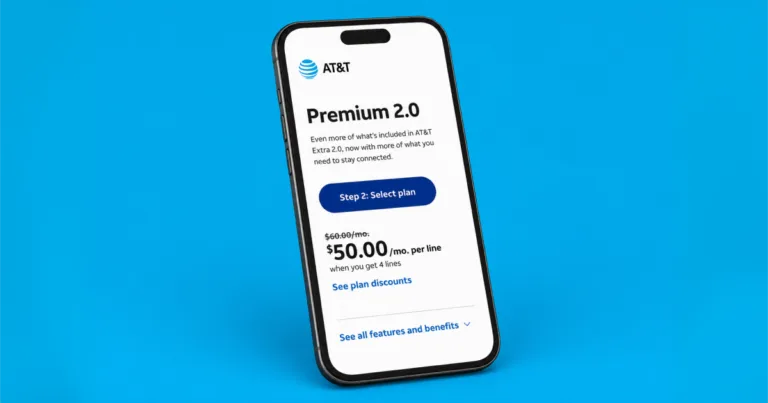
AT&T Premium 2.0 plan displayed on an iPhone screen showing $50.00 per month per line when you get 4 lines.

AT&T's Premium 2.0 plan starts at $50/mo. per line for 4 lines, down from the regular $60/mo. price.

// What AT&T's new plans cost before and after the fine print.
Benjamin Lee
May 30, 2026
Icon Time To Read6 min read
Icon CheckEdited ByBrenna Elieson

Halfway through 2026, we have to consider how the state of the economy will affect what we pay for cell service every month. AT&T’s newly revamped unlimited plan lineup offers four new tiers based on how much data you need or are willing to pay for.

At a quick glance, the new unlimited plans seem to be enticing deals. As an AT&T customer for the past four years, I could downgrade to save money or upgrade for more data, so I took a closer look at whether these new plans are actually worth it.

Here's what AT&T actually changed

AT&T's new unlimited plans are Value 2.0, Extra 2.0, Premium 2.0, and Elite 2.0. Although each tier progressively adds more perks, they all include unlimited talk and text in the U.S., Canada, and Mexico; 5G; and AT&T ActiveArmor. You can also include non-cellular devices on each tier: $20.99/mo. per tablet, $20.99/mo. per camera, and $10.99/mo. per wearable.

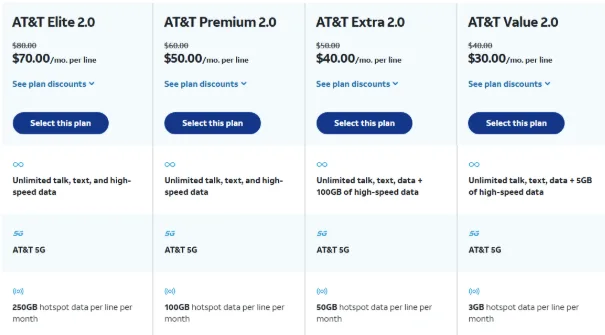
The lowest tier is Value 2.0 at $50/mo. for one line. It offers the bare minimum: 5GB of high-speed data, 3GB of hotspot, and standard-definition streaming. It essentially replaces the older entry-level plans, Starter SL, priced at $65/mo., and Value Plus VL, priced at $50.99/mo. Not only is Value 2.0 cheaper, but it also has more to offer. Among the previous unlimited plans, Starter SL includes only basic AT&T ActiveArmor, while all 2.0 plans include the advanced version. Each 2.0 plan offers hotspot data, while Value Plus VL does not.

The next tier is Extra 2.0 at $70/mo. for one line. Similar to Value 2.0, this tier is limited to standard-definition streaming and restricts data to your phone — connected devices like tablets and wearables aren’t included. However, this upgrade does have a significant boost: 100GB of high-speed data, 50GB of hotspot, and the option to include AT&T Turbo for $7.00/mo. The way I see it, Value 2.0 and Extra 2.0 are both budget-friendly tiers with Value 2.0 offering a smidgen of mobile data and Extra 2.0 offering … extra. Overall, these tiers are more affordable and offer a higher data threshold than their predecessors.

At $90/mo. for one line, we have Premium 2.0, which — as you may guess — is where the perks get lavish. You get unlimited high-speed data, 100GB of hotspot, 4K UHD streaming, and 50% off connectivity for additional devices per line. Similar to Extra 2.0, you can also add AT&T Turbo for the same $7 monthly fee. Premium 2.0 also extends its data to 20 Latin American countries. Compared to the previous Unlimited Premium PL, Premium 2.0 is costlier, rising from $85 to $90. However, the data and perks make it worth the price. For someone like me who prefers Wi-Fi over data, this is more than enough.

Finally, we have Elite 2.0 at $110/mo. for one line. It includes everything you get with Premium 2.0 plus some additional perks: 250GB of hotspot, free connectivity for one tablet and one watch per line, AT&T Turbo, and 20GB of data in over 210 international locations. While Premium 2.0 is already top-tier, Elite 2.0 gives you the VIP treatment.

AT&T's website comparing the 4 2.0 unlimited plan tiers — Value, Extra, Premium, and Elite — showing pricing, hotspot data, and 5G availability for each.

AT&T's 2.0 unlimited plans range from $30–$70/mo. per line with discounts applied. I compared each tier firsthand to break down what you're actually getting. Image by Benjamin Lee, Reviews.org

The part AT&T buries in the fine print

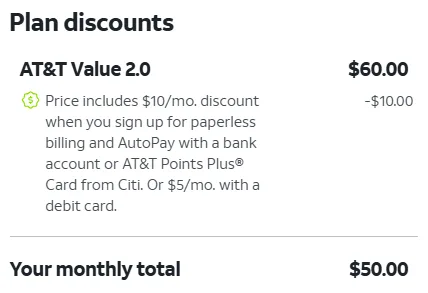
The AT&T website can be misleading at first glance, showing discounted prices for the unlimited plans. Looking at Value 2.0, for example, the website will display the price at $30/mo. per line. However, that rate only applies if you have four lines. The per-line breakdown only appears once you click into the plan. Even then, the advertised costs we see include a discount; you need to enroll in Autopay and paperless billing to get these rates.

An image showing how AT&T Value 2.0 is only priced at $50 per line if you sign up for paperless billing and Autopay.

AT&T offers discounts for teachers and medical professionals. Originally, discounts went up to 25%. Unfortunately, users report that discount caps have decreased to 20%, with many stating that they received an insignificant discount.

Each plan tier has a set hotspot data allotment. Once the threshold is met, data speed will drop to 128Kbps. This poses an issue, especially for Value 2.0. With the old Starter SL plan, my hotspot goes up to 5GB per month. A weekend trip to my favorite theme park is enough to use up that data and slow me down. While Value 2.0 is tempting on price, the 3GB hotspot cap is a real limitation.

Which plan is actually worth it—and which ones aren't

Value 2.0 is the most affordable but is unfit for travel. It’s best for light data users who prefer Wi-Fi connections, like remote workers and homebodies. Upgrading to Extra 2.0 increases the data threshold, making it suitable for short business trips and weekend getaways.

The frequent traveler is the perfect customer for Premium 2.0. With unlimited high-speed internet and 100GB of hotspot, you can enjoy a decent connection while in transit for long distances. I would personally benefit from Premium 2.0 as someone who often goes on spontaneous road trips and passes the time playing games on my phone.

Elite 2.0 is definitely excessive for the casual data user. With access to the fullest extent of AT&T’s international range, it is perfect for the traveling businessperson or nomad. Interestingly, Elite 2.0 also appeals to intensive gamers who take advantage of the free AT&T Turbo, the unlimited prioritized data intended to reduce lag, and 4K resolution.

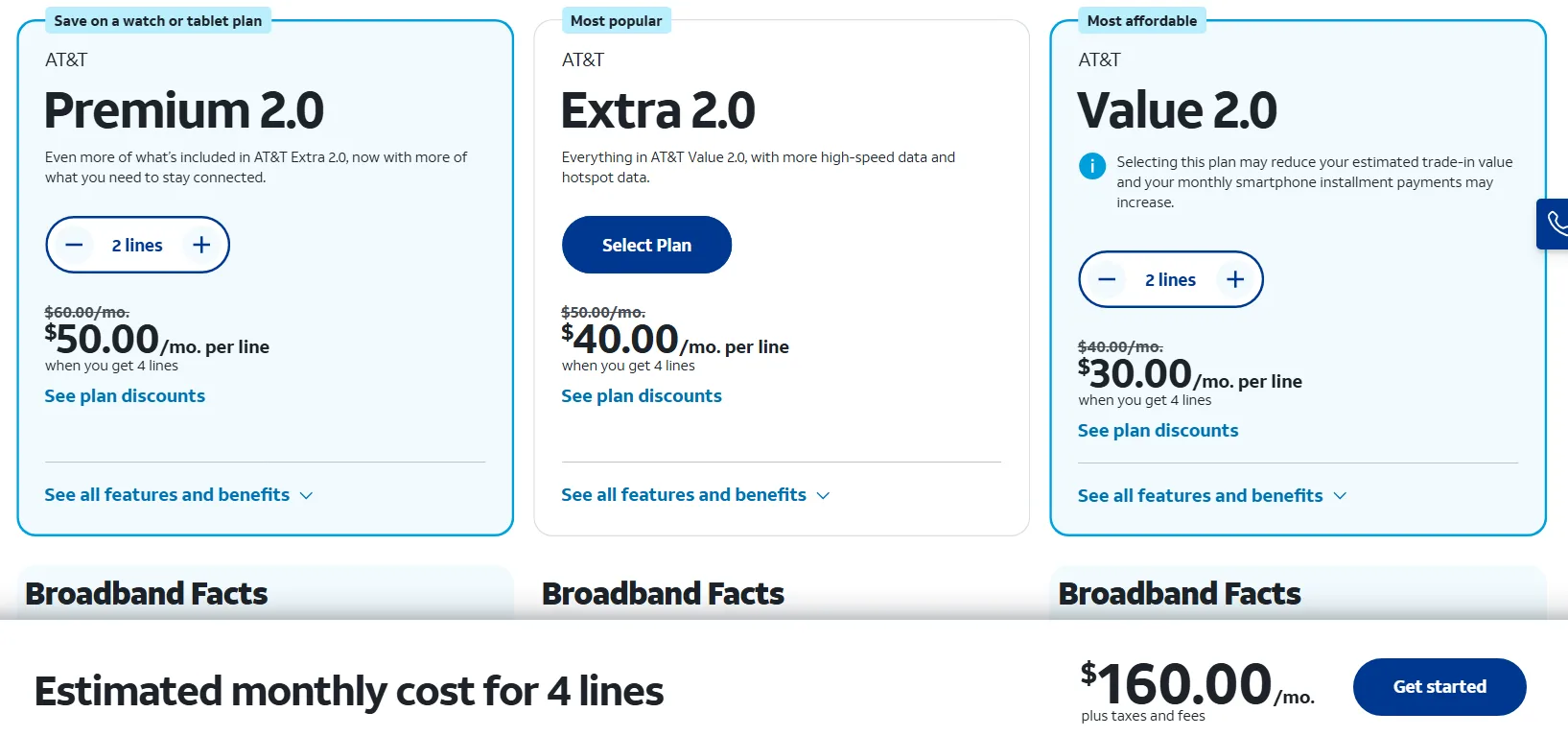
Overall, all AT&T unlimited plans are suitable for families. Just like the previous unlimited plans, the more lines you add, the lower the price. A frugal family would benefit from having four lines of Value 2.0, costing only $30/mo. per line. AT&T multi-line accounts are versatile, too, allowing you to mix and match different tiers. For example, you can have two lines of Premium 2.0 for $50/mo. each and two lines of Value 2.0 for $30/mo. each, totaling $160/mo.

An image showing how much your monthly payment will be if you combine 2 lines of Premium 2.0 and Value 2.0, totaling $160/mo.

With AT&T, users can combine different plan tiers to make a family plan that is suitable for your budget and data needs. Image by Benjamin Lee, Reviews.org

While these plans may be appealing to some, they may repel others. A single person who requires a large amount of data may be deterred by the cost of a single line, while a nomad who spends their life and money on traveling wouldn’t mind relying on a $110/mo. unlimited plan.

How AT&T's new plans stack up against T-Mobile and Verizon

Compared to Verizon, AT&T holds its own on hotspot data but falls short on streaming bundles. Comparing entry-level tiers, AT&T Value 2.0 offers 3GB while Verizon Unlimited Welcome doesn’t offer any at all. Verizon’s highest tier, Unlimited Ultimate, advertises unlimited hotspot but caps at 200GB before slowing speeds to 6Mbps. You would need to get AT&T Elite 2.0 to beat Verizon with 250GB of hotspot. Elite 2.0 runs $110/mo. for one line, compared to Verizon Unlimited Ultimate at $85/mo. for one line. In terms of streaming bundles, Verizon excels by offering add-ons for Disney+, Hulu, ESPN+, Netflix, HBO Max (with ads), YouTube Premium, Apple One, and Fox One.

T-Mobile’s bare-bones tier, Essentials, has its hotspot capped at 3G (600Kbps) speed. Its highest tier, Experience Beyond, advertises unlimited hotspot but really caps at 250GB before slowing to 600Kbps. This matches Elite 2.0’s 250GB, but T-Mobile’s is $10 less — $100/mo. for one line as opposed to Elite’s $110/mo. Additionally, T-Mobile offers more value by including Netflix Standard with ads, Apple TV+, and Hulu. As someone who had T-Mobile before AT&T, I remember its high-speed data being faster than what I currently get from AT&T — I imagine T-Mobile’s data today would beat out AT&T’s 2.0 plans as well.

Based on these differences, Verizon and T-Mobile would likely better suit those who use their data primarily for streaming.

Already an AT&T customer? Here's what to do next

For those on a previous AT&T unlimited plan, you might notice you were not automatically migrated to a new plan. As an existing customer, you have the choice to upgrade or stay with your current one, even if it is retired.

Staying with your current plan will come with a price hike. According to AT&T, select retired unlimited plans active prior to July 24, 2025, will increase by $10/mo. for a single line, or $20/mo. total for multiple lines — not $20 per line. This includes legacy plans like AT&T Unlimited Plus and Unlimited Choice, as well as Unlimited Your Way plans like Starter SL, Extra EL, and Premium PL.

Switching to a 2.0 unlimited plan will also have its drawbacks. As you may guess, once you switch, there’s no going back. When activating a new line on a new plan, expect a fee of up to $50 per line and potentially prorated bills when switching.

I’ve personally done the math and decided to stick with Starter SL. The overall cost and the provided benefits are perfect for my nestled lifestyle with the occasional adventurous stride. As the expression goes: “If it ain’t broke, don’t fix it.” But of course, AT&T’s new unlimited plans can be suitable for your own lifestyle.

If you would like to have a full breakdown of AT&T as a carrier to help you decide if it is worth sticking to the new unlimited plans, check out our in-depth review.

Benjamin Lee
Written by
Benjamin Lee doesn’t just strive to write, he strives to perfect. His writing style is informative and straightforward, with a dash of fun here and there. Starting out as a journalism major, he immersed himself in pop culture and media to write about the latest trends. As he journeyed through his career path, he realized just how much technology (from abundant streaming services to exciting apps) has entered the zeitgeist. He knew that writing in this field was his path.

Related Articles

AT&T Premium 2.0 plan displayed on an iPhone screen showing $50.00 per month per line when you get 4 lines.
AT&T Overhauled Its Unlimited Plans—Is It Actually a Better Deal?
AT&T overhauled its unlimited plans in 2026. As a 4-year AT&T customer, I broke down...
My DIRECTV Streaming Review (2026): Watch Almost Anything, Anytime
DIRECTV streaming brings my family live TV, DVR services, and a Netflix-like library, all rolled...
Rotating services by season, grabbing day passes, skipping cable — I tested every option so you know exactly where to spend (and save). See my picks.
Best Sports Streaming Services in 2026: My Top Picks For All Sports Fans
Rotating services by season, grabbing day passes, skipping cable — I tested every option so...
Two illustrated people enjoying movies with popcorn and a drink, surrounded by streaming service logos including Netflix, Disney+, and HBO Max.
Best Streaming Services for Movie Lovers (2026): Top Movie Subscription Services Ranked
Compare the best streaming services for movie lovers in 2026, with details on subscription prices,...