
Should Internet and Mobile Outages Come With Automatic Credits? Most Americans Say Yes

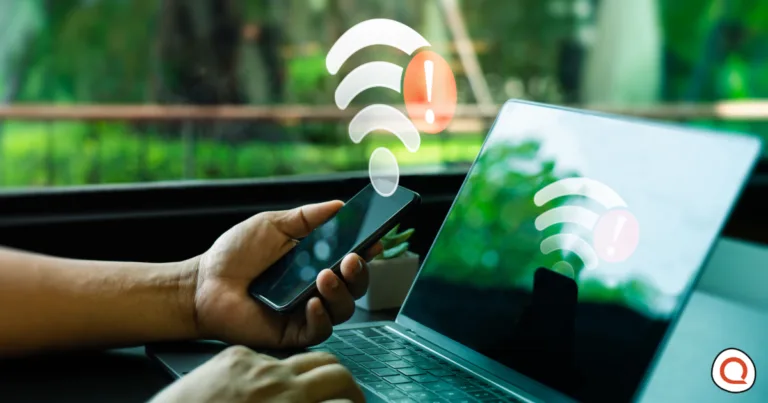
Person using smartphone and laptop showing Wi-Fi outage warning symbols during internet connection disruption

Internet outages can disrupt work and daily life—many consumers say service providers should automatically apply bill credits when disruptions occur. Image credit: iStock/Shutthiphong Chandaeng

// Recent outages? 54% say automatic bill credits should kick in after 1 hour.
Trevor Wheelwright
May 03, 2026
Icon Time To Read3 min read
Icon CheckEdited ByBrenna Elieson

Imagine you're working on a big project online when suddenly, you can't pull up your documents, reference pages, or email for the next few hours, or maybe even the next day — all due to your internet not working. That’s real money, time, and energy lost.

So you request an internet outage refund, and then you have to redeem it. On top of the interruptions in service, you're spending even more time and effort dealing with a problem that shouldn't be your responsibility.

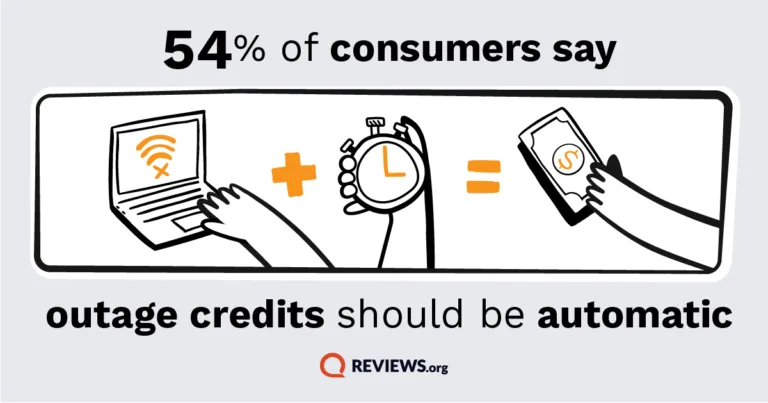
If you've run into this, you're not alone in that frustration. A Reviews.org survey found 54% of consumers say outage credits should be automatic.
Consumers don’t want to chase customer service for credits

Consumers don't want mere compensation, especially if they have to go out of their way to contact customer service to request it or redeem it.

It’s less about getting a $20 credit (like Verizon offered customers on January 15, 2026, via the myVerizon app) and more about the friction required to redeem the credit.

And as Fast Company reported, Verizon customers had to redeem this credit rather than have it applied automatically. That means customers had to be aware of the refund credit in the first place, then use the myVerizon app to apply the credit to their account. All of which puts the burden on the customer to ensure the bill is fair.

For most consumers, the compensation clock starts within the hour

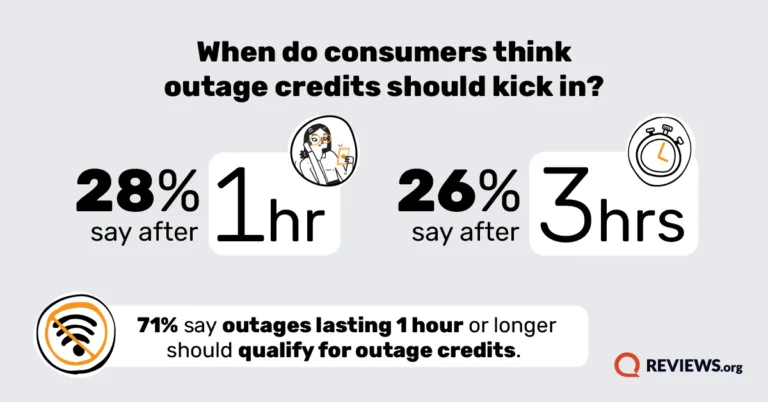
Consumers think credits should kick in relatively quickly, not only after prolonged outages. Reviews.org survey data shows 71% say outages of 1 hour or longer should qualify for credits — with 28% drawing the line at 1 hour and 26% at 3 hours.

Consumer outage graphic

All of this points to lost time — on top of the initial frustration — as a key driver of people's desires for internet outage compensation.

Most Americans think outages should come with money back

Regardless of restoration process or outage duration, the majority of Americans believe their lapses in service should come with some sort of compensation: 69% say customers should receive a reimbursement or credit when internet or mobile service goes down.

And internet service outage refunds have become a greater topic recently due to price increases across consumer services, along with massive outages across the country.

Recent outages put refund expectations back in the spotlight

Recent internet and mobile outages have been hitting thousands, if not millions, of Verizon customers (with a recent nationwide outage) and Xfinity subscribers (in places like Alabama, the Bay Area, and Tennessee). These outages cut people off from the digital connection they rely on for daily life and emergency updates — then left them paying for service they never received.

As mentioned earlier, Verizon said affected customers would receive a $20 account credit after its January 14 outage, and Fast Company reported that customers had to redeem it through the app. Similarly, Newsweek reported that Xfinity customers affected by the January 2026 Nashville outage could pursue refunds through Xfinity's process. That process includes a multi-step eligibility check with a virtual assistant, which either processes the credit or routes customers to an agent.

The companies' responses reveal exactly the kind of friction consumers say they don't want: compensation you have to work for.

The bigger takeaway: outages are becoming a billing fairness story

Internet and mobile outages mean paying for a service that you didn't receive.

It's frustrating enough to lose internet or mobile service, especially for long periods of time, and even worse to spend time dealing with customer service for relief when bill credits could be automatically applied by the service provider.

To put it simply, consumers want credits, they want them fast, and they want them automatic.

Methodology

Reviews.org conducted an online survey of 1,000 Americans on Feb. 22, 2026. The survey was designed to gauge consumer sentiment regarding internet and mobile outages, refund credits, and processes.

To ensure the findings accurately represent the national landscape, the results were stratified to reflect the current U.S. population according to Census data for age, gender, and geographic region. The margin of error for this study is ±3% with a 95% confidence level.

Trevor Wheelwright
Written by
Trevor’s written about YMYL (your money, your life) topics for over six years across editorial publications and retail/eCommerce sites. His work’s been featured on Forbes, RealSimple, USA Today, MSN, BusinessInsider, Entrepreneur, PCMag, and CNN. When he’s not researching and writing, you can find him around Salt Lake City, Utah, snapping photos of mountains and architecture or seeking out some good tunes and friendly faces.

Related Articles

Person using smartphone and laptop showing Wi-Fi outage warning symbols during internet connection disruption
Should Internet and Mobile Outages Come With Automatic Credits? Most Americans Say Yes
After recent Verizon and Xfinity outages, Reviews.org found most consumers think service disruptions should come...
Woman reviewing finances at a desk in her home. Image credit: iStock/damircudic
65% Feel Misled by Their ISP—Here’s What’s Driving It
Reviews.org survey: 65% feel misled by ISP pricing, and 67% say hidden fees made them...
Young family going over finances together at home with baby. Image credit: iStock/Pekic
Is Your Wi-Fi Getting More Expensive? 73% of Americans Say “Yes”
73% of Americans saw their internet bills rise in 2026. Discover why 65% of consumers...
Woman adjusting smart home thermostat. Image credit: iStock/monkeybusinessimages
The Typical American Home Now Has 11 Connected Devices—Does Yours?
Americans now have 11 connected devices at home on average, from smart TVs and doorbells...