Is the Landline Making a Comeback?

//How old-school tech solves today’s digital burnout.
Kelly Huh
Feb 27, 2026
Icon Time To Read3 min read
Icon CheckEdited ByBrenna Elieson

Constant connection via smartphone might be convenient, but many households are quietly considering whether a genuine sense of connection requires the friction of a landline call.

When I was a kid, a friend gave me a spiral-bound address and phone diary. I filled it with phone numbers of friends, church acquaintances, and Chinese restaurants. I even saved a toll-free 1-800 number to buy proactiv acne solutions at age eight (despite having zero dollars to my name).

It sounds inconvenient by today’s standards, but it forced a level of engagement that we’ve since lost. Calling someone required some social skill. You never knew if the other person would actually pick up, if someone else might be listening in, or if the conversation would drag on too long. With practice, I became proficient in actual, real-time conversation—swapping gossip, arguing, listening, and connecting with my friends on a deeper level.

How kids could benefit from home phones

Kids these days (and adults, for that matter) aren’t well-versed in the elusive landline phone call. For many of us, conversations happen in texts, Snapchat streaks, or through Marco Polo's. Is the humble landline our ‘communication trainer' in waiting?

A stationary home phone setup could be a useful stepping stone for kids learning how to communicate with friends and family, bridging the gap between total disconnection and full smartphone access. Here are some of the top benefits and drawbacks for kids:

pro
Pros
pro Learn conversation and listening skills
pro Stay in touch with friends without using social media
pro Filter calls to trusted contacts only
con
Cons
con Stationary
con Can be expensive to first set up
A photo of green and blue Tin Can, a kids’ home phone product

The Tin Can is gaining popularity these days. Not only does it have a memorable name, but it also features a kid-friendly design with its fun colors, stretchy spiral cord, and cute buttons. That being said, it costs $100 to get the device, and $10 to call people who don’t own a Tin Can. So if you’re wanting to get set up without the expense, there are cheaper options out there. Image from Tin Can.

Experts say we’re losing our "brain space" to social media

Social media is a constant presence in daily life, making Facebook, Instagram, TikTok, Snapchat, and other apps the default for interpersonal communication for most children and adults.

As screen time climbs, mental health professionals warn that the long-term effects are becoming harder to ignore.

“When we eliminate boredom with constant screen time, we rob the brain of space to daydream, reflect, and problem-solve—functions essential for healthy development and mental well-being,” says Sonya Andersen-Haile, a licensed professional counselor who was interviewed for Reviews.org’s Screen Time and Internet Usage report.

If constant connectivity is bogging you down, a good old-fashioned phone call could be an antidote.

Not your grandparent's landline

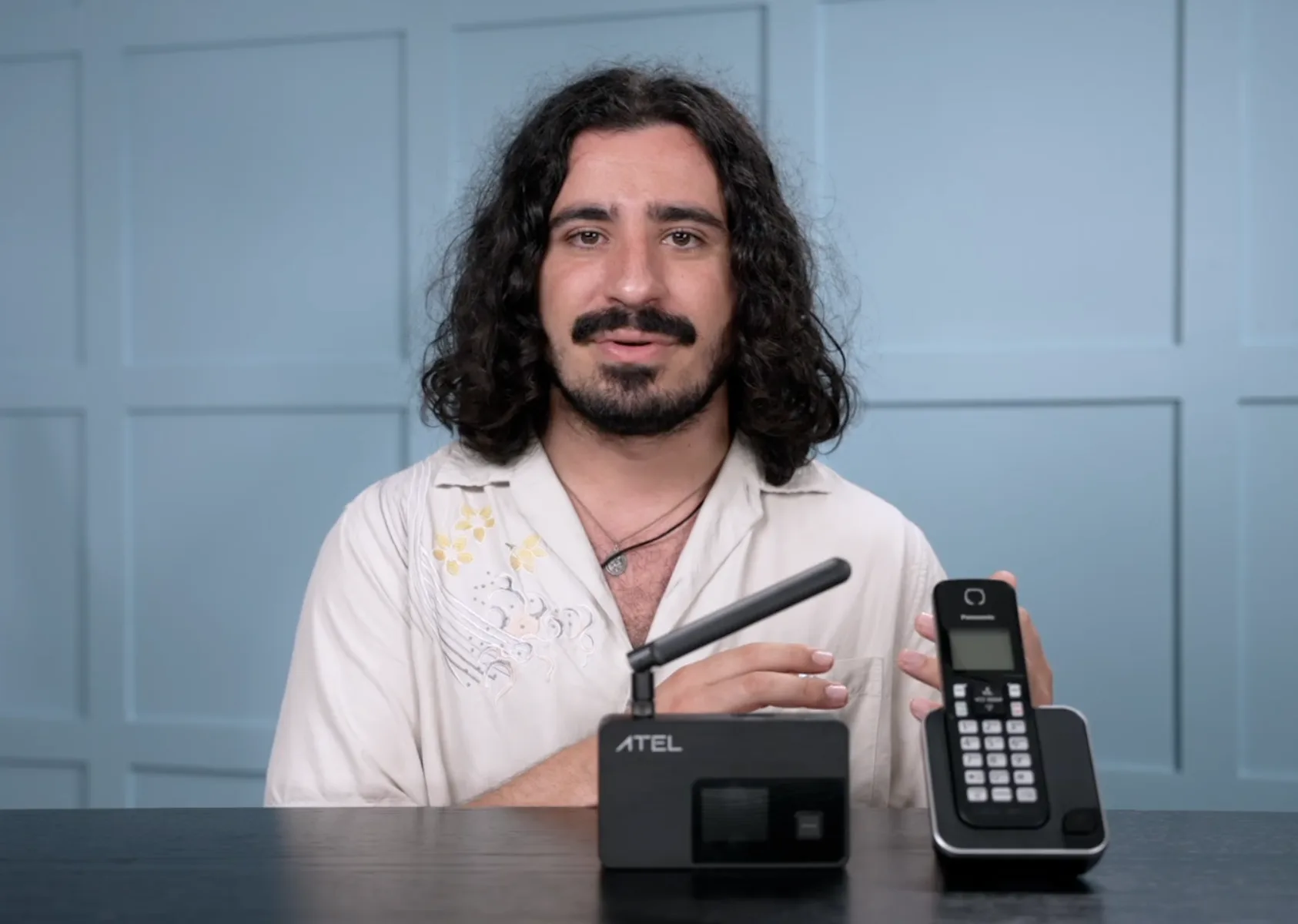
Today’s landlines aren’t the wall-mounted phones of the ’90s. In fact, they aren’t traditional landlines at all. Many run through your internet connection using VoIP technology or connect wirelessly to cellular towers, similar to a cell phone.

A screenshot of a US Mobile home phone setup video.

In my US Mobile Review, I found out that it offers a home phone service as well as its usual cell phone plans. You order the home phone base, activate a plan with a SIM card, and insert it into the base. It essentially works like a cell phone plan, but is tied to a physical location. Image from US Mobile’s website.

These modern “landline” systems typically include a cordless base station, offering caller ID and international calling. They offer a cheaper way to stay connected than adding another line to your wireless plan. And if you’ve got grandparents at home, it’s a handy way for them to stay connected without paying for wireless features they won’t use.

How much do landline phones cost?

The cost of a home phone service ranges from $10 to $40 a month, plus the upfront cost of home phone devices, starting around $25. 

For example, a US Mobile home phone service costs $10 monthly. To get the home phone base, which you need to run the service, it costs $110, or $179.99 when you bundle it with a cordless phone. This is more expensive than the Tin Can, so it’s likely more suitable if you’re going to have several users in a household, rather than opting for a product that’s made for kids.

You could also check out Ooma Telo, which offers hardware and service for a one-time $100 fee. It comes with free nationwide home phone service, but you do have to pay local taxes and fees.

Is it worth getting a landline phone?

If you want to reduce your screen time while still staying in touch with friends and family, a home phone offers an intentional method for connection.

A home phone provides a strong physical reminder that you can communicate with others on your own timeline without having to give in to notifications and addictive apps.

That said, a landline isn’t a total replacement. You still need your smartphone for the road, browsing the internet, or checking other useful apps like Google Maps or email.

Whether it becomes your new offline hobby or offers a training ground for adolescent communication skills, home phones provide an outlet for connection without the risks of the digital world.

Kelly Huh
Written by
Kelly helps readers find the best internet and mobile services. She’s written about every major internet and mobile provider, spending many of her waking hours decoding the fine print that no one reads. She enjoys digging through statistics and user data to put together Reviews.org’s consumer research analysis and proprietary surveys. She has also reached out to real customers all over the country and talked with them over the phone to see how their services fare in reality. In addition to reviewing internet services, Kelly covers efforts to bridge the digital divide for low-income and rural households—her report on the Broadband Equity, Access, and Deployment (BEAD) program was recently cited in a Supreme Court amicus brief in support of expanding internet access. Her articles have been cited by The New York Times, Fast Company, Telecompetitor, Benton Institute for Broadband, and the Federal Communications Commission. Originally from New Zealand, Kelly graduated from Brigham Young University with a degree in communications and is currently pursuing an MBA at Utah Valley University. She’s based in Provo, Utah, and sometimes bakes cakes (but being in the kitchen truly stresses her out).

Related Articles

Family sitting on couch watching TV in living room
My Xfinity X1 DVR Review 2026: A User-Friendly DVR With Cost Tradeoffs
News of XFINITY's X1 is everywhere, but how does it rate? Is it worth the...
3 men watching baseball
Why I’m Telling My Baseball-Loving Friends to Skip Optimum This Year
Why I’m Telling My Baseball-Loving Friends to Skip Optimum This Year The high price of...
Paramount Plus featured image of family watching tv and laughing
What Paramount+ Gets Right for Families (And What It Doesn’t)
Paramount Plus offers an ideal variety of content for families, with its Nickelodeon kids collection,...
Hulu + Live TV featured image
My Hulu + Live TV Review (2026): Full Cable Replacement But Not Worth the Price
If you’re looking for a live TV streaming service, we'll tell you everything you need...