
The $11 Commercial: Peacock’s Great Bait-and-Switch

// Exclusive content can't distract from perpetual marketing.
Benjamin Lee
Mar 10, 2026
Icon Time To Read3 min read

In a post-Olympic haze, my Peacock watchlist is empty and my free trial has come to an end — and now I have to decide if it's worth the monthly cost. Although I praise the vast library of titles and impressive sports coverage, the ad experience is hard to ignore. Why am I paying over $10 per month to still get ads?

We're paying for a premium service that is just Cable 2.0. When streaming became mainstream, we thought it would surpass cable as the gold standard of content viewing.

However, I can't start a movie without immediately seeing a 120-second ad, just like cable. The 'premium' label is nothing more than a veneer, concealing Peacock's disrespect for its customers' time and money through intrusive ads.
The ‘Premium’ paradox: Paying for the permission to watch ads

When we hear ‘premium,’ we think of superior value — Peacock Premium is not that. While the few-dollar upgrade from Peacock Select’s TV-only tier to Peacock Premium’s full access to movies, sports, and originals is definitely a steal, the upgrade simply gives us access rather than improves the quality of the viewing experience.

Despite the top-tier package’s prestigious name, Premium does not exclude ads, nor does it even shorten how often you get them. If anything, you are paying for more ads when you gain access to more content.

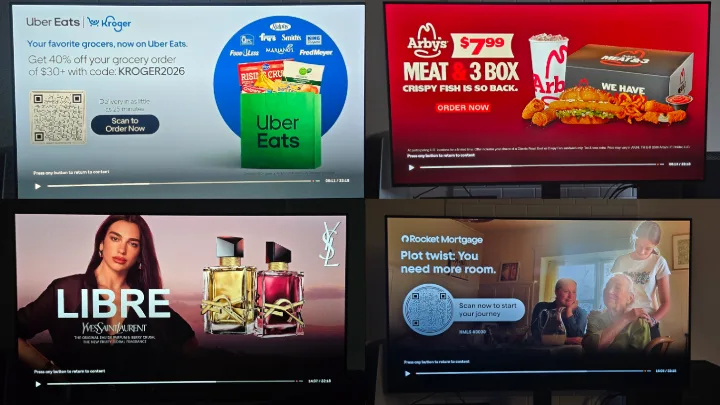
Four TV screens displaying ads for Uber Eats, Arby's, YSL, and Rocket Mortgage.

Ads on a Premium plan — and this isn't even the worst of it. Photo courtesy of Benjamin Lee, Reviews.org

Many of these ads are not even Peacock self-promotions. They span from the following:

  • Cat food
  • Allergy medication
  • Furniture
  • Mortgages
  • “Survivor 50” (a CBS original series that is not even on Peacock)

Live sports follow natural commercial breaks, but once replays and highlight videos are available on demand, expect 10–20+ ads.

Peacock Premium does not provide the luxury that its label implies; ads will remain a mandatory, inescapable part of the bill. And even upgrading to the highest tier may not be the escape you're hoping for.

The myth of ad-free

While the Premium label should invoke great esteem, Premium Plus should go beyond that; sadly, this is not the case.

The upgrade from Premium to Premium Plus is merely a reduction of ad frequency, not the removal of marketing itself. For $16.99, you can have access to everything that Premium provides with the promise of no ads. However, immediately after this promise, Peacock states that there are limited exclusions due to sponsorships. As a result, all channels, live sports, events, and some shows and movies will still have ads.

Although it is true that Peacock's sports coverage comes out on top, it is demeaning to think that a steadfast sports fan can never escape the glut of ad breaks.

Aside from the no-ads advertisement, the only other thing that Premium Plus provides is offline viewing, which I personally find to be the lowest priority when it comes to streaming. Even then, some titles don’t even qualify for download.

Paying to stay in the conversation

Despite the false promise of a truly premium experience, streaming services find ways to keep us devoted, oftentimes by leveraging exclusive content.

In the winter, Peacock hooks us with the Olympics. Once the curtains are drawn on the glittering pageantry, there is little else, aside from extended or uncensored content, such as “The Office: Superfan Episodes.”

Streaming services tend to time their releases to sway us to renew. On January 8, fans of reality TV had the joy of tuning into “The Traitors: Season 4,” a two-month commitment. On the same day of the finale, the next tawdry reality show, “House of Villains,” immediately replaces it. Whether your interest is piqued or you want to stay in the loop, you now have the choice to commit to another month — a choice Peacock was counting on.

With all of this talk of exclusivity, Peacock does have hypocritical terms. It touts itself as the home of Universal Pictures, DreamWorks Animation, and Focus Features, yet its major titles often move around due to licensing deals. I watched “Jurassic World: Rebirth” on Peacock, and it moved to Netflix a week later; suddenly, ‘exclusive’ almost means nothing.

Of course, Peacock aims to gaslight us in order to normalize excessive ads and poor user experience in exchange for its content.

Subscription nomadism is the only way to win the bait-and-switch

The way I see it, Peacock is only worth it during a major live event. Once that is over, just have a list of movies and TV shows you want to check out with your remaining time.

It is best to consider Peacock as a rental, not a commitment. Simply unsubscribe, start a free trial somewhere else, watch what you came for, then move on to the next; that is the tenet of subscription nomadism.

The bottom line: If paying Premium robs us of our time and agency, then maybe the most premium thing to do is to spend it somewhere else.

Benjamin Lee
Written by
Benjamin Lee doesn’t just strive to write, he strives to perfect. His writing style is informative and straightforward, with a dash of fun here and there. Starting out as a journalism major, he immersed himself in pop culture and media to write about the latest trends. As he journeyed through his career path, he realized just how much technology (from abundant streaming services to exciting apps) has entered the zeitgeist. He knew that writing in this field was his path.

Related Articles

The $11 Commercial: Peacock’s Great Bait-and-Switch
Peacock Premium promises a superior experience but delivers Cable 2.0 — here's why ads, exclusivity...
Why 87% of Americans Are Paying for Mobile Data They Never Use
New data reveals the average American uses only 15GB of mobile data, yet most pay...
T-Mobile’s AI Translation Could Change Everyday Calls
Starting in spring 2026, T-Mobile is offering a beta version of Live Translation. No apps...
Is Google Fi Best for Travel? Why I Use It (And Who Shouldn’t)
Whether you’re a frequent international traveler, a remote worker, or a family traveling abroad, Fi...