
They’re both very similar, but AT&T includes all the features you need on its cheapest plan.
AT&T vs. Verizon Cell Phone Plans Review: Which Is Better?




 6 min read
 Edited ByBrenna Elieson
AT&T and Verizon offer top-notch cell phone services, but they’re not cheap—both providers’ plans start at around $65 monthly.
To help you figure out which carrier is worth your money, we created this head-to-head comparison built from our in-depth reviews of AT&T and Verizon. In both reviews, we carried out coverage analysis, speed tests across urban and rural regions, and detailed plan breakdowns.
Overall, AT&T and Verizon get the same rating because they offer similar value and performance. So either way, you’re in good hands. However, AT&T is maybe a smidge more practical because it offers unlimited data, fast speeds, and hotspot data on every plan, while for Verizon, you need to get a more expensive plan for the same features.
Keep reading to get a closer look at the two carriers.

Why you can trust us
At Reviews.org, our team takes its editorial independence seriously. We may earn money when readers click affiliate links, but we don't work for our brand partners, and they don’t approve our pieces before publication. To learn more, visit our About us page.

Share your experience and rate your mobile carrier
Your feedback helps others find the right cell phone plan. Whether your experience was great, frustrating, or somewhere in between, we want to hear about it.

Our reviewers, Monica Yoshida (left) and Brenna Elieson (right) discussing their take on AT&T vs. Verizon. Photo by Kelly Huh, Reviews.org
The matchup: How we rate AT&T vs. Verizon
For all our mobile reviews, we give an expert rating based on four main criteria:
Then, we average the scores to make an overall rating. Here, we compare those ratings face to face. We then offer analysis for important factors to keep in mind. Want to know more? Read our full-length AT&T review and Verizon review.

Dollar value
AT&T
4/5
Verizon
4/5
First things first, let’s compare AT&T vs. Verizon plans. Both carriers have three main unlimited plans:
AT&T unlimited plans
- Unlimited Starter
- Unlimited Extra
- Unlimited Premium
Verizon unlimited plans
- Unlimited Welcome
- Unlimited Plus
- Unlimited Ultimate
Below, we take a closer look at each of the plans in comparison to the equivalent plan from the other carrier:
AT&T vs. Verizon: Cheapest unlimited plans
AT&T Unlimited Starter offers faster speeds and hotspot data, but Verizon Unlimited Welcome includes a handy three-year price lock guarantee.
If you’re choosing between Verizon Unlimited Welcome and AT&T Unlimited Starter, go with AT&T. Single-line pricing is almost identical, but AT&T Unlimited Starter offers higher maximum download speeds on its 5G+ network, so browsing the web or downloading files is faster on AT&T than Verizon. AT&T also includes hotspot data on its base plan, while Verizon doesn’t, so if you want to use your phone as a Wi-Fi source for remote work or streaming, you will either need to select AT&T Unlimited Starter or a more expensive Verizon plan.
One thing that might tip the scales is Verizon’s three-year price guarantee on each of its postpaid plans. AT&T customers have experienced price increases in the past, so it might be worth getting Verizon for the peace of mind.
AT&T vs. Verizon: Mid-tier unlimited plans
On price alone, AT&T Unlimited Extra is the better deal. However, Verizon Unlimited Plus offers unlimited data at faster speeds.
When it comes to mid-tier plans, AT&T Unlimited Extra is a solid option—The plan includes oodles of data and hotspot data for a lower price than Verizon. Although your high-speed data is capped at 75GB, most average cell phone users only need about 10GB of high-speed data per month, especially if they mostly connect to Wi-Fi. However, if you’re a heavy data user and want truly unlimited premium data, Verizon only costs $4 more.
AT&T vs. Verizon: Top-tier unlimited plans
The AT&T Unlimited Premium or Verizon Unlimited Plus plans aren’t worth the extra cost unless you travel often.
Most people won’t use all the features in premium cell phone plans, so they aren’t worth the cost unless you get a family plan discount (or if money is no object). If you do decide to get one of these, the main differences you’ll notice are the international and travel features. Here’s a quick breakdown:
AT&T Unlimited Premium includes the following:
- Unlimited talk, text, and high-speed data in 20 countries in Latin America
- Unlimited talk, text, and data in and between the U.S., Canada, and Mexico (available on all three AT&T unlimited plans)
Verizon Unlimited Ultimate is a little more expensive, but it includes the following:
- Unlimited international data, talk, and text in 210+ countries and destinations (after 15GB of high-speed data, you get unlimited data at 1.5Mbps)
- Up to 300 minutes of international calling from the U.S. to one country with Global Choice (select one country out of 140)
For just $4 more, the Verizon Unlimited Ultimate plan is the better pick for those who travel every month and want reliable data. However, most people who stay within the States will be better off with a cheaper, lower-tier plan.
Family plans and multi-line discounts
Both AT&T and Verizon offer discounts when you have multiple lines on one account. The main difference is that AT&T offers up to a $40 per-line discount when you get five lines on one account, whereas Verizon caps its multi-line discount to $35 per line with four or more lines. Either way, you’re getting a good discount.
It’s worth mentioning that AT&T offers a smaller discount (the lower end of the range listed above) on its Unlimited Starter plan, compared to its Unlimited Extra and Unlimited Premium plans.
Add-ons
Verizon sells most of its perks à la carte, such as $10 streaming bundles you can add to your account, like Disney+, Hulu, and ESPN, or Netflix and HBO Max. On the other hand,
AT&T doesn’t have the option to add discounted streaming apps, so you’re out of luck there.

Network coverage
AT&T
5/5
Verizon
5/5
AT&T and Verizon offer 4G LTE and 5G coverage, with both carriers winning awards for their top network performance. According to the J.D. Power 2025 U.S. Wireless Network Quality Performance Study, Verizon wins the title for best network quality in the Mid-Atlantic, Northeast, Southeast, and North Central regions. As for AT&T, it ties with Verizon in the Southwest region.
Our expert reviewers, Brenna Elieson and Monica Yoshida, both offered their perspectives on network performance in their reviews. Elieson’s decade-plus experience as a Verizon customer illustrated flawless calling reliability in urban, suburban, and rural areas, as well as solid performance on trips to Alaska. Verizon’s widespread 4G LTE footprint was also a huge benefit to her family, who experienced consistent coverage while living in a rural town.
Yoshida, on the other hand, found that AT&T customers she interviewed were highly satisfied with their coverage, and one customer even said that her coverage was better with AT&T than when she was on Verizon. In the end, it’s a toss-up between the two on whether one gets better coverage—whether one is better than the other ultimately depends on your location.

Data performance
AT&T
5/5
Verizon
5/5
Both AT&T and Verizon earn 5/5 for data performance, thanks to their fast speeds and reliability. AT&T customers can experience up to 472Mbps speeds when connected to AT&T’s 5G+ network, whereas Verizon customers experience up to 634Mbps speeds on Verizon’s 5G Ultra Wideband network. There’s not a noticeable difference between these maximum speeds—both should be able to support a range of apps like FaceTime, Gmail, Instagram, Slack, and TikTok.
Elieson finds that her Verizon plan comes in clutch whenever she takes a video call or even streams an entire movie on her phone. Her speed tests showed reliable performance in the city and surprisingly fast rural 4G LTE speeds.
These activities could also be supported by an AT&T plan. Brianne Sandorf, an AT&T customer and staff writer at Reviews.org, finds that her speeds hit nearly 350Mbps, a speed that rivals a home internet connection.
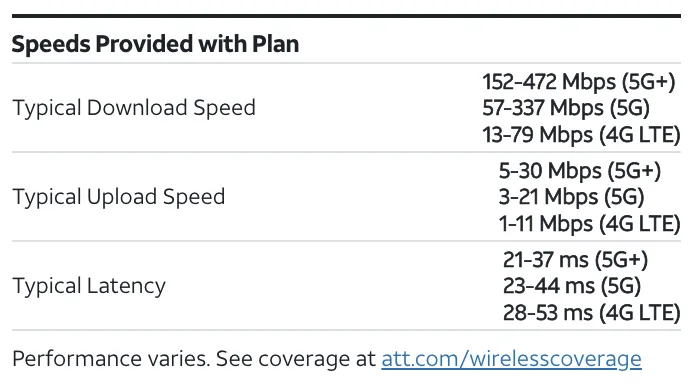
A screenshot of AT&T’s broadband facts label, which shows the speed ranges when you connect to 4G LTE, 5G, or 5G+. Image from AT&T’s website.
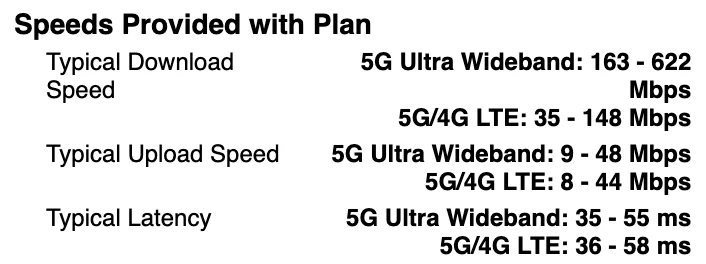
A screenshot of Verizon’s broadband facts label, which shows the speed ranges when you connect to 4G LTE, 5G, or 5G Ultra Wideband. Image from Verizon’s website.
Keep in mind that you only get standard data on the AT&T Unlimited Starter and Verizon Unlimited Welcome plans. This means that when the network is congested, you may experience slower speeds. On the mid- and top-tier plans, you get access to more premium data that doesn’t slow down, unless you surpass a listed data cap.

Customer service
AT&T
3/5
Verizon
3/5
Customer service ratings for both AT&T and Verizon mostly fall short, but it’s not all bad. AT&T customers we interviewed noted difficulties with mixing plan types on a single account and some slow responses from customer service during outages. At the same time, Yoshida’s direct experience with live chat was positive, connecting instantly to a helpful agent.
Verizon’s main strengths are in its self-service tools. Elieson thinks that the MyVerizon app is well organized, with clear billing information, data tracking, and plan details. The in-app AI chatbot works well for straightforward questions, though reaching a live agent took about 15 minutes. Elieson also interviewed a few Verizon customers, and major account changes sometimes cause friction, with some relying on in-store visits for smoother outcomes.
AT&T vs. Verizon : Which should you choose?

Overall quality
AT&T
4.3/5
Both AT&T and Verizon are worthy options. However, AT&T offers more well-rounded plans. Its cheapest plan, Unlimited Starter, packs in unlimited data, 5GB of hotspot data, and download speeds that support all your regular social and messaging apps.
Verizon
4.3/5
Verizon is also a solid carrier, and has better coverage than AT&T in more areas, a strong reputation for 4G LTE coverage in rural areas, and reliable 5G coverage in cities. The Unlimited Welcome plan pales in comparison to AT&T Unlimited Starter, but if you’re willing to fork over more than $70 for your phone plan, you might find that Verizon’s mid- and top-tier plans offer better all-around value when it comes to premium data.

This comparison relies entirely on findings from the two full Reviews.org expert evaluations of AT&T Wireless and Verizon, written by Monica Yoshida and Brenna Elieson, respectively. These reviews involved hands-on network tests, real customer interviews, speed tests across urban and rural regions, fine-print analysis, and independent data sources, including OpenSignal and RootMetrics. Reviews.org maintains strict editorial independence, and brand partners do not approve or influence the content in these evaluations.
Learn more about how we review on our Methodology page.

Related Articles
Spectrum Internet Plans and Deals
Find the latest Spectrum Internet deals, prices, and plans to get high-speed internet in your...

Fidium Internet Plans and Deals
Sign up for one of Fidium Fiber’s internet plans today.
Apple iPhone 17e Plans: Compare Prices and Deals
If you’re looking to pick up the new iPhone 17e on a plan, you’re in...
Brightspeed Internet Plans and Deals
Sign up for one of Brightspeed Internet’s plans today.



