
Mint delivers overall reliability while US Mobile delivers bigger data amounts and more network flexibility.
US Mobile vs. Mint Mobile Cell Phone Plans Review: Simplicity Beats Flexibility






 7 min read
 Edited ByBrenna Elieson
US Mobile calls itself a “Super Carrier.” Mint Mobile has Ryan Reynolds’ marketing charm. But don’t choose between these two carriers based on the flashy ads—we can tell you how these two prepaid carriers work in real life. Our comparison comes from two in-depth Reviews.org evaluations: Four years of daily Mint Mobile from reviewer Monica Yoshida, and a month of US Mobile testing across all three networks from reviewer Kelly Huh. Their experiences reveal what matters most in a prepaid phone plan: consistent speed, reliable coverage, responsive customer service, and the necessary trade-offs for such low prices.
Both carriers are budget-friendly, starting at $10 and $15 per month. Mint keeps things simple with cheap pricing on T-Mobile’s network, especially if you’re comfortable paying annually. US Mobile, on the other hand, offers huge data allotments and the flexibility to switch between Verizon, T-Mobile, and AT&T. Mint is the more predictable, low-effort option for most users, while US Mobile is the better fit for heavy data users and people who want the flexibility to push beyond typical MVNO limits.
A word to the wise: While unlimited data sounds ideal, you often don’t need it. Unless you seriously rely on your data while out and about or travel often and don’t want to depend on spotty Wi-Fi, then you’ll likely be very happy with lower data amounts. Here at Reviews.org, we recommend 10GB for the average user.
Keep reading to see how both carriers actually perform when it comes to coverage, data speeds, and customer service.

Why you can trust us
At Reviews.org, our team takes its editorial independence seriously. We may earn money when readers click affiliate links, but we don't work for our brand partners, and they don’t approve our pieces before publication. To learn more, visit our About us page.
“I love Mint Mobile for its reliability and inexpensive monthly bills, but if I really wanted to pay for premium data without going for a big and expensive mobile carrier, I’d definitely be interested in US Mobile’s premium plan.”
- Reviews.org Staff Writer and Mint Mobile user, Monica Yoshida
- Reviews.org Staff Writer and Mint Mobile user, Monica Yoshida

Yoshida and Huh put first-hand testing of Mint Mobile and US Mobile head to head. Both MVNOs offer a lot of value for different types of users. Photo by Monica Yoshida

Share your experience and rate your mobile carrier
Your feedback helps others find the right cell phone plan. Whether your experience was great, frustrating, or somewhere in between, we want to hear about it.
The matchup: How we rate US Mobile vs. Mint Mobile
For all our mobile reviews, we give an expert rating based on four main criteria:
Then, we average the scores to make an overall rating. Here, we compare those ratings face to face. We then offer analysis for important factors to keep in mind. Want to know more? Read our full-length US Mobile review and Mint Mobile review.

Dollar value
US Mobile
4/5
Mint Mobile
5/5
First things first, let’s compare US Mobile vs. Mint Mobile plans. Both carriers offer low starting prices, and both offer quite a range of data options and flexibility. If you want customization, buckle up because you’ll get it with US Mobile. If you want plain and simple data allotments without the frills, Mint Mobile is the way to go.
US Mobile plans
- By the Gig: $10/mo. for 2GB
- By the Gig: $15/mo. for 5GB
- By the Gig: $20/mo. for 10GB
- By the Gig: $35/mo. for 20GB ($15 per additional 10GB)
- Unlimited Starter: $25/mo. for unlimited data (70GB premium)
- Unlimited Premium: $44/mo. for unlimited premium data
- Unlimited Flex: $17.50/mo. ($210/yr.) - annual plan only
Mint Mobile plans
- 5GB Plan: $15/mo. ($45 upfront) for 5GB
- 15GB Plan: $20/mo. ($60 upfront) for 15GB
- 20GB Plan: $25/mo. ($75 upfront) for 20GB
- Unlimited plan: $30/mo. ($90 upfront) for unlimited data (50GB premium)
Mint Mobile delivers standout value by keeping pricing extremely low for those willing to prepay. Be ready to pay three, six, or 12 months in advance for any of Mint’s plans. Yoshida cut her bill from more than $30 per month on a T-Mobile family plan to just $15 per month on Mint, while still experiencing the same strong coverage. Mint even upgraded her plan from 4GB to 5GB without raising her price, proving that the carrier doesn’t only reserve the best promos for new customers. For most shoppers, the 15GB plan hits the best balance of price and breathing room, while Mint’s Unlimited plan delivers peace of mind with a 50GB allotment of premium speeds.
US Mobile delivers value through sheer volume of data. Huh called the $25 Unlimited Starter plan’s 70GB high-speed bucket a rare deal in today’s market. Unlimited Premium offers truly unlimited premium data at $35—something many MAJOR carriers reserve for their most premium plans. The By the Gig plan is practical for families who want to avoid wasted data by sharing one pool of data, while heavy streamers or hotspot users may find Unlimited Premium worth the upgrade for its larger hotspot allowances. To read more about how you can build your family plan with US Mobile, read our review of the Best Family Cell Phone Plans.
US Mobile vs. Mint Mobile: Premium unlimited plans
US Mobile’s Unlimited Premium plan on its Dark Star (AT&T) network offers unlimited premium data (won’t get slowed even during network congestion) for $32.50 when you pay a year upfront. For almost the same price, Mint Mobile’s Unlimited plan only gets you 50GB of premium data before your speeds can be deprioritized and slowed.
The two most premium plans for each carrier are dramatically different. For the same price, it all comes down to data: Do you want endless priority data that stays fast and crisp? Or can you live with a decent amount of priority data before your speeds can be deprioritized during network congestion? If you need super fast data speeds at all times, then US Mobile may be the better choice for an unlimited plan.
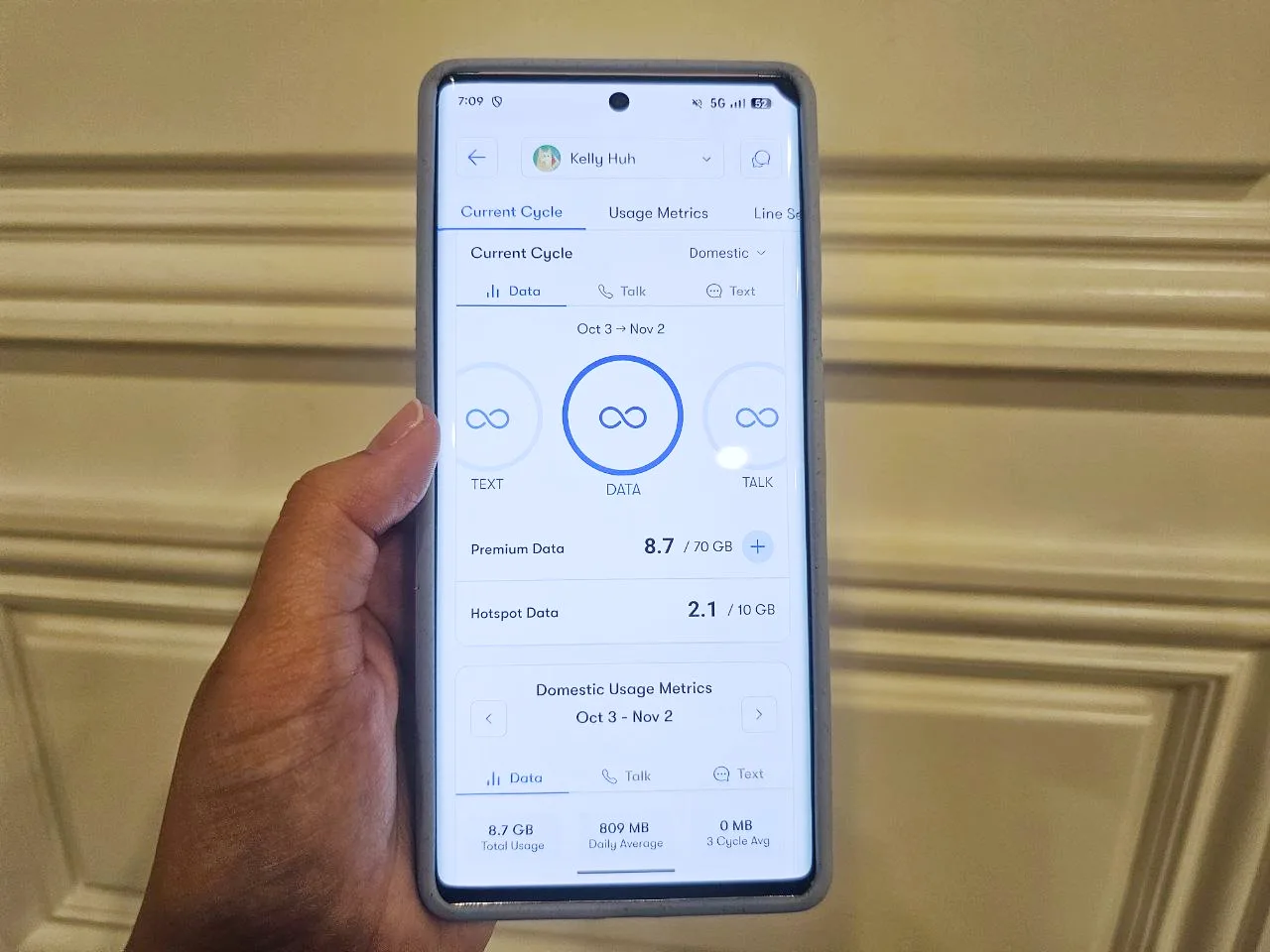
Huh tested US Mobile for 30 days, and shows the US Mobile app on her phone. She wasn’t impressed by the speeds. Photo by Monica Yoshida

Yoshida has been a Mint customer for almost five years, and shows us the Mint Mobile mascot, a cute fox. She thinks Mint is worth the switch. Photo by Jane Smith
Family plans and multi-line discounts
Mint’s family setup is built for simplicity rather than savings. You won’t find multi-line discounts with Mint, which is fine, considering that means you don’t need to round up five people onto a plan to make it affordable. You can manage two to five lines under one account, and each person can choose their own data amount without affecting anyone else’s price.
US Mobile also avoids traditional line discounts, but its By the Gig plan gives families a shared pool of data—an efficient option for households whose usage shifts from month to month.
Both Mint Mobile and US Mobile offer mix-and-match options on their family plan models. So if flexibility is what you’re after with multiple lines, both will deliver on that.
Add-ons and perks
Mint includes free calling to Mexico, Canada, and the UK on all plans and lets users on smaller plans buy 1GB or 3GB of extra data through the app. Long-term customers can even unlock an additional plan called the “Unnecessary plan” with expanded hotspot data after renewal.
US Mobile’s benefits lean toward international travel and entertainment: Customers get a free SIM kit with the option to add low-cost international calling, and Premium users with three lines receive a streaming credit that effectively lowers their overall monthly cost.

Network coverage
US Mobile
3/5
Mint Mobile
5/5
Mint Mobile’s coverage operates directly on T-Mobile’s 5G network—the leader of 5G coverage according to an OpenSignal report. With Mint Mobile, you’ll likely find reliable service across urban, suburban, and canyon areas of Utah County. As a Mint Mobile user, Yoshida has never encountered a dropped connection in almost five years.
US Mobile’s coverage varies more because it relies on three different networks—Verizon (Warp), T-Mobile (Light Speed), and AT&T (Dark Star). Performance differed significantly among them during Huh’s firsthand testing:
- Light Speed (T-Mobile network): Delivered the strongest results and felt only slightly slower than her direct T-Mobile plan.
- Warp (Verizon network): Stayed mostly on 4G LTE but still provided functional coverage in common daily locations like home, office, and Costco.
- Dark Star (AT&T network): Provided the weakest connection despite an AT&T map claiming 5G+ at her address. She frequently saw poor signal strength and very slow webpage loads, although texts and calls continued to work.
If you’re willing to try multiple networks to find the best fit, then you’ll enjoy tinkering around US Mobile’s flexible switching model. But for those who want an effortless, consistent coverage experience, Mint’s single-network model is more straightforward.
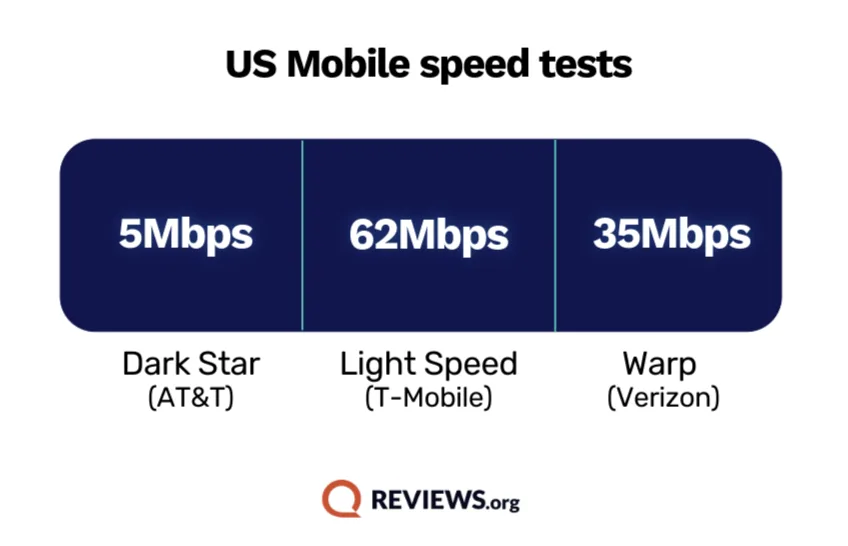
Out of the three networks, Light Speed (the T-Mobile network) delivered the strongest results for Huh during her firsthand testing. Photo by Kelly Huh

Data performance
US Mobile
4/5
Mint Mobile
5/5
Mint earns a 5/5 rating for data performance thanks to consistently strong speeds and reliable everyday usability. Yoshida notes she never felt limited by Mint’s high-speed allocations and rarely needed to buy extra data, even during heavy-use months. She found that Mint’s performance aligned closely with what she previously experienced on a T-Mobile family plan, reinforcing that Mint leverages T-Mobile’s broad 5G footprint effectively. Mint’s speeds stay fast enough for streaming, navigation, and long daily commutes without noticeable dips, which saves you from spending more on the expensive premium data tiers from major carriers.
US Mobile, despite offering large amounts of high-speed data, showed more variability in real-world speed tests. Huh found that while Unlimited Starter’s 70GB allotment was difficult to burn through, speeds on all three networks tended to fall near or below the low end of US Mobile’s published typical speed ranges. This affected performance during tasks that need stable speeds, such as Messenger audio calls—which cut out without the reviewer noticing—and an online college class over hotspot, wherethe audio got weird. App downloads also lagged significantly behind her direct T-Mobile plan: Instagram took roughly a minute on Light Speed and several minutes on Dark Star and Warp.
For consumers, US Mobile’s data performance is “good enough” for many tasks but requires choosing the right network and accepting that real-time workloads, like Wi-Fi calls or large downloads, may occasionally struggle.

Customer service
US Mobile
4/5
Mint Mobile
3/5
Mint Mobile’s customer service experience is defined by strong day-to-day reliability but weak initial support. Service stays smooth once activated, and it’s likely that most customers won’t need to access its customer support at all. However, when issues arise (especially with SIM activation), Mint falls short. The in-app chatbot was slow and semi-helpful.
US Mobile scored higher thanks to smoother onboarding and faster access to human support. Huh activated her eSIM in minutes using clear instructions, and cancelling service is even easier. The live US Mobile agents are polite and immediately reachable by chat or phone, which helps US Mobile stand out among MVNOs.
The main US Mobile challenge is the network-transfer feature: When switching networks, your phone may temporarily lose all service and data, and troubleshooting can take over an hour. Consumers should treat network transfers with caution and perform them only when connected to Wi-Fi.
US Mobile vs. Mint Mobile: Which should you choose?

Overall quality
Mint Mobile
4.5/5
Mint Mobile is the better fit for most people thanks to its low annual pricing, strong T-Mobile-based coverage, and consistently reliable data performance. It works best for those who want to keep their monthly cell phone bill low, families who want easy multi-line management, and anyone who prefers a set-it-and-forget-it plan without needing to test multiple networks.
US Mobile
3.8/5
US Mobile is the stronger option if you prioritize flexibility and large amounts of fast data. Its ability to switch between Verizon, T-Mobile, and AT&T and its Premium unlimited plans with up to 70GB of premium data make it ideal for heavy data users as well as tech-savvy users, though speeds can vary and network transfers may not be as straightforward as advertised.

This comparison comes directly from:
- Two standalone Reviews.org carrier reviews spanning firsthand testing experiences over a month to four years.
- First-person speed tests, coverage checks, hotspot trials, customer service interactions, and billing experiences to evaluate daily performance.
- Plan details, ratings, and user observations.
- Interviews with real customers across forums and in person
Reviews.org maintains strict editorial independence, and carriers do not review or influence our findings.
Learn more about how we review on our Methodology page.

Related Articles

Best Internet Deals in March: Save Money on Home Wi-Fi
Save money with the best home internet deals this month, including Xfinity deals, AT&T deals,...

My Xfinity X1 DVR Review 2026: A User-Friendly DVR With Cost Tradeoffs
News of XFINITY's X1 is everywhere, but how does it rate? Is it worth the...

My Optimum Mobile Review (2026): A Service Mostly for Optimum Internet Customers
Optimum Mobile (formerly Altice Mobile) is a small phone carrier that uses T-Mobile’s network. It’s...

Why I’m Telling My Baseball-Loving Friends to Skip Optimum This Year
Why I’m Telling My Baseball-Loving Friends to Skip Optimum This Year The high price of...



