
AT&T’s 5G and 4G LTE networks cover a lot of ground in the U.S.
How Good is AT&T’s Coverage? See the 5G and 4G LTE Map

 2 min read
 Edited ByBrenna Elieson
Switching mobile providers means switching coverage, so before you take the plunge and move to AT&T, let’s talk about AT&T’s coverage. AT&T 5G and 4G LTE networks are both solid and cover a lot of ground in the U.S.
Read on to learn more about AT&T’s network and how to check the AT&T coverage map.

Why you can trust us
At Reviews.org, our team takes its editorial independence seriously. We may earn money when readers click affiliate links, but we don't work for our brand partners, and they don’t approve our pieces before publication. To learn more, visit our About us page.
How to check AT&T coverage in your area
The easiest way to check AT&T coverage is to look at AT&T’s official coverage map. You can enter your address or simply zoom in to see whether AT&T’s coverage includes your home, workplace, and anywhere else you frequent.
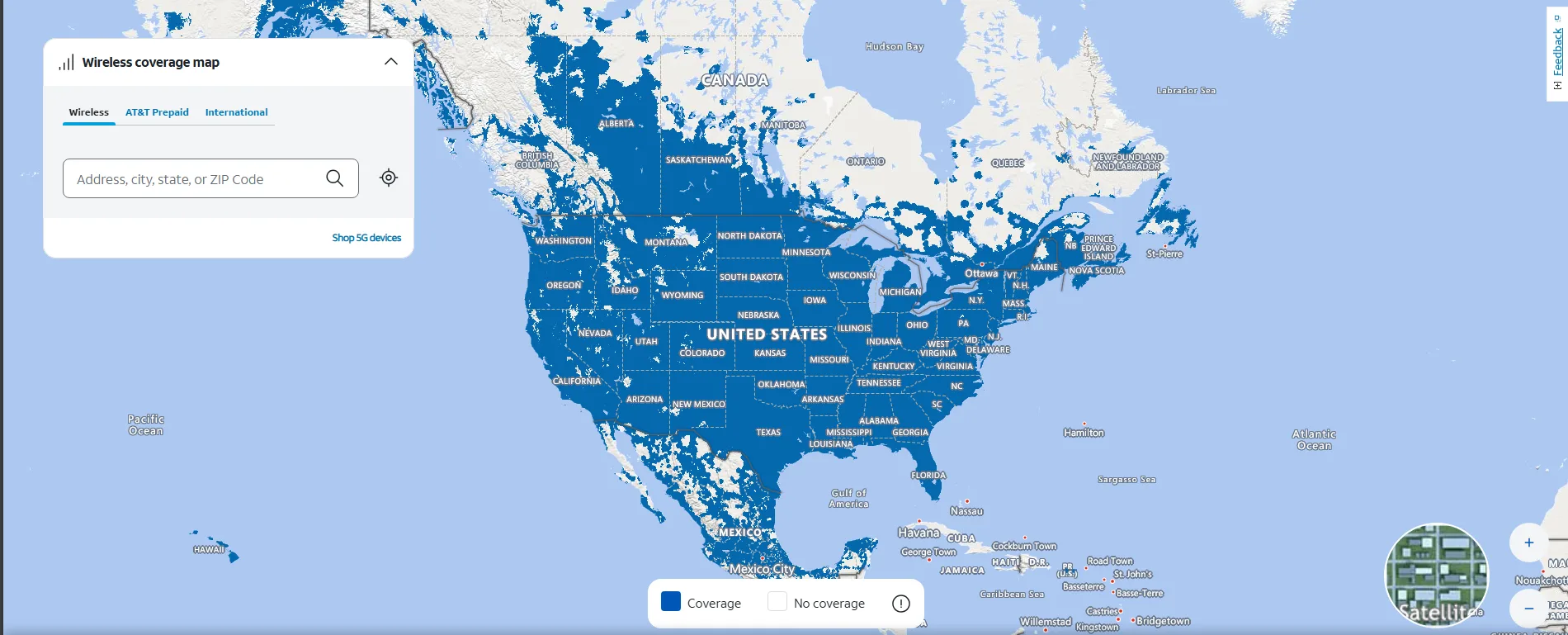
Screenshot of the official AT&T coverage map and search tool
What is AT&T 5G+?
AT&T 5G+ is a faster version of AT&T 5G that uses mid- and high-band frequencies to transmit data. Dark blue areas indicate places where you can find 5G+.
What is AT&T 5G?
AT&T 5G is AT&T’s slower, low-band 5G option, which is more comparable to 4G LTE. You can find it on the map wherever the medium blue color appears.
What is AT&T 4G LTE?
AT&T 4G LTE is the backbone of the AT&T network. It’s slower than 5G coverage but much faster than the old-school 3G technology that preceded it. The 4G LTE coverage appears on the map as light blue areas.
How AT&T's coverage compares to T-Mobile and Verizon
If you’re switching to AT&T from T-Mobile or Verizon, you’re probably wondering how its coverage area compares to your old carrier’s. Luckily, the answers are here.
AT&T vs. T-Mobile coverage
AT&T’s coverage area is similar to T-Mobile’s. AT&T 5G coverage is a little less spacious, but its 4G LTE coverage is slightly better. So you should receive phone access in more places with AT&T than with T-Mobile, but the service may not be as fast.
AT&T vs. T-Mobile network coverage comparison
AT&T vs. Verizon coverage
Compared to Verizon, AT&T offers about twice as much 5G coverage and almost as much 4G LTE coverage. In other words, you get more coverage overall with AT&T.
AT&T vs. Verizon network coverage comparison
AT&T coverage map accuracy
AT&T’s official coverage map looks almost identical to the FCC’s independently verified map. In other words, you can trust AT&T’s coverage map.
Get AT&T’s network for a lower price
If you want to hop on the AT&T network but don’t want to pay AT&T’s prices, my colleague Monica Yoshida can help with these tips for lowering your AT&T bill.
The easiest way to get AT&T for cheap is to try MVNO provider Mint Mobile. Mint uses AT&T’s network but charges far less for its wireless plans. And if Mint’s not your thing, you can try other small carriers that use the AT&T network.
There are other ways to save money on AT&T, too. You can try a more basic plan, find an employee or student discount, or even bundle your phone with AT&T’s awesome fiber internet.
Frequently asked questions about AT&T coverage (FAQ)
AT&T’s coverage isn’t exactly better than Verizon’s (the Verizon network is more critically acclaimed than the AT&T network), but it covers more ground.
If your AT&T-connected phone is using 5G service but the speeds feel slow, then you’re probably currently using AT&T 5G (rather than AT&T 5G+, which is faster). Your phone should speed up once you enter an AT&T 5G+ service area.
You can check AT&T coverage in your area by consulting the AT&T coverage map.
Smaller carriers that use AT&T’s network include:
AT&T's rural coverage is okay, although I regard Verizon as the best rural carrier.

Related Articles

Watching Sports Now Costs the Average Household $1,475 Per Year
Americans now spend nearly $1,500 a year to watch live sports. See the breakdown of...
Nearly 3 in 10 Americans Admit to Using Their Phone While Driving
Reviews.org survey data shows 29.3% of Americans admit to using their phone while driving in...

My Peacock Review (2026): Massive Content, Elite Sports, but Too Many Ads
Check out why the NBCUniversal Peacock streaming service could be perfect for you if you’re...

YouTube TV Not Working? The Top Expert Fixes to Get You Back to Streaming (2026)
Are you getting a playback error message on your YouTube TV account? These are the...



