
AT&T has a lot to offer – but is it the best choice when you can switch with the tap of a button?
US Mobile Dark Star: Is the AT&T Network Right for You?

 4 min read
 Edited ByBrenna Elieson
Unique from other cell plan providers, US Mobile gives you options. Most MVNOs use one network, and even services offering two will manage the switching for you. But US Mobile lets you choose for yourself which network you want to use — so you can pick the network with the best features or the best coverage in your area.
US Mobile doesn't use typical names for its networks, though, labeling them Dark Star, Warp, and Light Speed. Curious about Dark Star and whether it's the best US Mobile network for you? Here's what you need to know.

Why you can trust us
At Reviews.org, our team takes its editorial independence seriously. We may earn money when readers click affiliate links, but we don't work for our brand partners, and they don’t approve our pieces before publication. To learn more, visit our About us page.
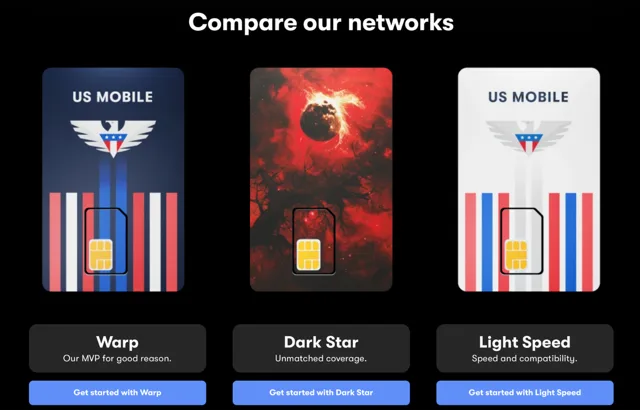
US Mobile’s three network options: Dark Star (AT&T), Warp (Verizon), and Light Speed (T-Mobile). Image from US Mobile.
What is US Mobile Dark Star?
US Mobile lets you choose between the three major US networks — Dark Star (AT&T), Warp (Verizon), and Light Speed (T-Mobile). Dark Star is a standout choice for those who want one of the largest networks in the country without paying premium AT&T prices.
The option to switch between networks is what makes US Mobile, in its own words, a "Super Carrier." Instead of committing to one network, US Mobile lets you bounce between them as needed. Of course, it's not necessarily that simple, but it is a whole lot easier than it would be if you wanted to switch networks on any other provider, which would involve switching phone companies entirely. On US Mobile, the first two transfers are free, with subsequent transfers costing $2 each. That's unless you have US Mobile's Unlimited Premium plan, which lets you transfer up to eight times per month for free.
If you haven't looked into US Mobile before, our full US Mobile review covers everything you need to know.
Coverage and network performance
Because Dark Star runs on AT&T's infrastructure, it offers one of the broadest coverage footprints in the US. AT&T’s service has long been strong in cities and suburbs, so you should expect solid call quality, reliable texts, and steady data speeds in those areas.
Rural performance is respectable, too, though your mileage will always vary depending on exactly where you are. AT&T scores well in industry benchmarks like JD Power's wireless network quality studies and OpenSignal's mobile experience reports. That said, it's worth keeping in mind that MVNO customers on deprioritized plans might not see the same speeds as AT&T's postpaid users, especially in high-traffic areas. I definitely suggest pulling up AT&T's coverage map and checking your home address and regular routes before making a decision.
Understanding data priority (QCI 8 vs. QCI 9)
What is QCI and why does it matter?
Quality of Service Class Indicator (QCI) is the technical framework that decides whose data gets handled first when a cell tower is under heavy load. Confusingly, a higher QCI number actually means lower priority — Think of it like a number in line or a boarding group; the higher your number, the longer you wait behind others during peak times.
Most MVNOs, including US Mobile's base plans, sit at QCI 9, which is last in line. Priority users get QCI 8. In day-to-day use, there's a good chance you'll never feel the difference. But if you're in a dense crowd, like a big concert or busy airport gate, you might find that while your friend's AT&T data is working perfectly fine, yours is struggling to load a web page.
Pay to upgrade to QCI 8 "Priority Data" on Dark Star
If you're on a Dark Star base plan and want to move up the priority chain, US Mobile sells a QCI 8 add-on for $12/month. That bumps you from QCI 9 (deprioritized) to QCI 8 (medium-tier priority), and in congested areas, the improvement can be noticeable. For people who mostly connect in quieter, less crowded spots, it's probably not worth the extra spend. But if you're a power user or you regularly find yourself in congestion-heavy zones, it's a decent way to get a better experience without having to pay the cash for a premium carrier plan.
Comparing Dark Star to Warp and Light Speed features
Dark Star (AT&T) vs. Warp (Verizon)
Hotspot data is the headline difference between Dark Star and Warp plans. If hotspot isn't something you care much about, the real deciding factor is probably going to be which network simply performs better where you actually are.
On the Unlimited Premium plan, Dark Star offers 200GB of hotspot data compared to Warp's 50GB. That's a pretty large gap if you lean on hotspots for work or travel. For coverage, Verizon and AT&T each have regional strengths, and neither one has a clear across-the-board edge, so it's worth checking coverage maps for your home and places you frequent. Both offer deprioritized base plans with optional priority upgrades.
Dark Star (AT&T) vs. Light Speed (T-Mobile)
Hotspot data allotment is another big difference here. Dark Star's 200GB of high-speed hotspot data blows past Light Speed's 50GB on the same Premium plan. Beyond that, the coverage is also a factor. T-Mobile has traditionally lagged behind AT&T in rural areas, though that gap has closed a lot in recent years. In plenty of urban markets, T-Mobile actually matches or even beats AT&T on speeds. Again, you'll want to check coverage maps before you decide on a network.
How to switch to Dark Star using Teleportal
One of the useful and more rare features US Mobile offers is Teleportal, a tool that lets you hop between Dark Star, Warp, and Light Speed without creating a new account or giving up your phone number. It's managed through the US Mobile app or your web dashboard.
Here's how it works:
- Log in to your US Mobile account (app or website) and head to your line settings.
- Select Switch Network under your plan management options.
- Choose Dark Star as your target network and pick either eSIM or physical SIM.
- If using an eSIM, enter your device details and confirm the transfer. You'll receive a QR code via email to install the new eSIM.
- If using a physical SIM, you'll need a compatible SIM card on hand (or you can order one, which typically arrives in 4–6 business days).
- The network transfer usually completes within a few minutes, and you'll get an email confirmation when it's done.
Frequently asked questions about Dark Star
Dark Star runs on AT&T's network — specifically, the infrastructure AT&T makes available for prepaid and MVNO services. You're connected to the same towers and coverage area as AT&T's direct customers, though data priority can differ depending on your plan tier and whether you've added the QCI 8 upgrade.
Switching between Dark Star, Warp, and Light Speed through Teleportal is free — US Mobile doesn't charge activation fees or lock you into new contracts. If you need a physical SIM card for the switch, though, there may be a small shipping cost. The feature is most useful for those who use an eSIM, as it doesn't require actually switching SIM cards.
That really depends on what you need. If you're a heavy hotspot user, Dark Star is the obvious pick thanks to that 200GB high-speed data allocation. But when it comes to raw network performance, it's all about location. One network might be faster in your neighborhood than the others. The real advantage of US Mobile compared to other networks is that you can choose between the networks without having to completely change providers.

Related Articles
US Mobile Dark Star: Is the AT&T Network Right for You?
Curious about Dark Star and whether it's the best US Mobile network for you? Here's...
Verizon Cell Phone Plans and Deals
Verizon offers great deals and top-notch coverage for its unlimited cell phone plans. Read all...
Boost Mobile Cell Phone Plans and Deals
Boost Mobile offers unlimited data mobile plans at some of the most affordable prices available....
Mint Mobile Cell Phone Plans and Deals
Mint Mobile Cell Phone Plans and Deals Get top-notch 5G coverage with Mint Mobile’s affordable...



