
GFiber (previously Google Fiber) and GFiber Webpass both offer different internet services from the same company. See what you get from both.
GFiber vs. GFiber Webpass: Which One Is Worth Your Money?




 4 min read
Both GFiber and GFiber Webpass are owned by Alphabet Inc., Google's parent company. In 2016, Google Fiber—now GFiber—acquired Webpass, a smaller ISP, and incorporated its network of connected neighborhoods into its own. While both internet services have fiber in their name, GFiber offers a fiber connection, while GFiber Webpass offers a wireless connection. However, both offer symmetrical speeds.
GFiber is the best kind of fiber and the best overall internet you can get, according to Reviews.org. It offers big speeds, consistent connections, and fair prices for its powerful symmetrical internet speeds. While it doesn't offer a ton of flashy new-customer deals, Google's fiber service does offer simple and standalone internet plans—no tricky promos or new-customer pricing. If you’re lucky enough to get it on your block, here’s what you get:
- Gigabit and multi-gigabit speeds
- Free installation
- No annual contract
- No extra fee for modem
GFiber Webpass uses wireless technology to deliver symmetrical internet speeds. It’s offered in even fewer places than GFiber, but you can find it in individual buildings like apartments and condominiums. Webpass tops out at 1Gig (which isn’t slow at all). Here’s what you get with GFiber Webpass:
- Gigabit speeds
- Free installation
- No annual contract
- No extra fee for modem

Trying to hop on the GFiber train? Enter your zip code below to see if GFiber or GFiber Webpass are available in your area.

Share your experience and rate your internet provider
Your feedback helps others find the right internet provider. Whether your experience was great, frustrating, or somewhere in between, we want to hear about it.
GFiber vs. GFiber Webpass: Plans, pricing, and deals
GFiber plans and prices
Provider | Plan | Price | Download speed | Details |
| 1 Gig | $70/mo.* | Up to 1000 Mbps Mbps | View Plan | |
| 2 Gig | $100/mo.* | Up to 2000 Mbps Mbps | View Plan | |
| Home 3 Gig | $100/mo. | Up to 3000 Mbps Mbps | View Plan | |
| 5 Gig | $125/mo.† | Up to 5000 Mbps Mbps | View Plan | |
| 8 Gig | $150/mo.† | Up to 8000 Mbps Mbps | View Plan |
*
Plus taxes and fees. Upload/download speed and device streaming claims are based on maximum wired speeds. Actual Internet speeds are not guaranteed and may vary based on factors such as hardware and software limitations, latency, packet loss, etc.
†
Available in select markets only. Plus taxes and fees. Upload/download speed and device streaming claims are based on maximum wired speeds. Actual Internet speeds are not guaranteed and may vary based on factors such as hardware and software limitations, latency, packet loss, etc.
GFiber Webpass plans and prices
Provider | Plan | Price | Download speed | Details |
| 1 Gig | $70/mo.* | Up to 1000 Mbps Mbps | View Plan |
*
Plus taxes and fees. Upload/download speed and device streaming claims are based on maximum wired speeds. Actual Internet speeds are not guaranteed and may vary based on factors such as hardware and software limitations, latency, packet loss, etc.
Google's fiber internet has four main plans called 1 Gig, 2 Gig, 5 Gig, and 8 Gig—super straightforward names just like the plans themselves. GFiber’s cheapest plan with 1,000Mbps is perfect for most households and doesn’t tack on any extra fees like professional installation or modem/router fees. There are some extra plans available, though very limited to specific zip codes.
GFiber Webpass is a less common internet service, installed in specific apartments or residential buildings. It provides internet over a wireless connection while still offering symmetrical speeds. Google Fiber Webpass offers a simple 1 Gig plan for $70 (unless you want to pay a flat annual fee of $750). You can read more about GFiber Webpass in our full GFiber review.
Good to know
Searching for Google Fiber? You're in the right place. Google Fiber is now called GFiber, but the plans and pricing haven't changed.
GFiber vs. GFiber Webpass: Fees for modem and installation
GFiber add-ons and perks
Comes with the 1 Gig Core plan
Comes with the 2 Gig and higher plans
No installation, activation, or extra monthly Wi-Fi fees for internet customers
Refer a friend and both people get a free month of service after friend’s first paid month
GFiber Webpass add-ons and perks
Fiber jack and mesh router are included (option to ask a second free router)
No installation, activation, or extra monthly Wi-Fi fees for internet customers
Refer a friend and both people get a free month of service after friend’s first paid month
What makes this review legit?
Our fact-based research process centers on interviews with internet customers across the country, helping us understand how internet services hold up against diverse needs and challenges.
To put together this review, we looked at results from our speed test, pulled data from customer satisfaction surveys, and pored over the fine print to compare prices and speeds between the two providers. To flesh out our analysis, we also interviewed Spectrum and T-Mobile customers to get their first-hand insights. We let their experiences guide our research and shape our conclusions. We also speak with ISP spokespeople and industry experts to get insights into connection types, speed capabilities, and other technical issues related to internet service.

Where are GFiber and GFiber Webpass available?
GFiber and GFiber Webpass are small-time internet service providers, especially when you compare them to the big players like Comcast Xfinity or Spectrum.
GFiber is only available in about a dozen cities across the United States. Here’s the list of current places where it’s operating.
- Atlanta, Georgia
- Austin, Texas
- Carrboro, North Carolina
- Chapel Hill, North Carolina
- Charlotte, North Carolina
- Chicago, Illinois
- Denver, Colorado
- Des Moines, Iowa
- Huntsville, Alabama
- Irvine, California
- Kansas City, Missouri
- Kansas City, Kansas
- Mesa, Arizona
- Miami, Florida
- Nashville, Tennessee
- North Salt Lake, Utah
- Oakland, California
- Huntington Beach, California
- Provo, Utah
- Raleigh, North Carolina
- Salt Lake City, Utah
- San Antonio, Texas
- San Diego, California
- Sandy, Utah
- San Francisco, California
- Seattle, Washington
Google has talked about expanding its Fiber service in several new markets in the coming years, including cities in Idaho, Nevada, Tennessee, North Carolina, and Colorado.
GFiber Webpass is available in even fewer places than GFiber. Some notable cities it operates in are San Francisco, Oakland, Denver, and Miami. Check out this map for a full view of the cities with Webpass-connected buildings.
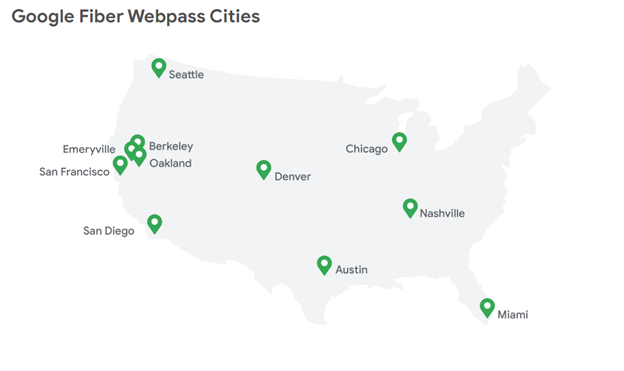
Image source: screenshot from Google Webpass
If you live in a city where GFiber Webpass has a presence but isn’t connected to your office or residential building, you can request the service on Google’s website.
GFiber and Webpass alternatives
Both of Google’s internet services are great internet providers. But with the limited availability and relatively high prices, they’re not the perfect option for every kind of user.
We recommend the ISPs listed in this chart if you want a cheaper internet plan.
Cheapest internet deals
‡
w/AutoPay. Guarantee exclusions like taxes and fees apply.
^
Includes $5 off with AutoPay and Paperless Bill
°
Limited time offer; subject to change; new residential customers only (no Spectrum services within past 30 days) and in good standing with Spectrum. Taxes and fees extra in select states. SPECTRUM INTERNET: Standard rates apply after promo period. Additional charge for installation. Speeds based on wired connection. Actual speeds (including wireless) vary and are not guaranteed. Capable modem required for all Gig speeds. For a list of capable modems, visit Spectrum.net/modem. Services subject to all applicable service terms and conditions, subject to change. Not available in all areas. Restrictions apply. ©2025 Charter Communications, all rights reserved.
**
For 12 months, no term contract. Restrictions apply. Autopay w/ stored bank account and paperless billing req’d. Taxes and fees extra and subj. to change. Reduced speeds after 30 GB of usage/line. Data thresholds may vary.

Related Articles
Xfinity Internet Plans and Deals
Read about Xfinity prices, plans, and deals for high-speed internet.

Xfinity Internet Review: Customers Call It “Reasonable” and “Reliable”
Comcast Xfinity offers fast internet speeds at affordable prices. Our review digs into Xfinity’s pricing,...

Android Hidden Costs: Insurance, Repairs, and Fine Print
Android repairs can cost more than you'd expect, with or without insurance. Find out what...
Best Sports Packages in 2026: I Tested and Ranked the Top Picks
We have a list of the best sports packages in the streaming, cable, and satellite...



