
43% of Americans plan to cancel a streaming service in the next 3 months. Here’s what our survey of 1,000 people reveals about streaming fatigue, price hikes, and where viewers are cutting back.
Streaming Fatigue Report 2026: How Price Hikes Are Changing the Way Americans Watch TV

 4 min read
Americans have about three streaming services on average, but 43% say they are likely to cancel in the next three months. Overloaded with streaming platforms and faced with increasing prices, consumers are finding ways to cut back on their streaming spending.
We surveyed 1,000 Americans to find out how they’re handling rising prices, multiple subscriptions, crackdowns on password-sharing, and if they’ve embraced cheaper streaming options.
Guide to this report:
Key findings:
Here’s a look at the key findings from Reviews.org’s Streaming Fatigue Report 2026:
- Americans pay for about three streaming services on average.
- 68% of Americans would consolidate all their streaming services into one monthly bill if they could.
- 58% regularly watch free, ad-supported YouTube content as a substitute for paid streaming.
- 55% use free ad-supported streaming services because they can no longer justify paying for another subscription.
- 55% have re-subscribed to a streaming service they previously canceled.
- 52% have canceled or downgraded a streaming service because of a price increase.
- 48% have subscribed to a streaming service for one show or event, then canceled afterwards.
Americans juggle multiple streaming subscriptions
Americans subscribe to an average of three streaming services. Only 8% said they have none, 12% said they have one, and on the high end, 21% have five or more subscriptions.
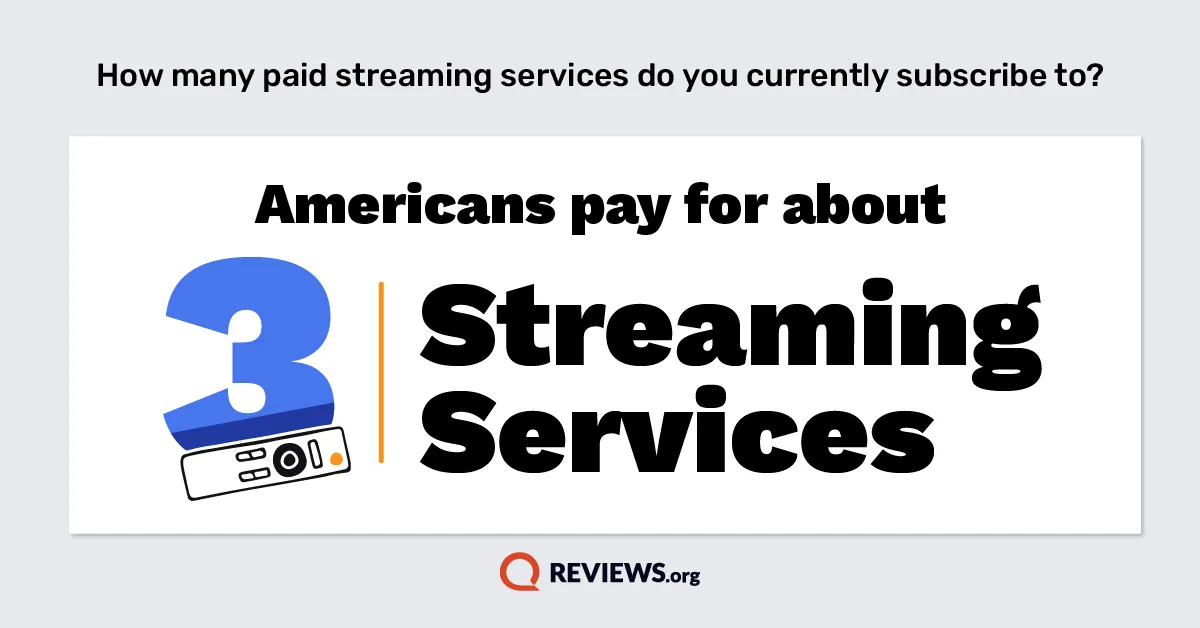
Americans pay for about 3 streaming services
The average number of paid streaming services is approximately three, which also happens to be the most common number reported by respondents (24%).
How many paid streaming services do you subscribe to?
Broken down by service, Netflix, Amazon Prime Video, Hulu, Disney+ and Peacock lead reported subscriptions.
Netflix stands out as the most widely used service among survey respondents, with a sizable share of users in both ads-based (42%) and no-ad (33%) tiers.
Despite ranking fourth overall, survey participants with Disney+ have the second-highest share of no-ad subscriptions (23%), beating out the proportion of ad-free subscribers of Amazon Prime (19%) and Hulu (18%).
Sports and more niche content channels, like ESPN+ (29%) and discovery+ (22%), still have sizable subscriber bases.
Diehard film lovers who subscribe to Mubi and Criterion Channel have the lowest share of subscriptions at only 4% with ads, and 6% without ads.
Which paid streaming services do you currently subscribe to?
Price hikes change how Americans manage streaming
With so many options and price hikes, consumers may turn to cheaper or free ways to tune into what they want to watch.
According to our survey, 52% of respondents have canceled or downgraded because of a price increase, and 43% are likely to cancel at least one streaming service in the next three months.
In efforts to save money, 48% of respondents said they have subscribed for one show specifically and cancelled afterward, 55% re-subscribed to a previously cancelled service, and 38% switched from a paid ad-free streaming to an ad-supported tier in the past year.
Overall, respondents treat streaming subscriptions as flexible expenses rather than long-term commitments.
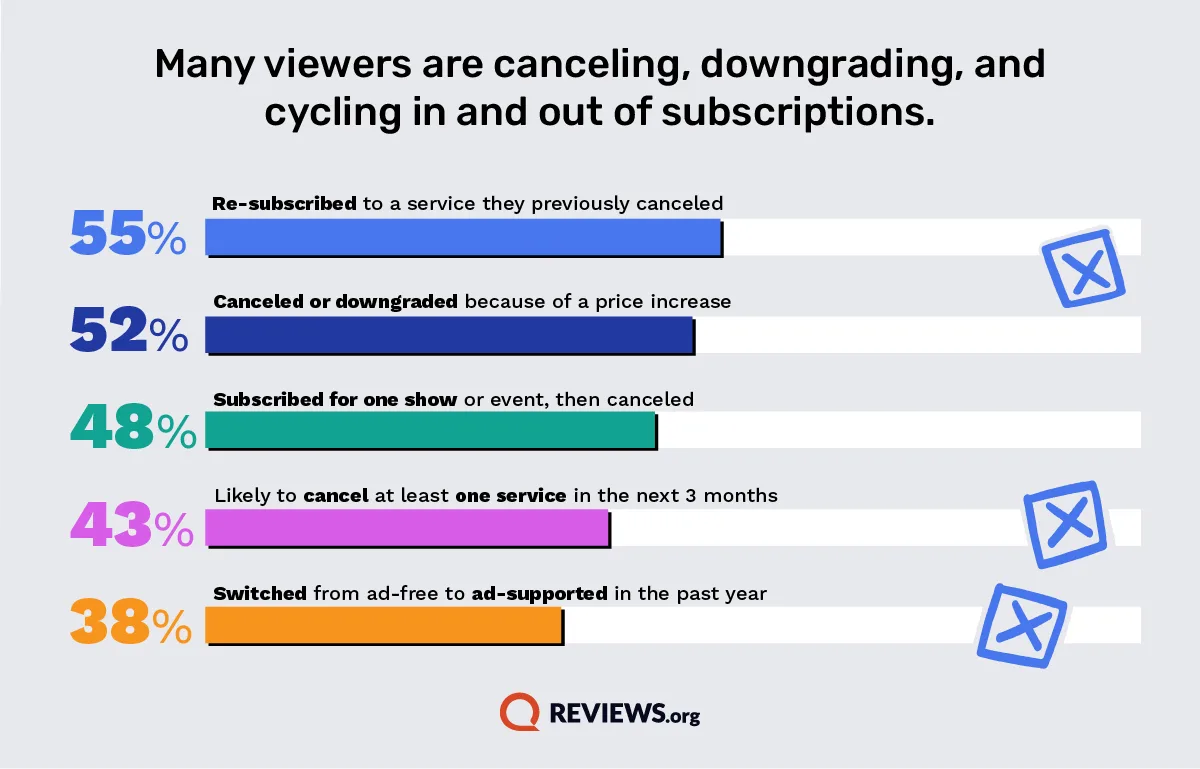
How Americans manage their streaming subscriptions
Viewers cancel, downgrade, and cycle in and out of subscriptions.
How have rising prices changed the way you manage your streaming subscriptions?
Viewers watch more free TV to avoid another subscription
There are plenty of ways to stream without having a paid subscription. Services like Tubi or video hubs like YouTube run free with ad-support and can go a long way.
Still, others turn to cheap one-time purchases for a long-term solution: 37% said they use over-the-air antennas to watch local channels. When using an antenna, 41% of respondents say they receive all available local broadcast channels, while 44% say they get most but not all.
Only 2% reported not getting any channels. This could be due to a mixture of interference, equipment issues, or broadcast licensing.
Which of the following free or low-cost viewing options do you use?
55% said they would use free ad-supported streaming services because they can no longer justify paying for another streaming subscription.
Respondents reported that Tubi was their most-used free ad-supported streaming service, followed by The Roku Channel, and Pluto TV.
Despite the wide variety of free options, nearly 23% of respondents said they didn’t use any free ad-supported streaming services.
Which free ad-supported streaming services do you use most?
Password-sharing crackdowns push viewers in different directions
While password-sharing crackdowns may convert some users, they also push others to drop services or find workarounds. In response to the crackdowns, Americans opted for going without the service (19%) or for paying for their own account (18%). As many as 13% of password sharers found other workarounds — resorting to sharing streaming passwords outside the household, using unauthorized or illegal streams to watch live content.
How did you respond to password-sharing crackdowns?
On the other side, nearly 40% of Americans say they have never shared a streaming service password. And about 10% said they weren’t aware of password-sharing crackdowns.
Have you ever shared a streaming password with someone outside your household?
Americans want streaming to feel simple again
Consumers are still a fan of the idea of bundling streaming content together under one bill: nearly 68% of Americans reported that they would consolidate all their streaming services into one bill if they could, and 46% of respondents already bundle their streaming services together.
And when it comes to content, people feel that, while prices are rising, quality is slipping: 49% of respondents reported feeling that the content available on streaming services has become worse over the past two years.
And with those considerations in mind, it shouldn’t be surprising that 43% of consumers are likely to cancel at least one streaming service in the next 3 months.
How do you currently manage your streaming services?


Reviews.org surveyed 1,000 Americans about their streaming habits. The survey asked how many paid services people subscribe to, which platforms they use, and whether they choose ad-supported or ad-free tiers. It also explored how rising prices, password-sharing crackdowns, free streaming services, antenna use, bundling, and cancellation intent are shaping the way people watch TV. Survey results were analyzed to identify national trends in streaming fatigue, cost-cutting behavior, subscription cycling, and consumer demand for simpler ways to manage streaming. Percentages were rounded to the nearest whole number for readability.

Related Articles

What Age Should Your Kid Get a Phone?
When should you get your kid a phone? A smartphone? A social media account? Find...
Quitting Her Job for Instagram Was Easy. Making It Work Took Years
After going full-time on content creation without a plan, one influencer went back to a...

FTTH or FTTN: Is FTTN Internet a Smart Choice for Families with Kids?
Both FTTH and FTTN are solid choices for fiber internet, but FTTN might be the...

Fiber vs. HFC Internet: What’s the Difference for Everyday Users
Fiber-powered internet delivers faster speeds than traditional cable. Xfinity delivers fast, fiber-rich data to homes...
